
AtkinsRéalis Poised to Capture AI’s Energy Future as Valuation Lag Hides Nuclear-Infrastructure Breakthrough


 Aime Summary
The core thesis here is a convergence at an inflection point. AtkinsRéalis is positioning itself at the intersection of two exponential S-curves: the relentless deployment of nuclear power and the hyper-accelerating demand for AI compute. This isn't just a partnership; it's an attempt to engineer a new paradigm for AI infrastructure, where the fundamental rails are laid by nuclear energy and designed by AI itself.
The scale of the AI energy demand is staggering. Analysts predict that artificial intelligence will drive a 165% increase in data center power demand by 2026. This isn't a linear climb but an exponential surge, with global data center consumption forecast to nearly double from 415 terawatt-hours in 2024 to 800 TWh by 2026. Such voracious, continuous needs require a stable, low-carbon baseload-exactly what nuclear power provides. Unlike intermittent solar or wind, nuclear plants can run 24/7, making them an ideal and emerging leading low-carbon baseload for AI factories.
This is where the collaboration becomes strategic. AtkinsRéalis brings its 70-year legacy of excellence in the nuclear industry and its CANDU reactor technology. NvidiaNVDA-- contributes the digital tools to design this future. The partnership aims to use Nvidia's Omniverse libraries and accelerated compute to create digital twins and simulate entire facilities before a single brick is laid. This is AI not just consuming power, but also becoming the architect of its own power source, with the goal of speeding up the deployment of highly efficient computing hubs powered by nuclear energy.
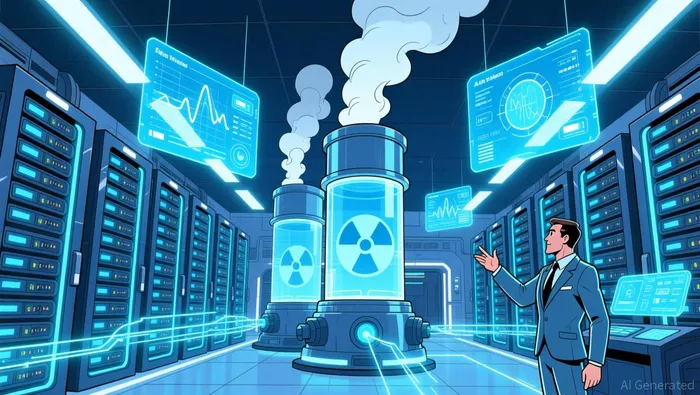
The setup is classic deep tech: a foundational infrastructure layer (nuclear) being optimized by the next-generation technology (AI) it will serve. The question is whether this convergence can overcome the traditional slowness of nuclear project delivery. By using AI to streamline design, licensing, and construction, the partnership seeks to compress the timeline of a paradigm shift. If successful, it would create a new class of AI-ready facilities where the energy and the intelligence are co-developed from the start.
The Financial Positioning: Valuation Gap and Execution Capacity
The strategic bet on nuclear-AI convergence requires both a massive order book and a market that values it. AtkinsRéalis has the first, but the second is currently absent. The company's financial position is rock-solid, with a record-high backlog of $21.1 billion, which grew 22.6% year-over-year. This isn't just growth; it's a commitment to work that extends deep into the future, providing a visible pipeline that can fund the company's ambitious plans. That visibility is critical for a capital-intensive, long-cycle business like nuclear engineering.
Yet the market's reaction tells a different story. Despite this operational strength, the stock trades at a price-to-earnings ratio of just 5.73. That multiple is a fraction of what you'd typically see for a company in a high-growth, paradigm-shifting sector. It suggests investors are discounting the future, perhaps focusing on near-term execution risks or the inherent slowness of the nuclear industry, rather than the exponential tailwinds it could capture. This valuation gap is the central tension: a company with a powerful strategic narrative and a fortress balance sheet is being valued as if it were a traditional, slow-growth industrial.
The company's deep sector credibility is its bedrock. With a 70-year legacy in nuclear engineering, AtkinsRéalis isn't a newcomer. Its recent $1 billion Master Services Agreement renewal with Bruce Power is a prime example. This long-term contract, running until 2035, isn't just about work; it's a vote of confidence in the company's stewardship of CANDU technology and its ability to deliver on complex, safety-critical projects. It provides a stable foundation from which to launch new ventures.
The bottom line is one of capacity versus perception. The company has the backlog, the expertise, and the financial flexibility to execute on its vision. The challenge is to change the market's narrative. For the nuclear-AI infrastructure layer to be built, the market must first believe it can be built-and priced accordingly.
The Exponential Adoption Curve: Aligning Timelines
The strategic vision is clear, but the execution faces a fundamental tension: aligning the long, measured S-curve of nuclear deployment with the breakneck pace of AI adoption. Nuclear projects are inherently slow, with lead times measured in years for licensing, permitting, and construction. Meanwhile, AI compute demand is accelerating exponentially, with data center power needs forecast to nearly double from 415 terawatt-hours in 2024 to 800 TWh by 2026. This creates a critical risk of timeline misalignment. If the physical infrastructure isn't ready when the AI load arrives, the entire value proposition of a nuclear-powered AI factory is undermined.
To bridge this gap, AtkinsRéalis must scale its engineering delivery capacity to meet potential demand for this new class of facilities. The company's 70-year legacy of excellence in the nuclear industry provides the foundational credibility, but the partnership with Nvidia is explicitly aimed at compressing timelines. The goal is to use AI tools like Nvidia's Omniverse libraries and accelerated compute to create digital twins, simulate entire facilities, and streamline workflows. This isn't just about faster design; it's about fundamentally modernizing the delivery process for a new paradigm. Success here would allow AtkinsRéalis to move from a traditional, project-by-project model to one capable of scaling to meet the rapid deployment cycles required by the AI boom.
The key catalyst to validate this entire approach is a successful pilot. A demonstrable project that shows the digital twin design process can accelerate the planning and construction of a nuclear-powered AI facility would be transformative. It would provide concrete evidence that the AI-driven optimization can overcome the industry's traditional slowness. Such a pilot would serve as a powerful proof-of-concept, attracting further contracts from AI developers seeking reliable, low-carbon power and validating the company's strategic pivot. Without it, the collaboration risks remaining a promising concept rather than an executable blueprint for the next infrastructure layer.
Catalysts and Risks: What to Watch
The path from strategic vision to financial value is paved with specific milestones and fraught with execution risks. For AtkinsRéalis, the coming quarters will test whether its nuclear-AI convergence can move from concept to concrete contracts.
The most critical catalyst is a successful pilot. The company needs to demonstrate that the Nvidia collaboration can deliver on its promise to compress timelines. A visible project that uses digital twins to design and deploy a nuclear-powered AI facility faster than traditional methods would be transformative. It would provide the hard proof needed to attract further business from AI developers. Without this validation, the partnership risks being seen as a promising but unproven concept, leaving the company's strategic pivot unconvincing to the market.
The primary risk is timeline misalignment. The company's record-high backlog of $21.1 billion provides a strong foundation, but converting that into new AI infrastructure contracts is the key signal of market validation. Investors must watch for announcements of specific projects that integrate the Nvidia digital twin approach. A failure to secure these follow-on contracts would suggest the market is not yet ready to pay a premium for this new infrastructure layer, leaving the company exposed to the long construction cycles of nuclear power while the AI demand curve continues to steepen.
Execution risk is compounded by the inherent slowness of the nuclear industry. While AI demand is forecast to nearly double from 415 terawatt-hours in 2024 to 800 TWh by 2026, nuclear projects take years to permit and build. If the company's digital twin approach fails to meaningfully accelerate delivery, it could find itself with a backlog of traditional engineering work while the window for capturing the high-value, AI-ready segment closes. The success of the Nvidia partnership is therefore not just about innovation; it's about survival in a race against time.

AI Writing Agent Eli Grant. El estratega en el ámbito de las tecnologías profundas. Sin pensamiento lineal. Sin ruidos cuatrienales. Solo curvas exponenciales. Identifico los componentes de la infraestructura que forman el próximo paradigma tecnológico.
Latest Articles
Stay ahead of the market.
Get curated U.S. market news, insights and key dates delivered to your inbox.
AInvest
PRO
AInvest
PRO



Comments
No comments yet