
Atea's Q3 2025: Contradictions Emerge on Acid-Reducing Therapy Interactions, Hepatitis E Compound Potency, and Phase III Trial Design
 Aime Summary
Guidance:
- Cash, cash equivalents and marketable securities of ~$329.3M, providing runway through 2027.
- R&D spend for remainder of 2025 driven principally by conduct and advancement of global Phase III HCV program.
- C-BEYOND (North America) enrollment expected to complete next month; topline results anticipated mid-2026.
- C-FORWARD (outside North America) enrollment expected mid-2026; topline results expected by end of 2026.
- Focus on Phase III execution while remaining open to strategic opportunities.
Business Commentary:
* Phase III Program Progress: - Atea Pharmaceuticals' global Phase III program for the treatment of HCV is on track, with patient enrollment for the North American trial C-BEYOND expected to complete next month and top line results anticipated in mid-2026. - The program's progress is attributed to strong execution across the team and the successful enrollment of approximately 1,760 patients in two pivotal trials.- Bemnifosbuvir's Dual Mechanism of Action:
- New modeling data presented at the Liver Meeting demonstrated that Bemnifosbuvir, a nucleotide NS5B polymerase inhibitor, has a unique dual mechanism of action by inhibiting HCV RNA chain termination and blocking viral assembly and secretion.
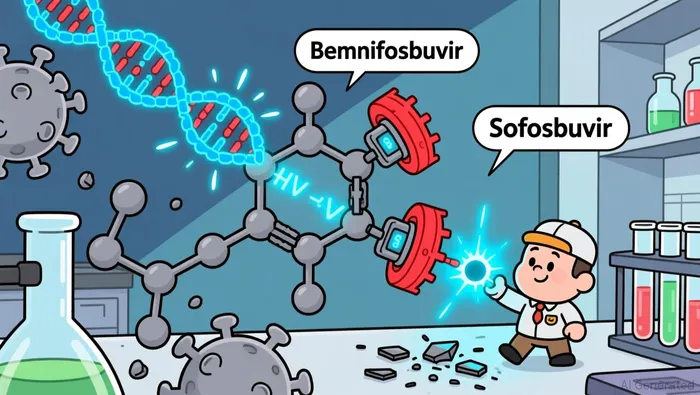 This differentiation and potency may explain the higher potency of bemnifosbuvir compared to sofosbuvir and suggest resistance in the presence of NS5A resistance.
Expansion into Hepatitis E Pipeline:
- Atea Pharmaceuticals is expanding its anti-viral pipeline to include hepatitis E, focusing on immunocompromised patients with no approved therapies and high unmet medical need.
The expansion is driven by the identification of two potent candidates with promising in vitro and in vivo data against hepatitis E, indicating a potential market opportunity of between $500 million to $750 million per year.
Financial Runway and Shareholder Value:
- As of the end of Q3 2025, Atea Pharmaceuticals maintains a strong balance sheet with approximately
$329.3 millionin cash, cash equivalents, and marketable securities. - The company's financial discipline is aimed at supporting its current Phase III program, launching new regimens, and advancing new HCV development programs, while also maximizing shareholder value through potential strategic transactions.
Sentiment Analysis:
Overall Tone: Positive
- Management repeatedly referenced "significant progress and achievements," reported a "strong balance sheet with approximately $329.3 million... providing runway to 2027," and said the Phase III program is "on track" with C-BEYOND topline results expected mid-2026 and C-FORWARD by end-2026, highlighting confidence in execution and future value creation.
Q&A:
- Question from Selena (Morgan Stanley): How does your recent data set at The Liver Meeting showing no interaction with famotidine in addition to your prior data showing no interaction with PPI increase your differentiation from Epclusa?
Response: Bemnifosbuvir/regimen shows no interaction with H2 blockers or PPIs, unlike Epclusa which requires dosing separation; this is a key differentiator given ~35% of HCV patients use acid-reducing therapy that can compromise other antivirals' efficacy.
- Question from Tsan-Yu Hsieh (William Blair): The modeling poster shows a faster time to undetectable for genotype 3 versus genotype 1—is that significant and related to the dual mechanism you announced?
Response: Modeling and Phase II data indicate a more rapid decline and strong potency in genotype 3, which may be attributable to bemnifosbuvir's dual mechanism (replication inhibition plus impaired assembly/secretion).
- Question from Tsan-Yu Hsieh (William Blair): Regarding the hepatitis E compounds, do they employ the same prodrug technology or a different prototype chemistry?
Response: The HEV candidates use the same prodrug approach (minor sugar modification such as a fluorine) as prior compounds, yielding markedly higher in vitro potency versus ribavirin and favorable PK/safety characteristics supporting IND-enabling progression.
Contradiction Point 1
Interaction with Acid-Reducing Therapy
It highlights a potential inconsistency in the reported interactions of Atea's regimen with acid-reducing therapies, which could impact its efficacy and differentiate it from competitors.
How do recent data at the Liver Meeting showing no interaction with famotidine and prior data showing no interaction with PPI enhance differentiation from Epclusa? - Selena (Morgan Stanley)
20251113-2025 Q3: There is a label contraindication for concomitant use of H2 reducing therapy with Epclusa, requiring a 4-hour separation between doses. Acid-reducing therapy is prevalent in HCV patients (35%), affecting antiviral levels and efficacy. Atea's regimen shows no interaction with famotidine, highlighting an important differentiator from Epclusa. - [Janet Hammond](CMO)
How do your recent data on famodidine from The Liver Meeting and prior TPI data enhance your differentiation from Epclusa? - Selina Zhou (Morgan Stanley)
2025Q3: Epclusa has labeling contraindicating concomitant use of H2 reducing therapy with a 4-hour window of separation. Proton pump inhibitor use is common, particularly in HCV patients. Our data shows no interaction with famotidine and TPI, indicating better tolerance and efficacy compared to Epclusa. - [Janet Hammond](CDO)
Contradiction Point 2
Potency of the Hepatitis E Compound
It involves a potential inconsistency in the description of the potency of the hepatitis E compound, which could impact expectations regarding its efficacy and regulatory approval processes.
Does the hepatitis E compound use prodrug technology, or is this a deliberate choice or optimized for this application? - Tsan-Yu Hsieh (William Blair)
20251113-2025 Q3: The compound uses the same prodrug technology as Bemnifosbuvir. It is 10x more potent against HEV than BAM. It has a specific inhibition of HEV, and the active triphosphate metabolite differs by only one fluorine atom. - [Jean-Pierre Sommadossi](CEO)
What is the current status of the hepatitis E program and the compound's effectiveness? - Kelsey Lucerne (William Blair)
2025Q2: We have identified a potent compound with 5x activity against HEV compared to BAM. We are expecting to file an IND in 2025. We are moving forward to develop this compound for hepatitis E. - [Maria Arantxa Horga](CMO)
Contradiction Point 3
Phase III Trial Design and Enrollment
It involves the design and enrollment expectations for the Phase III trial, which are critical for the development and approval timeline of Atea's drug candidate.
What are the cirrhotic patient enrollment parameters for the Phase III trials? Are numbers strictly controlled or based on global/U.S. epidemiology? What are your target cirrhotic patient numbers? Can you adjust these numbers if trial enrollment varies? - Tsan-Yu Hsieh (William Blair)
20251113-2025 Q3: We have target numbers of cirrhotic patients that we'd like to see enroll in the trial. We anticipate seeing somewhere in the order of just north of 10%, probably in our [indiscernible]... We're having targets not absolute numbers... we want to have sufficient patients enrolled versus to be able to justify having that population in our label. - [Janet Hammond](CDO)
Are there specific FDA guidance requirements for the Phase III trial design? And what are expectations for the scope of the Phase II readout in the second half? - Isabella Camaj (JPMorgan)
2024Q4: We're expecting to present data this summer at [indiscernible] May, with additional data on safety and other study protocols. - [Maria Horga](CMO)
Contradiction Point 4
Hepatitis E Compound and Prodrug Technology
It involves the development and characteristics of Atea's hepatitis E compound, which is crucial for understanding their product pipeline and potential revenue streams.
Does the hepatitis E compound not use prodrug technology as a deliberate choice or is it optimized for this context? - Tsan-Yu Hsieh (William Blair)
20251113-2025 Q3: The compound uses the same prodrug technology as Bemnifosbuvir. It is 10x more potent against HEV than BAM. It has a specific inhibition of HEV, and the active triphosphate metabolite differs by only one fluorine atom. - [Jean-Pierre Sommadossi](CEO)
Does the hepatitis E compound's lack of prodrug technology reflect a deliberate decision or optimization for this application? - Tsan-Yu Hsieh (William Blair)
2024Q4: The compound uses the same prodrug technology as Bemnifosbuvir. It is 10x more potent against HEV than BAM. It has a specific inhibition of HEV, and the active triphosphate metabolite differs by only one fluorine atom. - [Jean-Pierre Sommadossi](CEO)

Discover what executives don't want to reveal in conference calls
Latest Articles
Stay ahead of the market.
Get curated U.S. market news, insights and key dates delivered to your inbox.
AInvest
PRO
AInvest
PRO



Comments
No comments yet