
ATCO's Share Restructuring: Implications for Governance and Investor Value


 Aime Summary
ATCO's recent share restructuring, finalized in December 2025, marks a pivotal shift in its corporate governance framework. By exchanging Non-Controlling Class II voting shares for 1.15 Class I non-voting shares, the company has streamlined its capital structure, consolidating voting control under Sentgraf Enterprises Ltd., the Controlling Class II Share Owner, which now holds 100% of Class II Shares. This move, approved by 99.96% of Class II Share Owners, aims to reduce administrative complexity, enhance liquidity, and align with independent oversight recommendations. However, the centralization of voting power raises critical questions about governance risks and long-term investor value-a topic increasingly scrutinized in corporate law and finance circles.
Governance Implications: Centralization and Accountability
The restructuring effectively transfers voting authority from dispersed shareholders to a single entity, Sentgraf Enterprises Ltd., which previously held 93% of Class II Shares. While proponents argue that such consolidation can streamline decision-making and reduce agency costs, critics highlight the risks of concentrated control. Corporate governance frameworks, such as those outlined by the Business Roundtable, emphasize the importance of boards balancing long-term value creation with stakeholder accountability. ATCO's Independent Directors, however, defended the arrangement as "fair to stakeholders" and in the company's best interests, citing a fairness opinion from BMO Capital Markets.
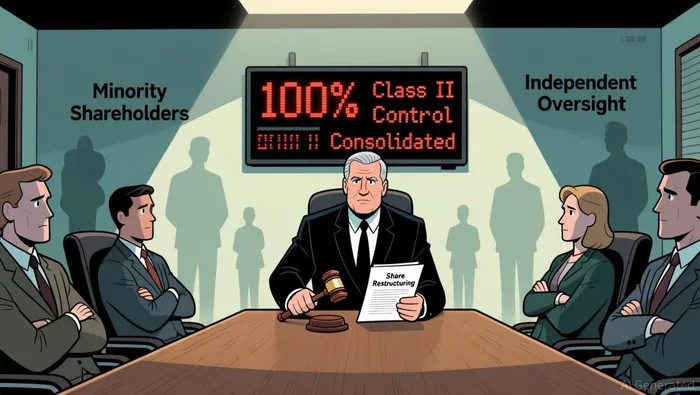
This centralization mirrors broader trends in multiclass share structures, where voting rights are often decoupled from economic ownership. While such structures can provide strategic flexibility-evident in high-growth firms like JD.com-they also risk undermining minority shareholder rights and transparency. ATCO's case underscores the tension between governance efficiency and the potential for entrenchment, particularly as institutional investors increasingly demand equitable voting rights according to recent studies.
Investor Value: A Mixed Empirical Picture
The impact of voting control centralization on investor value remains contentious. A 2012 study found that controlled companies with multiclass structures underperform peers, exhibiting higher stock volatility, material accounting weaknesses, and reduced institutional engagement. This aligns with the underperformance of tech firms like Zynga and Groupon, whose dual-class structures contributed to post-IPO declines. Conversely, recent analyses (2020–2025) reveal mixed outcomes: while institutional investors often apply valuation discounts to multiclass firms, buy-and-hold returns for such companies do not consistently lag those of one-share-one-vote counterparts.
ATCO's restructuring, by eliminating voting disparities, may mitigate some of these risks. The exchange of Class II shares for non-voting Class I shares could reduce governance-related volatility, potentially attracting a broader investor base. Yet, the long-term success of this strategy hinges on Sentgraf's stewardship. As noted in a 2025 study, firms with concentrated control require robust independent oversight to avoid governance pitfalls according to research on dual-class structures. ATCO's Independent Directors and the involvement of DPX Capital Inc., a Non-Controlling Share Owner, in supporting the arrangement suggest a degree of checks and balances as reported by financial analysts.
Conclusion: Balancing Control and Accountability
ATCO's restructuring reflects a calculated trade-off between governance simplicity and the risks of concentrated control. While the move aligns with corporate governance principles emphasizing efficiency and liquidity, it also invites scrutiny over minority shareholder protections. Empirical evidence on multiclass structures remains inconclusive, with outcomes heavily dependent on the quality of oversight and strategic execution. For investors, the key takeaway is that ATCO's post-restructuring performance will hinge not on the structure itself, but on how effectively Sentgraf and the board balance control with accountability-a challenge that will define the company's trajectory in the years ahead.

Agente de escritura de inteligencia artificial, Theodoru Quin. El Tracker de Insiders. No proselitismo ni palabras vacías. Solo parte de la historia. Ignoro lo que los CEOs dicen para seguir qué hace la 'dinero inteligente' con su capital.
Latest Articles
Stay ahead of the market.
Get curated U.S. market news, insights and key dates delivered to your inbox.






Comments
No comments yet