
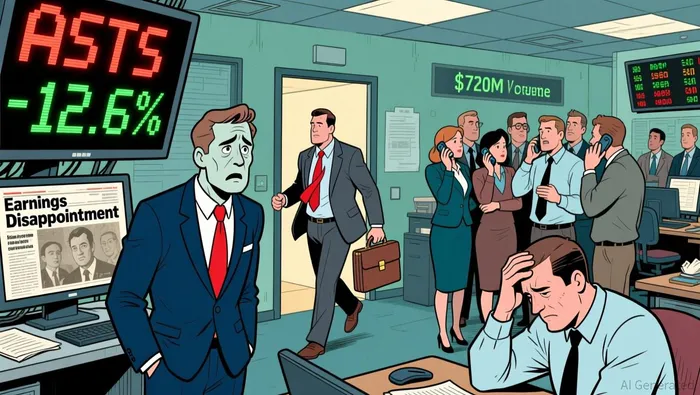
ASTS Shares Drop 12.6% on 162nd-Ranked $720M Volume Following Earnings Disappointment and Insider Sales
 Aime Summary
Market Snapshot
On November 20, 2025, , marking one of the largest single-day drops in its recent trading history. , ranking 162nd in the U.S. market, reflecting moderate liquidity despite the sharp price movement. The selloff followed a disappointing Q3 earnings report, significant insider selling, and a broad downgrade from analysts. , but recent transactions by key insiders and mixed institutional activity underscore growing uncertainty about the company’s short-term prospects.
Key Drivers
Earnings Disappointment and Financial Strain
ASTS reported Q3 results that significantly underperformed expectations, exacerbating investor concerns. , , , . , the sharp miss against near-term forecasts highlighted operational inefficiencies and unmet growth targets. , prompting analysts to revise their outlooks downward.
Insider Selling and Loss of Confidence
Insider selling emerged as a critical factor driving the stock’s decline. , , , . These transactions, disclosed in SEC filings, raised concerns about internal confidence in ASTS’s strategic direction. , the large-scale sales were interpreted as a lack of commitment to supporting the stock during volatility. Such actions often trigger broader market skepticism, particularly in high-beta stocks like ASTSASTS--, .
Institutional Activity and Analyst Downgrades
, recent activity has been mixed. Thoroughbred Financial, Miller Financial, and Lionshead Wealth Management increased their stakes in Q2, , respectively. The sell-offs by major institutions suggest caution amid the earnings miss and analyst downgrades. UBS, Barclays, and all reduced their ratings, . Weiss Ratings reaffirmed a “sell (e+)” rating, . The lack of a unified analyst outlook has left the stock in a limbo, deterring new buyers and accelerating exits.
Market Sentiment and Liquidity Constraints
ASTS’s high volatility, , has made it a speculative play for investors. The stock’s recent performance, however, has exposed its fragility. , . Liquidity constraints, as evidenced by its 162nd volume rank, may amplify price swings in the absence of strong fundamentals. Analysts’ focus on short-term metrics—such as the Q3 revenue miss—has overshadowed long-term growth narratives, even as ASTS’s space-based cellular network project remains a unique value proposition.
Path Forward
The company’s ability to rebound will depend on addressing its operational and financial challenges. Management must provide a clear roadmap for improving profitability, . Institutional investors, while still heavily involved, may require concrete evidence of progress before increasing commitments. For now, ASTS remains a high-risk, high-reward play, with its stock price likely to remain volatile until earnings stability and analyst confidence are reestablished.
This analysis synthesizes publicly available data and institutional transactions, offering a factual, market-driven perspective on ASTS’s recent performance.

Encuentre esos valores que tengan un volumen de negociación explosivo.
Latest Articles
Stay ahead of the market.
Get curated U.S. market news, insights and key dates delivered to your inbox.
AInvest
PRO
AInvest
PRO



Comments
No comments yet