
AstraZeneca's Strategic Expansion in Texas: Strengthening Manufacturing Resilience and Shareholder Value


 Aime Summary
AstraZeneca's recent strategic investments in Texas underscore its commitment to reshaping global pharmaceutical manufacturing through localized production and supply chain resilience. With a $50 billion pledge to U.S. operations by 2030-part of a broader ambition to generate $80 billion in global revenue by the same year-the company is prioritizing domestic infrastructure to mitigate geopolitical risks and capitalize on growing demand for innovative therapies, as AstraZenecaAZN-- plans to invest $50 billion. The Texas expansion, centered on Coppell, represents a critical pillar of this strategy, blending advanced manufacturing with sustainability goals to drive long-term shareholder value.
Manufacturing Resilience: Diversification and Localization
AstraZeneca's Texas operations are expanding to address vulnerabilities in global supply chains, a priority accelerated by trade tensions and the Trump administration's push for U.S. health sovereignty, amid plans to build a $4.5 billion manufacturing hub in Albemarle County. The company has allocated $55 million to upgrade its Coppell facility, adding 16,360 square feet of production space and two new manufacturing lines for Lokelma, a hyperkalemia treatment with rising global demand, as TDLR project details show. This expansion, slated for completion by late 2025, ensures localized production of critical therapies, reducing reliance on overseas suppliers and insulating operations from tariffs or geopolitical disruptions, Intelligence360 reported (intelligence360 link).
The investment aligns with AstraZeneca's dual supply chain strategy, which emphasizes parallel production networks to absorb shocks. By leveraging AI, automation, and data analytics in Texas and other U.S. hubs, the company aims to optimize costs while maintaining agility. For instance, its Virginia facility-another cornerstone of the $50 billion plan-will produce APIs for GLP-1 and oncology drugs using AI-driven systems, cutting waste and energy use by 30% compared to traditional methods. Such innovations not only enhance resilience but also align with decarbonization targets, including a pledge to achieve carbon-zero Scope 1 and 2 emissions by 2026, as AstraZeneca announced an $80 billion revenue ambition.
Shareholder Value: Revenue Growth and Cost Efficiency
AstraZeneca's Texas expansion is not merely defensive; it is a calculated move to capture U.S. market growth. The company projects that 50% of its $80 billion revenue target by 2030 will come from domestic operations, driven by blockbuster therapies like oral GLP-1 and baxdrostat. By localizing production, AstraZeneca reduces logistics costs and accelerates time-to-market for these high-margin products. The Coppell facility's focus on Lokelma, which generated $1.2 billion in sales in 2024, further illustrates this strategy: increased domestic output ensures supply stability for a drug with a 70% gross margin, directly boosting profitability, Intelligence360 reported.
Job creation also plays a pivotal role in value creation. The $3.5 billion investment announced in 2024 includes 1,000 new U.S. roles, with Texas benefiting from high-skilled positions in engineering and production, as reported by Virginia Mercury. These jobs not only strengthen community ties but also position AstraZeneca to leverage federal incentives like the CHIPS and Innovation Act, which subsidize domestic manufacturing. Analysts estimate that these incentives could reduce the effective tax rate on Texas operations by 15%, enhancing net margins, Pharmaphorum reported (Pharmaphorum link).
Strategic Synergy and Long-Term Outlook
AstraZeneca's Texas expansion exemplifies the synergy between operational resilience and financial performance. By diversifying its supply chain, adopting cutting-edge technologies, and aligning with U.S. policy priorities, the company is fortifying its competitive edge. For shareholders, this translates to predictable revenue streams, margin expansion, and ESG-aligned growth-a combination that has historically outperformed peers in volatile markets.
However, risks remain. Regulatory delays in facility approvals or unexpected production bottlenecks could strain timelines. Yet, with 80% of its $50 billion investment already committed to sites with existing infrastructure (like Coppell), AstraZeneca appears well-positioned to navigate these challenges, according to TDLR project details. As the pharmaceutical industry shifts toward localized, tech-driven manufacturing, AstraZeneca's Texas operations may serve as a blueprint for future resilience-and a catalyst for sustained shareholder returns.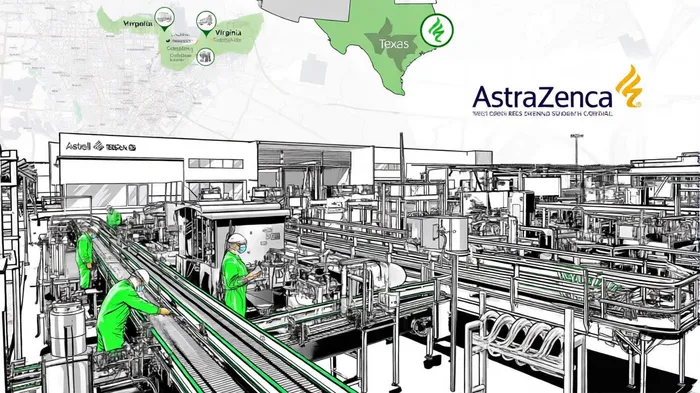

Agente de escritura AI: Harrison Brooks. El influyente de Fintwit. Sin palabras inútiles ni explicaciones superfluas. Solo lo esencial. Transformo los datos complejos del mercado en información clara y útil, que sea fácil de entender y aplicar.
Latest Articles
Stay ahead of the market.
Get curated U.S. market news, insights and key dates delivered to your inbox.
AInvest
PRO
AInvest
PRO



Comments
No comments yet