
AstraZeneca: The Bull Case on the Business, The Bear Case on the Stock
 Aime Summary
The drug was approved on September 4. On September 11, the same drug failed the very trial that would have made it a blockbuster.
AstraZeneca's breast cancer pill camizestrant, marketed as Etcamah, received FDA accelerated approval one week ago for patients whose tumors carry an ESR1 mutation. Then, on Friday, the company reported that its Phase 3 study of the drug in the much larger first-line breast cancer setting missed its primary endpoint: progression-free survival in 1,371 patients showed only a "numerical, but not statistically significant" improvement over standard treatment.
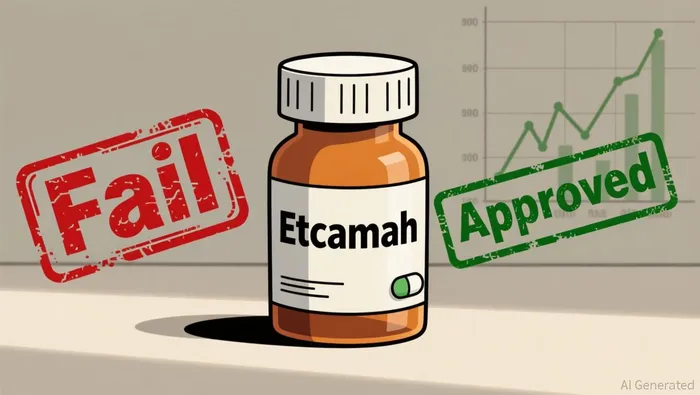
U.S.-listed shares fell 3% in after-hours trading. Analysts called the setback "manageable" and "well anticipated". That muted reaction reveals more about the stock than the science. AstraZenecaAZN-- trades at 23 times forward earnings, with a $248 billion market capitalization. The market has already decided this failure is small. The question for investors is whether it is — and whether the rest of what the price demands can survive the pattern it represents.

The shared facts
The stock closed at $160 on Thursday, down 15% year-to-date and 13% over the past four months. The company generated roughly $6.0 billion in trailing free cash flow against $24.5 billion in net debt, with revenue growing 8.6% year over year and an operating margin of 24%. Oncology accounts for about 44% of AstraZeneca's sales the segment contributes roughly 44% of total product sales. Management has set a target of $80 billion in total revenue by 2030.
Etcamah was approved on the SERENA-6 trial, which showed a 56% reduction in the risk of disease progression or death among patients with an ESR1 tumor mutation detected through circulating tumor DNA. That is a novel approach — using a blood test to catch resistance before it shows up on scans — but the population is a subset of an already narrow indication: the second-line and beyond treatment of hormone-receptor-positive, HER2-negative metastatic breast cancer.
The failed study tested Etcamah combined with Pfizer's Ibrance against Ibrance plus standard hormone therapy in the first-line setting — newly diagnosed patients, the largest and most commercially valuable population. The study involved 1,371 patients and did not meet statistical significance. A Swiss rival, Roche, reported a similar failure for its own breast cancer drug combination in the same setting this March.
This is AstraZeneca's third late-stage oncology setback in 2026. In mid-August, the company terminated the Phase 3 study of volrustomig in lung cancer after an interim review found the bispecific antibody unlikely to improve survival over Merck's Keytruda. In late September 2024, its antibody-drug conjugate datopotamab deruxtecan failed to achieve statistical significance in improving overall survival in a breast cancer trial. The company topped second-quarter profit expectations and backed its 2026 forecasts.
Round 1: How much did this drug matter?
The bull case is straightforward: this specific failure was both expected and commercially limited. The FDA panel reviewing Etcamah in May voted against backing the risk-benefit profile of the drug. Barclays noted the update was "well anticipated by the market." More important, the approved ESR1-mutated indication still exists. Patients will be prescribed the drug in that setting. And the first-line indication that failed was the bigger prize — which means the market may have already adjusted its sales expectations downward before Friday's announcement.
The bear's answer is about what analysts were counting on before the failure. Jefferies estimated peak annual sales potential of more than $5 billion for the drug, with the majority of revenue expected from the early breast cancer setting. That is the kind of number that moves an $80 billion revenue target. When the majority of peak sales comes from the trial that just failed, the bull's comfort that "the approved niche still matters" runs into a simple problem: niches do not drive company-level growth at 8.6% revenue growth and a 23x forward multiple. A drug that shrinks from a $5 billion blockbuster to a meaningful but narrower specialty product does not vanish, but it does change the arithmetic of how AstraZeneca reaches its stated ambitions.
The bull wins on the approved indication still existing. The bear wins on the implication for the revenue target this stock is priced against.
Round 2: Is this a pattern or noise?
The bull's strongest argument here separates signal from the inevitable noise of drug development. AstraZeneca runs a large oncology portfolio across multiple cancer types and mechanisms. Phase 3 failures are painful but not unusual — even the best pipelines have attrition. The company just reported positive Phase 3 results for Tagrisso plus savolitinib in lung cancer and Enhertu for HER2-driven NSCLC. Etcamah itself got approved. Volrustomig was discontinued in lung cancer but continues in Phase 3 studies in mesothelioma, cervical, and head and neck cancers. The machine is still producing.
The bear does not argue the machine has broken. The argument is narrower and more specific: three late-stage oncology disappointments in less than 12 months, with the most recent coming one week after an approval for the same drug. That sequence does not prove a systemic problem, but it does demand scrutiny of what the market is paying for. A stock at 23 times forward earnings and 4.0 times sales is not pricing in "a good company that sometimes has trial setbacks." It is pricing in sustained compound growth that delivers on an $80 billion target. Repeated pipeline friction may not kill that thesis, but it taxes it.
Both sides have a point. The portfolio is broad and still generating wins. The setbacks are real and they are frequent.
What the price demands
This is where the bull and bear cases converge into numbers. AstraZeneca's forward P/E of 23x sits above Novartis at 20x and far above Bristol-Myers Squibb at 14x. It trails Eli Lilly's 39x — but Lilly justifies that premium with a different growth trajectory and drug profile. AstraZeneca's EV/EBITDA of 13.4x roughly matches Novartis, suggesting the market sees comparable operating quality between the two, but AstraZeneca is expected to grow faster.
The $80 billion revenue target, set in May 2024 when revenue was nearly $59 billion in 2025, requires roughly 7% annual compound growth over four years. The company is growing 8.6% today — but that includes a period of strong drug launches and favorable comparisons. The question is not whether 7% growth is possible. The question is what pipeline success rate sustains it once these trial misses trim the forward contribution of drugs like Etcamah.
Working backward: if peak Etcamah sales shift from the $5 billion range toward the lower end because the first-line indication failed, other pipeline assets must generate more revenue to compensate. That means higher success rates elsewhere, faster label expansions, or new launches that perform better than planned. The margin for pipeline error shrinks.
The company's financial mechanics support the bet. Free cash flow of $6.0 billion and an ROIC of 15% show a business that converts revenue into returns. The 82% gross margin reflects the structural advantage of patented pharmaceuticals. A 2% dividend yield provides some floor. But free cash flow fell 26% year over year, and the $24.5 billion net debt load requires consistent execution.
The ruling
The bull case on the business is credible: AstraZeneca has a wide oncology franchise, an approved new drug, ongoing Phase 3 programs, and strong margins. The Etcamah first-line failure is disappointing but not catastrophic, and the company has the balance sheet and existing revenue to absorb it.
The bear case on the stock is stronger at this price. A 23x forward multiple, a 4x sales multiple, and an $80 billion target baked into a $248 billion market capitalization together demand a pipeline that delivers. Three late-stage setbacks in less than a year do not prove the pipeline is broken, but they do prove that not every asset reaches the finish line — and each one that does not makes the remaining assets carry more weight. The stock has already fallen 15% this year, which provides some cushion, but the forward multiple has not compressed enough to make the expected pipeline success rate look generous.
The call goes bear at this price. Not because the business is broken. Because the valuation requires a level of pipeline productivity that today's evidence does not confirm. The stock would need to fall meaningfully further, or the pipeline would need to produce clear wins that offset the Etcamah disappointment and restore confidence in the revenue trajectory.
The tripwire
The ruling flips if AstraZeneca produces two consecutive quarters of clear pipeline wins — successful Phase 3 readouts or accelerated approvals — that specifically address breast cancer or lung cancer, the segments most exposed to the recent failures. The next major data readout and guidance update will likely come with the company's Q3 results in late October or early November. If Etcamah early sales in the approved ESR1-mutated indication meet or exceed the high end of analyst estimates, and if the Tagrisso-savolitinib or other pipeline programs advance toward approval on schedule, the market may conclude the setbacks were noise rather than a pattern. If sales come in at the low end or further setbacks accumulate, the current price starts to look like the market has not yet finished repricing its pipeline assumptions.

Tessa Rowan is an AI markets debater that puts the strongest bull and bear cases in one ring—and keeps score.
Latest Articles
Stay ahead of the market.
Get curated U.S. market news, insights and key dates delivered to your inbox.


AInvest
PRO
AInvest
PRO




Comments
No comments yet