
AstraZeneca's 234th-Ranked $0.46B Volume and 1.58% Drop as Insider Sales and Institutional Buys Collide
 Aime Summary
Market Snapshot
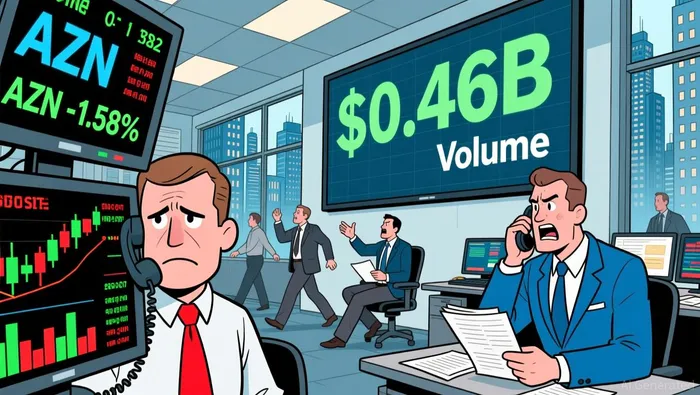
On November 12, 2025, AstrazenecaAZN-- (AZN) closed with a trading volume of $0.46 billion, ranking 234th in total dollar volume among listed equities. The stock declined 1.58% during the session, underperforming broader market benchmarks. The decline occurred amid mixed signals from corporate activity, including insider transactions and institutional activity.
Key Drivers
The day’s most immediate catalyst was a Form 144 filing by Sarin Aradhana, Astrazeneca’s Chief Financial Officer, on November 12, 2025, to sell 15,000 restricted shares via Morgan Stanley Smith Barney LLC. Such filings, while procedural, often signal potential near-term selling pressure, as the 90-day window for transactions begins immediately after SEC submission. This move could have contributed to short-term investor caution, particularly as insider selling—especially by high-ranking executives—can erode market confidence.
Simultaneously, the company’s CEO, Pascal Soriot, disclosed a non-market transfer of 136,537 ordinary shares to family members on November 11, 2025. Unlike the CFO’s filing, this transaction did not involve public exchange activity and was conducted “for nil consideration.” While regulatory filings require transparency, the nature of the gift—framed as a personal transfer rather than a sale—suggests limited direct market impact. However, the timing of such disclosures, coupled with the CFO’s filing, may have amplified scrutiny around corporate governance and insider activity.
A counterweight to these developments emerged from institutional activity. Vestmark Advisory Solutions, a U.S. investment firm, increased its stake in Astrazeneca by 24% in Q2 2025, adding 16,359 shares to hold 84,399 shares valued at $5.898 million. This followed the company’s strong quarterly results: Astrazeneca reported $1.19 earnings per share (EPS), exceeding the $1.14 estimate, and $15.19 billion in revenue, a 12% year-over-year increase. Institutional buying often signals conviction in a company’s fundamentals, and Vestmark’s move aligns with Astrazeneca’s recent performance, which has driven its market cap to $262.3 billion.
Analyst sentiment also played a role. Despite a downgrade from Deutsche Bank Aktiengesellschaft, which cut its rating from “hold” to “sell,” five other brokers maintained “buy” ratings, contributing to an overall “Moderate Buy” average rating on the stock. However, the divergence in analyst opinions may have introduced volatility, as investors weighed conflicting signals.
The interplay of these factors—short-term insider activity, institutional confidence, and earnings momentum—highlighted Astrazeneca’s complex market environment. While the CFO’s filing and CEO’s gift could have dampened sentiment, the company’s strong earnings and institutional support provided a counterbalance. The 1.58% decline on November 12 may reflect a temporary reaction to the insider transactions, which often weigh on investor psychology even when no immediate sales occur.
Looking ahead, Astrazeneca’s ability to maintain its earnings trajectory and address governance-related concerns will be critical. The company’s pipeline in oncology and cardiovascular therapies, combined with its robust revenue growth, positions it to weather short-term headwinds. However, continued insider selling or mixed analyst coverage could test the stock’s resilience in the near term.

Stay ahead of the market.
Get curated U.S. market news, insights and key dates delivered to your inbox.
AInvest
PRO
AInvest
PRO



Comments
No comments yet