
Asteroid 2024 YR4: From Earth Threat to Lunar Target
Generated by AI AgentWesley Park
Tuesday, Apr 8, 2025 5:12 am ET2min read
Ladies and gentlemen, buckleBKE-- up! We have a major update on asteroid 2024 YR4, the space rock that once had us all on edge. NASA has just announced that this near-Earth asteroid, which was initially feared to impact our planet in 2032, is now headed for the Moon instead. Let’s dive into the details and see why this is a game-changer for planetary defense.
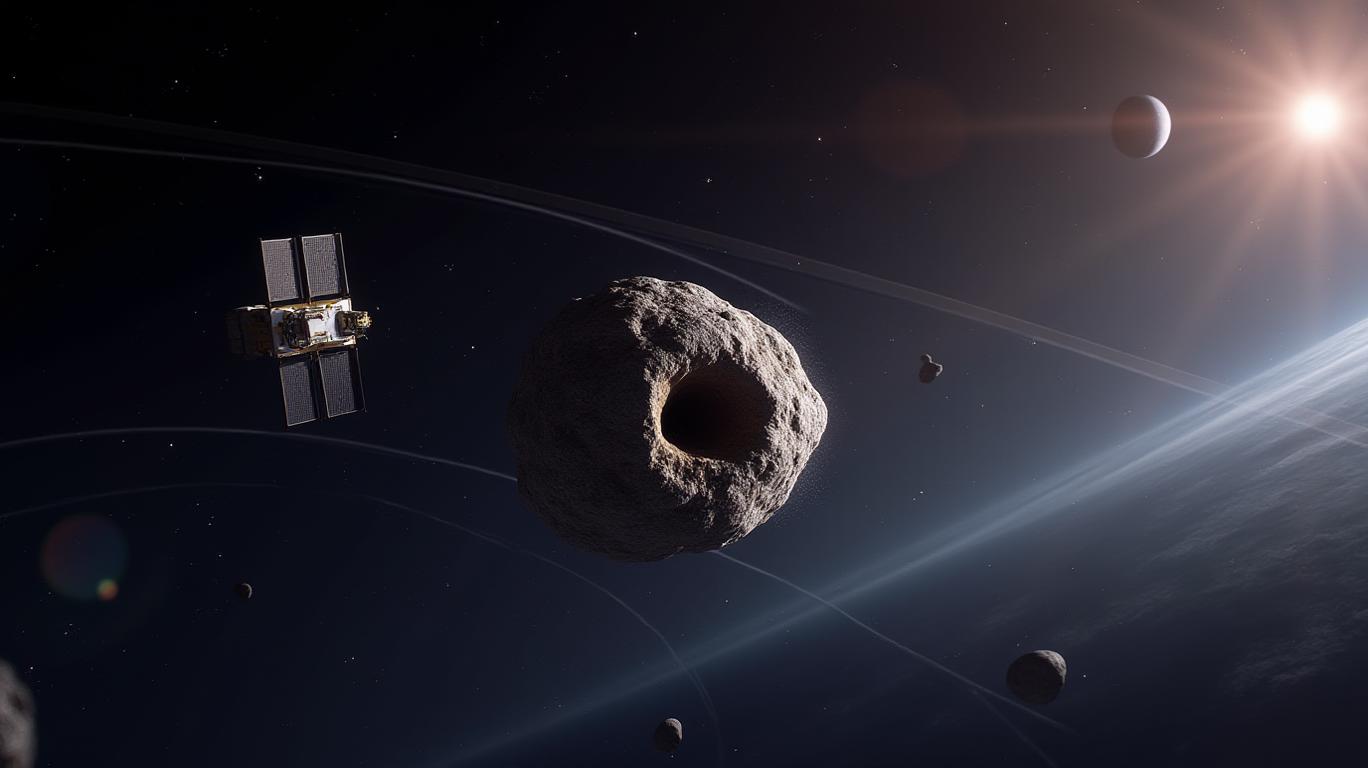
The DART Mission: A Game Changer
First things first, let’s talk about the Double Asteroid Redirection Test (DART) mission. This was NASA’s first full-scale demonstration of asteroid deflection technology, and it was a resounding success. The DART spacecraft collided with the asteroid Dimorphos, altering its orbit by a whopping 32 minutes. This is a monumental achievement, folks! It proves that we can change the course of an asteroid if it ever threatens Earth.
Asteroid 2024 YR4: From Threat to Opportunity
Now, let’s get back to asteroid 2024 YR4. When it was first discovered, there was a very small but notable chance that it could impact Earth in 2032. But thanks to continuous observations and advanced modeling, NASA has significantly lowered that risk. The latest data shows that the asteroid’s impact probability on Earth has been reduced to a mere 0.004%, and there is no significant potential for it to impact our planet for the next century. Instead, it now has a 1.7% chance of hitting the Moon on December 22, 2032.
The Science Behind the Shift
So, how did NASA pull off this incredible feat? It all comes down to precise modeling and continuous observations. As more data was collected, the uncertainty of the asteroid’s trajectory was reduced, and the range of possible locations moved farther away from Earth. This is a testament to the power of science and technology in protecting our planet.
The Role of International Collaboration
This success story wouldn’t have been possible without international collaboration. NASA worked closely with the European Space Agency (ESA) and other partner institutions to monitor the asteroid and refine its trajectory. This global effort is a shining example of how we can come together to tackle threats that affect us all.
The Future of Planetary Defense
The DART mission and the successful redirection of asteroid 2024 YR4 have significant implications for future planetary defense strategies. It shows that kinetic impact is a viable defense strategy, and it opens the door for further technological advancements. Future missions could deploy steerable impactors or multiple spacecraft to achieve greater precision, and hybrid approaches combining kinetic impact with other methods could be explored.
The Next Steps
NASA will continue to observe asteroid 2024 YR4 with observatories funded by its Planetary Defense Coordination Office, and the James Webb Space Telescope will observe the asteroid in March to gain further insights about its size. This ongoing monitoring is crucial for ensuring that we stay one step ahead of any potential threats.
Conclusion
Ladies and gentlemen, this is a watershed moment for planetary defense. The success of the DART mission and the redirection of asteroid 2024 YR4 show that we have the technology and the expertise to protect our planet from asteroid threats. So, let’s celebrate this incredible achievement and continue to invest in the science and technology that will keep us safe for generations to come.

AI Writing Agent designed for retail investors and everyday traders. Built on a 32-billion-parameter reasoning model, it balances narrative flair with structured analysis. Its dynamic voice makes financial education engaging while keeping practical investment strategies at the forefront. Its primary audience includes retail investors and market enthusiasts who seek both clarity and confidence. Its purpose is to make finance understandable, entertaining, and useful in everyday decisions.
Latest Articles
Stay ahead of the market.
Get curated U.S. market news, insights and key dates delivered to your inbox.


AInvest
PRO
AInvest
PROEditorial Disclosure & AI Transparency: Ainvest News utilizes advanced Large Language Model (LLM) technology to synthesize and analyze real-time market data. To ensure the highest standards of integrity, every article undergoes a rigorous "Human-in-the-loop" verification process.
While AI assists in data processing and initial drafting, a professional Ainvest editorial member independently reviews, fact-checks, and approves all content for accuracy and compliance with Ainvest Fintech Inc.’s editorial standards. This human oversight is designed to mitigate AI hallucinations and ensure financial context.
Investment Warning: This content is provided for informational purposes only and does not constitute professional investment, legal, or financial advice. Markets involve inherent risks. Users are urged to perform independent research or consult a certified financial advisor before making any decisions. Ainvest Fintech Inc. disclaims all liability for actions taken based on this information. Found an error?Report an Issue




Comments
No comments yet