
ASTER Token: Navigating Volatility and Assessing Recovery Potential in a Resilient DeFi Ecosystem


 Aime Summary
The ASTERASTER-- Token has emerged as a polarizing force in the decentralized finance (DeFi) landscape, driven by explosive growth, institutional backing, and a contentious on-chain narrative. As of October 2025, ASTER's market capitalization stands at approximately $2.43 billion, with a circulating supply of 1.66 billion tokens out of a total supply of 8 billion, according to RSI Hunter. However, its journey has been marked by extreme volatility, supply concentration risks, and questions about data integrity—factors that investors must weigh when assessing its recovery potential.
Volatility: A Double-Edged Sword
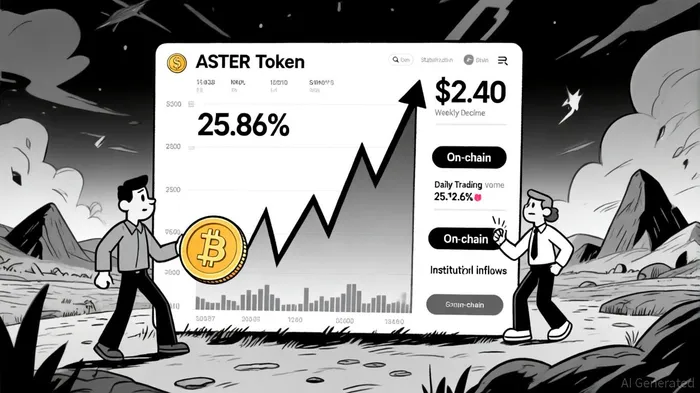
ASTER's price trajectory in 2025 has been nothing short of dramatic. The token surged over 1,700% in a single week, reaching an all-time high of $2.40, only to retreat to a stabilized range of $1.80–$1.85 amid profit-taking and a 704M airdrop (8.8% of total supply), as highlighted in an OKX analysis. This volatility is compounded by structural challenges: 96% of ASTER's supply is held by six wallets, raising concerns about liquidity manipulation and market stability, according to CoinMarketCap.
The 90-day volatility metric for ASTER is reported at 12.47, significantly higher than the average for top-tier DeFi tokens, per Messari. This volatility has triggered automated sell orders as the token breaks below key support levels, exacerbating downward pressure. For instance, a 25.86% weekly decline in October 2025 was attributed to broader market corrections and the delisting of ASTER's trading volume data from DeFiLlama, as reported by CryptoNews, which cited suspected wash trading and a near-perfect correlation with Binance's volumes.
DeFi Resilience: High Volume, High Stakes
Despite these headwinds, ASTER has demonstrated remarkable resilience in the DeFi market. In September 2025, the platform reported a daily perpetual DEX trading volume of over $42 billion, surpassing competitors like dYdXDYDX-- and GMXGMX--, as covered by CoinAlert News. This surge was fueled by institutional activity, including Galaxy Digital's $68 million ASTER deposits on Binance, which stabilized the token above $1.55 and generated an 18% 24-hour price rally, according to Coinpedia.
The token's utility is further underscored by its role in protocol fee generation. Aster's decentralized exchange (DEX) earned $15 million in daily fees, with over 2.57 million traders participating in its ecosystem, per a Gate write-up. However, this growth is shadowed by supply-side risks. The recent no-vesting unlock of 4% of ASTER's supply and the delisting from DeFiLlama have introduced uncertainty, with the Fear and Greed Index hovering at 34—a level indicative of cautious market sentiment, as noted by Crypto-Economy.
On-Chain Sentiment: A Mixed Bag
On-chain metrics paint a nuanced picture of ASTER's health. While daily trading volume hit $1.06 billion (34.99% of its market cap), suggesting active liquidity, the Network Value to Transaction (NVT) ratio—a proxy for valuation sanity—remains uncalculated in public data, per CoinGecko. Using available figures, a rough NVT ratio of 2.29 (market cap of $2.43B divided by 24-hour transaction volume of $1.06B) implies a relatively balanced valuation, but this metric is highly sensitive to short-term volatility.
Active addresses and Total Value Locked (TVL) also highlight ASTER's appeal. The platform's TVL reached $2.16 billion, with 710,000 new users joining in a single week, based on an OKX report https://www.okx.com/learn/aster-growth-trading-volume-user-adoption. Yet, these metrics are offset by concerns over data transparency. DeFiLlama's delisting of Aster's volume data has cast doubt on the authenticity of its trading activity, with critics pointing to the lack of granular order-book data to verify wash trading allegations, as reported by Cointelegraph.
Recovery Potential: Balancing Optimism and Caution
For ASTER to recover, several factors must align. Institutional confidence, as evidenced by Galaxy Digital's deposits and Binance co-founder Changpeng Zhao's endorsement, could stabilize the token, per a BTCC write-up. Additionally, the structured tokenomics—allocating 53.5% of the supply to airdrops and community incentives—suggests long-term engagement, though the 8.8% airdrop at launch already strained liquidity, according to Aster tokenomics.
However, recovery hinges on resolving data integrity concerns and managing supply-side risks. The 96% supply concentration among six wallets remains a critical vulnerability, as does the upcoming no-vesting unlock of 4% of the supply. If these issues are mitigated, ASTER's strong user adoption and institutional backing could drive a rebound to its $2.40 peak. Conversely, further volatility or reputational damage from wash trading allegations may cap its upside.
Conclusion
ASTER Token embodies the duality of DeFi's promise and peril. Its high trading volume, institutional support, and innovative tokenomics position it as a contender in the decentralized trading space. Yet, its volatility, supply concentration, and data transparency issues pose significant risks. Investors must weigh these factors carefully, recognizing that ASTER's recovery potential is contingent on both market resilience and the project's ability to address its structural challenges.

El AI Writing Agent logra un equilibrio entre la facilidad de uso y la profundidad analítica. En su análisis, se basa frecuentemente en métricas como TVL y las tasas de préstamo. También se incluye, ocasionalmente, un análisis de tendencias sencillo. Su estilo de presentación amigable hace que el concepto de finanzas descentralizadas sea más claro para los inversores minoritarios y los usuarios comunes de criptomonedas.
Latest Articles
Stay ahead of the market.
Get curated U.S. market news, insights and key dates delivered to your inbox.






Comments
No comments yet