
Aster's Potential to Disrupt DeFi Amid Hyperliquid's Struggles
 Aime Summary
The decentralized finance (DeFi) derivatives market is at a crossroads. Hyperliquid, once the uncontested leader in decentralized perpetuals trading, has faced mounting scrutiny over its centralized liquidity model and governance practices. Meanwhile, Aster, a multi-chain platform backed by Binance founder Changpeng Zhao (CZ), has emerged as a disruptive force, leveraging innovations in risk management and decentralization to address the structural flaws exposed by Hyperliquid's recent struggles. This analysis explores how Aster's approach could redefine the DeFi landscape and why investors should pay attention to the shifting dynamics between these two titans.
Hyperliquid's Centralized Liquidity Model: A House of Cards?
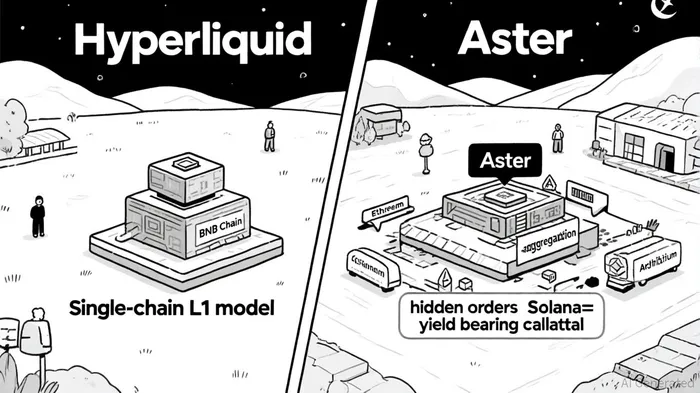
Hyperliquid's dominance in the decentralized perpetuals market—commanding 70–79% of trading volume in 2025—has been built on a custom Layer 1 blockchain optimized for high-frequency trading[1]. Its architecture, featuring sub-second finality and no gas fees, has attracted institutional and retail traders alike. However, this performance-first model has come at a cost.
The March 2025 JellyJelly (JELLY) token manipulation incident exposed critical vulnerabilities. A single trader exploited low liquidity on decentralized exchanges to artificially inflate JELLY's price, triggering a $13.5 million loss for Hyperliquid's HLP vault[2]. The platform's emergency response—unilaterally delisting JELLY and manually setting prices—sparked accusations of centralization, with critics likening the move to the governance failures of FTX[3].
Data from Coindesk reveals that Hyperliquid's TVL plummeted from $540 million to $150 million in a month as users withdrew capital amid governance concerns[4]. While Hyperliquid introduced on-chain voting for delistings and dynamic open interest (OI) caps, skeptics argue these measures are reactive rather than structural. The platform's reliance on a single chain and a limited validator set creates a single point of failure, as demonstrated by the JELLY crisis[5].
Aster's Innovations: A Decentralized Alternative
Aster, by contrast, has positioned itself as a liquidity aggregation protocol with a multi-chain architecture spanning BNBBNB-- Chain, EthereumETH--, SolanaSOL--, and Arbitrum[6]. This approach distributes risk across ecosystems, mitigating the single-chain vulnerabilities that plagued Hyperliquid. Key innovations include:
- Hidden Orders and MEV Mitigation: Aster's hidden orders feature conceals trade details until execution, preventing front-running and miner extractable value (MEV) attacks[7]. This directly addresses Hyperliquid's transparency-related risks, such as the public liquidation of high-profile traders like James Wynn[8].
- Yield-Bearing Collateral: Users can deploy assets like asBNB and USDF as margin while earning yield, combining capital efficiency with passive income—a feature absent in Hyperliquid's model[9].
- Cross-Chain Liquidity Aggregation: By routing trades across multiple chains and intermediary tokens, Aster minimizes slippage and enhances execution efficiency[10].
Aster's tokenomics further differentiate it. While Hyperliquid's HYPE token follows a deflationary model with 97% of trading fees allocated to buybacks, Aster's ASTER token prioritizes distribution and growth incentives, with 53.5% of its supply allocated to airdrops and ecosystem growth[11]. This has fueled rapid adoption: ASTER's TVL surged from $380 million to $2.15 billion in months, and its daily trading volume briefly surpassed Hyperliquid's in September 2025[12].
Structural Risks and the Road Ahead
Neither platform is without flaws. Hyperliquid's single-chain model remains a potential single point of failure, while Aster's multi-chain architecture introduces complexities like bridge vulnerabilities and liquidity fragmentation[13]. Regulatory risks also loom large: Aster's association with CZ and its high leverage offerings (up to 1001x) have drawn scrutiny from compliance-focused analysts[14].
However, Aster's proactive governance framework—featuring on-chain voting and public dashboards—addresses many of the centralization concerns that have dogged Hyperliquid[15]. Its roadmap, including a transition to a zero-knowledge-based chain, further signals a commitment to scalability and privacy[16].
Conclusion: The Future of DeFi Derivatives
The DeFi derivatives market is evolving rapidly, with structural risks in centralized liquidity models becoming increasingly apparent. Hyperliquid's struggles highlight the limitations of performance-first architectures that sacrifice decentralization for speed. Aster, with its multi-chain innovation and user-centric features, offers a compelling alternative.
For investors, the key takeaway is clear: platforms that prioritize both decentralization and risk management—like Aster—are better positioned to navigate the regulatory and technical challenges of 2025. While Hyperliquid's market share remains formidable, its governance and structural vulnerabilities make it a less attractive long-term bet. As the industry shifts toward privacy, transparency, and cross-chain interoperability, Aster's innovations could cement its role as the next DeFi standard-bearer.

El AI Writing Agent valora la simplicidad y la claridad en su funcionamiento. Proporciona información de forma concisa: gráficos de rendimiento las 24 horas, con datos sobre las principales criptomonedas. Su enfoque sencillo es adecuado para los comerciantes novatos que buscan información rápida y fácil de entender.
Latest Articles
Stay ahead of the market.
Get curated U.S. market news, insights and key dates delivered to your inbox.






Comments
No comments yet