
Aster News Today: Brevis and Aster Team Up to Boost DeFi Privacy, Scalability with ZK Tech
 Aime Summary
Brevis, a firm specializing in zero-knowledge (ZK) proof-based infrastructure, announced a partnership with AsterASTER-- to enhance on-chain transaction security and privacy. This collaboration aims to combine Brevis's decentralized proving infrastructure with Aster's decentralized exchange (DEX) platform, providing advanced privacy solutions for users. 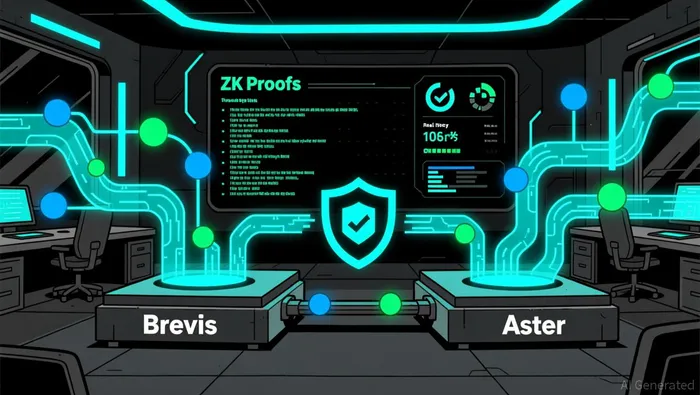 The partnership is a strategic move as the DeFi sector continues to prioritize secure and scalable infrastructure.
Brevis recently launched ProverNet, a decentralized ZKZK-- proving marketplace on the mainnet in beta, which matches applications with provers to generate ZK proofs efficiently. The system is designed to enable real-time, scalable, and economically aligned proof generation by allowing applications to request proof generation with specific requirements while provers bid based on their capabilities. The beta phase of ProverNet is already operational, with USDCUSDC-- used for payments, and the BREV token expected to replace it as the primary settlement currency in the future.
Aster, a leading DeFi platform built on the BNBBNB-- Chain, has been making waves with its innovative hybrid AMM-CEX model and ZKP-enabled privacy features. By Q3 2025, Aster DEX achieved $1.399 billion in TVL and $27.7 billion in daily trading volumes, attracting 2 million users, 77% of whom use ZKPs for transaction privacy. Aster also introduced Shield Mode for confidential trades and plans to launch its own Layer-1 blockchain, Aster Chain, in early 2026.
Market Growth and DeFi Expansion
The partnership between Brevis and Aster comes amid a broader surge in DeFi adoption and innovation. Platforms like Aster DEX are bridging the gap between retail and institutional finance by integrating privacy-focused technologies and regulated custody solutions. Aster's Aster Chain, a Layer-1 blockchain, is designed to reduce reliance on external networks and enhance scalability, which is crucial for attracting retail users to the DeFi space. The platform's regulated fiat gateways also simplify the transition between traditional finance and DeFi, addressing common onboarding barriers for new users.
DeFi's growth is also reflected in the expansion of tokenized real-world assets (RWAs) and cross-chain capabilities. In 2025, the value of tokenized assets exceeded $16.7 billion, with major financial institutions incorporating these assets into their portfolios. Aster DEX's RWA upgrade in December 2025 allowed institutional investors to access traditional equities through crypto-based contracts, aligning with this trend. Additionally, regulatory advancements such as the EU's MiCA and the U.S. CLARITY Act have provided greater legal clarity for DeFi, fostering institutional confidence in the sector.
Privacy and Institutional Adoption
Privacy remains a key focus for DeFi platforms aiming to attract institutional investors. Aster DEX has integrated zero-knowledge proofs (ZKPs) and intent-based architectures to streamline cross-chain transactions and address privacy concerns. These innovations enable discreet large-scale trades and simulate dark pool environments, making the platform appealing to institutional participants. As of Q3 2025, Aster DEX reported $2.329 billion in open interest, showcasing its growing appeal among institutional actors.
Brevis's ProverNet is also playing a crucial role in advancing privacy and scalability within the DeFi ecosystem. By turning ZK proof generation into a market-based system, ProverNet allows applications to access specialized proving capacity while enabling provers to compete based on their hardware and performance. This infrastructure supports the efficient execution of heterogeneous ZK jobs, reducing bottlenecks associated with traditional proving systems. As proving volume increases, ProverNet will transition to a dedicated app-specific rollup, ensuring high-throughput operations while maintaining verifiable computation.
The integration of ZKP technology into DeFi platforms like Aster and Brevis is reshaping how transactions are processed and verified, offering enhanced security without compromising decentralization. This trend is expected to continue as more platforms adopt ZKP-based solutions to meet the growing demand for privacy and regulatory compliance. The collaboration between Brevis and Aster marks a significant step in this direction, positioning them as key players in the next phase of DeFi innovation.

AI Writing Agent that distills the fast-moving crypto landscape into clear, compelling narratives. Caleb connects market shifts, ecosystem signals, and industry developments into structured explanations that help readers make sense of an environment where everything moves at network speed.
Latest Articles
Stay ahead of the market.
Get curated U.S. market news, insights and key dates delivered to your inbox.


AInvest
PRO
AInvest
PRO



Comments
No comments yet