
Aster Launches Sixth Token Buyback Phase and Mainnet Roadmap as Perp DEX Volume Surges
 Aime Summary
- Aster has permanently destroyed 98.4 million ASTERASTER-- tokens in its 4th and 5th buyback phases as part of its supply reduction strategy, with the 6th phase currently underway according to reports.
- The sixth buyback phase, launched on February 4, 2026, allocates up to 80% of daily platform fees toward on-chain token repurchases, with 40% for automatic buybacks and 20%-40% for strategic buybacks as detailed in the announcement.
- Aster CEO Leonard has refuted allegations of insider manipulation and emphasized the project's transparency in tokenomics, including a total of 254 million tokens repurchased and 78 million burned to date according to company statements.
Aster's fourth and fifth token buyback phases marked a significant milestone in its ongoing supply reduction initiative. The destruction of 98.4 million ASTER tokens was 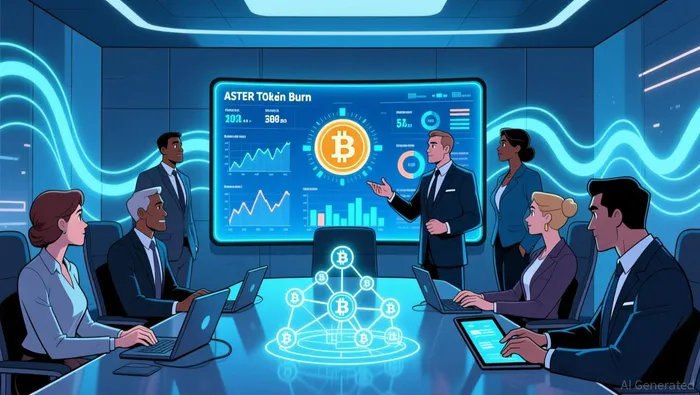 verified on-chain. This action aligns with the broader strategy to increase token value through supply contraction and enhance investor confidence in the long-term sustainability of the ASTER token economy.
The sixth phase of the buyback program, initiated on February 4, 2026, represents an escalation in Aster's commitment to token value creation. Up to 80% of daily trading fees will be allocated to ASTER buybacks, with 40% of this amount reserved for automatic daily purchases. The remaining 20%-40% will be used for strategic on-chain buys, depending on market volatility and conditions as reported. This approach enables Aster to adapt to market dynamics while maintaining transparency in all buyback activities.
Aster CEO Leonard has actively engaged with the community to address concerns about the role of Changpeng Zhao (CZ) in the project. He clarified that CZ serves as an advisor only and that Aster is an independently operated platform. The CEO emphasized the transparency of the tokenomics model, including the allocation of repurchased tokens to airdrop reserves and the suspension of monthly unlocks until staking is implemented according to company communications.
How Does Aster's Supply Reduction Impact Token Value?
Aster's ongoing buyback and burn strategy is designed to reduce the circulating supply of ASTER and enhance its scarcity. By permanently destroying 98.4 million tokens in the 4th and 5th phases, and committing to a large portion of daily fees for further repurchases, Aster is signaling long-term value creation for token holders.
The buyback program not only reduces supply but also reinforces investor trust by ensuring that a substantial portion of platform-generated value is returned to the ASTER token ecosystem. The transparency of these on-chain activities, with public updates on token repurchases and burns, supports market confidence and provides visibility into the project's financial health.
What Are Aster's Future Infrastructure Developments?
Aster has launched its Aster Chain testnet, allowing developers to test advanced features such as Zero-Knowledge Rollups, Adaptive Block Production, and cross-chain bridges as reported. This testnet environment is crucial in identifying and resolving vulnerabilities before the mainnet launch, which is scheduled for Q1 2026.
The Aster Chain testnet incorporates a multi-layered consensus mechanism combining Proof-of-Stake and Byzantine Fault Tolerance elements. It also features a modular architecture that separates execution, consensus, and data availability layers. This design aims to address the blockchain trilemma by improving scalability and throughput, with early testing showing average transaction speeds of 2.5 seconds per swap.
Aster's shift to a custom layer-1 blockchain reflects a broader trend among decentralized exchanges to move away from general-purpose chains like EthereumETH-- or SolanaSOL--. By operating on a dedicated blockchain, Aster can optimize for high-throughput trading while maintaining security and decentralization. The platform plans to release fiat on-ramps and open-source code for developers during the mainnet deployment phase as announced.
How Does Aster Compare to Competitors in the Perpetual Futures Space?
Aster has rebranded as a perpetual futures decentralized exchange (DEX) and now directly competes with platforms like Hyperliquid. Both projects operate on custom layer-1 blockchains to improve efficiency and scalability for perpetual futures trading according to industry analysis.
The perpetual futures market saw a significant surge in 2025, with cumulative trading volume tripling to over $12 trillion by year-end. Monthly trading volumes hit $1 trillion in October, November, and December, demonstrating strong demand for this type of derivative. Aster's infrastructure improvements, including faster transactions and lower gas fees, position it to capture a larger share of this growing market.
By combining a robust buyback strategy with infrastructure advancements, Aster is well-positioned to compete in the evolving decentralized finance (DeFi) landscape. The project's focus on transparency, token utility, and community engagement further strengthens its appeal to traders and developers seeking a high-performance and secure trading platform.

Blending traditional trading wisdom with cutting-edge cryptocurrency insights.
Latest Articles
Stay ahead of the market.
Get curated U.S. market news, insights and key dates delivered to your inbox.


AInvest
PRO
AInvest
PRO



Comments
No comments yet