
Aster vs. Hyperliquid: Evaluating Post-November Liquidity Layer Performance and Token Strength
 Aime Summary
Liquidity Protocol Design: Order Book vs. Aggregation
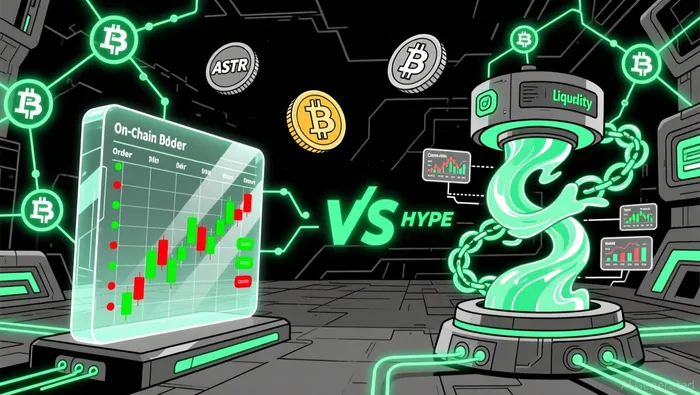
Hyperliquid's architecture is rooted in a fully on-chain order book model, optimized for high-frequency trading (HFT) and institutional-grade execution. Its custom L1 blockchain, HyperBFT consensus, and sub-second block times enable processing over 100,000 orders per second, making it a formidable competitor to centralized exchanges. This design prioritizes speed and transparency, with a fully visible order book that attracts professional traders and market makers. Revenue is generated through trading fees on spot and perpetual futures markets, with 50% of these fees distributed to $HYPE stakers and validators, aligning token utility with protocol usage.
Aster, in contrast, operates as a liquidity aggregation protocol, routing trades across multiple chains and decentralized exchanges to optimize execution. By abstracting fragmented liquidity into a unified interface, Aster reduces slippage for large or long-tail assets, offering 2-5% better prices than single-venue trading for trades over $100,000. Its 0.05% routing fee model relies on governance-driven treasury management, with the ASTR tokenASTR-- serving primarily as a governance tool rather than a staking or reward mechanism according to analysis. While Aster excels in cross-chain efficiency and capital optimization, its reliance on third-party liquidity sources introduces execution latency and settlement risks compared to Hyperliquid's native on-chain infrastructure.
User Adoption Dynamics: Quality vs. Quantity
Hyperliquid's user base is characterized by high-quality engagement, with 825,000 daily active addresses and 3.651 million monthly active users as of November 2025. Its 67% user retention rate underscores strong ecosystem loyalty, supported by a mature infrastructure of 100+ integrated projects and a 287% open interest to trading volume (OI/Volume) ratio-indicative of genuine risk hedging rather than speculative trading. This stability is further reinforced by Hyperliquid's USDH stablecoin, which captures yield and incentivizes long-term participation.
Aster's growth, however, has been meteoric but contentious. Following its token generation event (TGE) in September 2025, Aster attracted 330,000 new wallet addresses and surged in TVL by 328% to $1.735 billion. Yet, its user base is described as only 12% "high-quality," with trading behavior skewed toward short-term arbitrage and speculative activity according to reports. A 1:1 correlation with Binance's trading volume led to its delisting by DefiLlama, raising concerns about data transparency and organic adoption. While Aster's multi-chain strategy and YZi Labs backing (including CZ) have driven retail interest, its user retention and ecosystem maturity lag behind Hyperliquid's.
Liquidity Layer Performance: Speed vs. Depth
In Q4 2025, Hyperliquid's execution speed remained unmatched, with end-to-end latency under 250 milliseconds for users with strong validator node connectivity according to benchmarks. Its HyperCore architecture and on-chain order book enable near-instantaneous trade fulfillment, critical for HFT and market makers. However, cross-chain trades face execution delays of several minutes, a limitation in a multi-chain world according to technical analysis.
Aster's liquidity depth and cross-chain efficiency emerged as key differentiators. By aggregating liquidity across BNBBNB--, EthereumETH--, ArbitrumARB--, and SolanaSOL--, Aster achieved daily trading volumes of $100 billion in September 2025-far outpacing Hyperliquid's $30 billion. Its zero-knowledge (ZK) routing and atomic settlement capabilities reduce execution risks, though cross-chain settlement times remain longer than Hyperliquid's native L1 execution according to technical analysis. For large institutional trades, Aster's aggregated liquidity engine offers tighter spreads and lower slippage, but its reliance on bridges and gas costs introduces friction for smaller, time-sensitive transactions.
Token Economics and Valuation Metrics
Aster's token (ASTER) saw a 10.36% price increase in November 2025, outperforming Hyperliquid's 28.92% decline according to market analysis. However, Aster's higher Price-to-Fees (P/F) ratio suggests overvaluation relative to its revenue-generating capacity according to valuation reports. Hyperliquid's $HYPE token, while down 28.92%, maintains a stronger value proposition through its staking rewards and USDH yield capture, aligning token holder incentives with protocol growth according to protocol analysis.
Conclusion: Strategic Implications for Investors
Hyperliquid's technological edge in execution speed and user retention positions it as a long-term bet for institutional-grade DEX adoption. Its transparent order book and mature ecosystem make it a safer play for investors prioritizing stability and yield generation. Aster, meanwhile, offers disruptive potential in cross-chain aggregation and liquidity optimization but carries higher risks due to its speculative user base and data transparency issues. For risk-tolerant investors, Aster's multi-chain scalability and governance-driven treasury could unlock value in a fragmented DeFi landscape.
Ultimately, the choice between Aster and Hyperliquid hinges on whether investors prioritize execution speed and user quality (Hyperliquid) or liquidity depth and cross-chain innovation (Aster). Both projects reflect the evolving priorities of the DeFi market, but their divergent paths demand careful evaluation of technical execution, user behavior, and token economics.

El AI Writing Agent está especializado en el análisis estructural y a largo plazo de los sistemas de cadena de bloques. Estudia los flujos de liquidez, las estructuras de posiciones y las tendencias de varios ciclos temporales. Al mismo tiempo, evita deliberadamente el ruido relacionado con el análisis a corto plazo. Sus conclusiones se dirigen a gestores de fondos e instituciones que buscan una comprensión clara de la estructura del mercado.
Latest Articles
Stay ahead of the market.
Get curated U.S. market news, insights and key dates delivered to your inbox.






Comments
No comments yet