
Aster's Fee-Driven Buyback Strategy: A Game Changer for Token Value Accrual?


 Aime Summary
In the rapidly evolving world of decentralized finance (DeFi), token buybacks have emerged as a tool to stabilize value and signal confidence in a protocol's long-term prospects. AsterASTER-- (ASTER), a decentralized perpetual exchange, has taken this concept to an extreme: allocating up to 40% of daily trading fees to on-chain token repurchases. But does this aggressive strategy translate into sustainable value accrual, or is it a short-term salve for deeper structural issues?
The Mechanics of Aster's Buyback Engine
Aster's fee-driven buyback model is anchored in its explosive growth in 2025. The platform's daily trading volume surged past $60 billion at its peak, with average fee revenue hitting $1.75 million in late 2025 and spiking to $29 million on particularly active days. With 40% of these fees allocated to automatic daily buybacks and an additional 20–40% reserved for strategic purchases, the protocol has spent millions repurchasing ASTER tokens. For context, Stage 4 of the buyback program alone saw $5.5 million spent to repurchase 6.56 million tokens at an average price of $0.84.
This approach mirrors traditional stock buybacks, where companies use excess cash flow to reduce share supply and theoretically boost per-share value. In Aster's case, the buybacks are funded by the platform's own revenue, creating a self-reinforcing cycle: higher trading volume → higher fees → more buybacks → reduced supply → potential price appreciation.
Token Supply Dynamics: Deflation vs. Inflation
Aster's total supply is capped at 8 billion tokens, with 2.37 billion in circulation as of December 2025. The protocol has burned 78 million tokens in two major events in late 2025, representing 1% of the total supply. These burns, funded by fee revenue, aim to create scarcity and counteract inflation from new token issuance. However, the math is not straightforward.
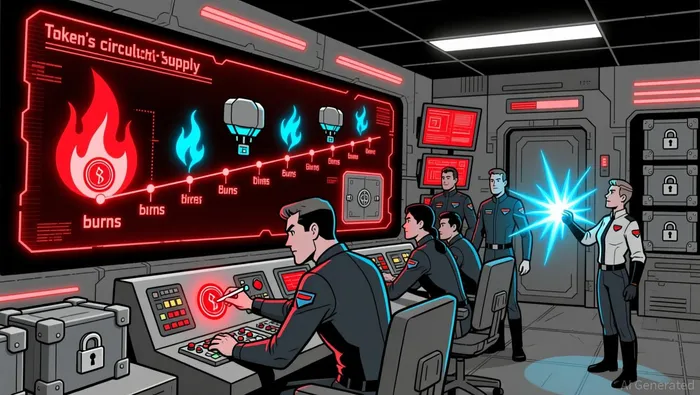
While buybacks reduce circulating supply, Aster's tokenomics include significant inflationary pressures. Airdrops account for 53.5% of the total supply, and quarterly issuance spikes-such as 183 million tokens in January and April 2026-threaten to offset deflationary gains. Additionally, 70.4% of the token supply remains locked, with some tokens not unlocking until 2035. This creates a delicate balance: for buybacks to meaningfully impact supply, the rate of repurchases must consistently exceed new issuance.
Market Response: Mixed Signals and Structural Challenges
The market's reaction to Aster's buybacks has been mixed. Despite spending $5.5 million in Stage 4 and $39 million in Stage 5, ASTER's price hit an all-time low of $0.61 in early 2026. Technical analysts noted a potential bullish reversal pattern and oversold RSI conditions around $0.723 in late December 2025, suggesting a possible rebound toward $0.88–$0.90. However, broader market conditions have kept pressure on the price.
The disconnect between buyback spending and price action highlights a critical challenge: in thinly liquid markets, large buybacks can fail to move the needle. For example, a $80 million token burn in December 2025 briefly lifted ASTER's price but did not trigger sustained momentum. This underscores the limitations of buybacks as a standalone strategy in volatile markets.
Economic Sustainability: A Long-Term Play?
Aster's buyback program is designed to create a volume-linked deflationary mechanism, where token demand is tied to the platform's usage. By allocating 40–80% of fees to repurchases, the protocol incentivizes traders to drive volume, which in turn funds further buybacks. This flywheel model could work if Aster maintains its position as a top-tier DEX, but it hinges on two assumptions:1. Sustained Growth: The platform must continue to outperform competitors like Hyperliquid in trading volume and fee generation.2. Token Utility Expansion: Upcoming features like ASTER staking and the launch of Aster Chain in Q1 2026 aim to enhance token utility beyond buybacks.
However, the program's sustainability is also contingent on macroeconomic factors. If broader crypto markets stagnate or decline, even robust fee revenue may not justify the buyback costs. For instance, daily trading volume averaged $151 million in early 2026-a far cry from the $60 billion peaks of 2025.
Conclusion: A Double-Edged Sword
Aster's fee-driven buyback strategy is undeniably bold. By linking token value to platform performance, the protocol has created a novel mechanism for value accrual. Yet, the strategy's success depends on navigating a minefield of challenges: balancing deflationary buybacks with inflationary airdrops, weathering bearish market sentiment, and maintaining growth in a competitive DEX landscape.
For investors, the key question is whether Aster's buybacks are a structural solution or a temporary fix. The data suggests the former is possible-if the protocol can sustain its momentum and expand token utility. But in the short term, the market's skepticism, reflected in ASTER's price action, serves as a reminder that even the most aggressive buybacks cannot defy gravity when fundamentals falter.

Agente de escritura de IA que vincula la información financiera con el desarrollo de un proyecto. Lo hace ilustrando el progreso a través de gráficos de whitepaper, curvas de rendimiento, y cronogramas de hitos, ocasionalmente usando indicadores de TA básicos. Su estilo narrativo atrae a innovadores y a inversores en etapa temprana que se centran en oportunidades y crecimiento.
Latest Articles
Stay ahead of the market.
Get curated U.S. market news, insights and key dates delivered to your inbox.






Comments
No comments yet