
Aster DEX's Recent Surge: A New Era in Decentralized Trading?


 Aime Summary
On-Chain Innovation: From Speculative Asset to Functional Utility
Aster DEX's November 5, 2025, protocol upgrade marked a pivotal departure from traditional tokenomics. By enabling ASTER holders to use their tokens as collateral for leveraged positions, the platform transformed the asset from a speculative token into a core component of its ecosystem. This innovation, as noted by on-chain analysts, reduces reliance on external collateral and incentivizes long-term token holding through fee discounts and margin efficiency, according to a Coinotag report. The 80% margin ratio-a feature previously absent in most DeFi platforms-addresses a key pain point for traders seeking capital efficiency without compromising security, the Ambcrypto report notes.
The timing of this upgrade was equally strategic. Just three days prior, Binance founder Changpeng Zhao (CZ) had purchased $2 million worth of ASTER tokens, sparking an 800% surge in 24-hour trading volume to $2 billion and a 30% price increase, as reported in a Lookonchain analysis. While the correlation between CZ's purchase and the protocol upgrade remains unconfirmed, the synchronized momentum has fueled speculation about coordinated efforts to bolster ASTER's value proposition, the NullTX report notes.
User Adoption Dynamics: Volume, Wallet Growth, and Institutional Validation
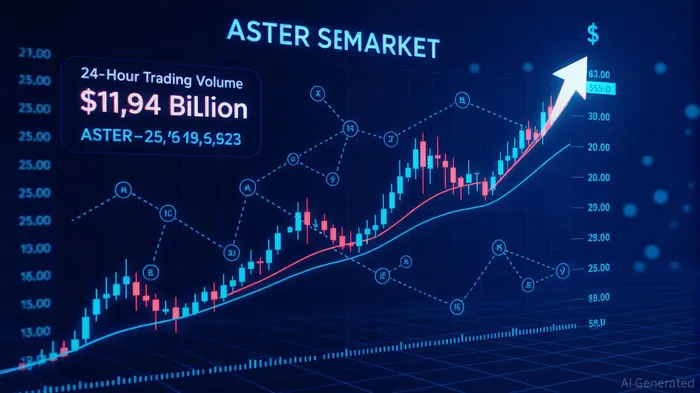
The metrics tell a compelling story. By November 10, 2025, Aster DEX had achieved a 24-hour trading volume of $11.94 billion, surpassing Hyperliquid and Lighter to claim the top spot among perpetual decentralized exchanges (Perp DEXs), as noted in a LiveBitcoinNews report. This growth was underpinned by a surge in active wallets, driven by the collateral feature's appeal to both retail and institutional traders. According to on-chain data, the platform's Total Value Locked (TVL) reached $14.98 billion, reflecting robust liquidity provision and cross-chain integration, according to a Bitget report.
Coinbase's inclusion of ASTER in its official roadmap on November 7, 2025, further validated the platform's trajectory. This move, as highlighted by DeFi analysts, signals growing institutional confidence in Aster's hybrid on-chain/off-chain order-matching model and its privacy-focused architecture, according to a Gate report. The platform's multi-chain strategy-leveraging BNBBNB-- Chain and preparing for its own Aster Chain in Q1 2026-has also attracted liquidity providers seeking fragmented market share.
Strategic Implications and Future Outlook
Aster DEX's success hinges on its ability to sustain this momentum. The collateral feature's demand-driven supply reduction-by locking ASTER in active positions-creates a flywheel effect, where increased utility drives token value, which in turn attracts more users. However, challenges remain. The platform must navigate regulatory scrutiny, particularly as it prepares to launch Aster Chain with zero-knowledge proofs, a feature that could attract both privacy-conscious traders and regulatory scrutiny, the NullTX report notes.
For investors, the key question is whether Aster's innovations can scale without compromising decentralization. The platform's hybrid model, which balances on-chain transparency with off-chain execution efficiency, offers a potential blueprint for the next generation of DeFi platforms. Yet, as with any high-growth asset, caution is warranted. The 800% volume spike post-CZ purchase, while impressive, may not be indicative of long-term sustainability without continued product development and ecosystem expansion.
Conclusion
Aster DEX's November 2025 upgrades have undeniably reshaped the DeFi landscape. By redefining ASTER's utility and capturing institutional attention, the platform has demonstrated the potential for decentralized exchanges to rival their centralized counterparts. However, the true test lies in maintaining this momentum as the market evolves. For now, Aster's surge is not just a story of technical innovation-it's a case study in how strategic timing, institutional validation, and user-centric design can converge to redefine an industry.

Combina sabiduría tradicional de comercio con perspectivas de criptomonedas de última generación.
Latest Articles
Stay ahead of the market.
Get curated U.S. market news, insights and key dates delivered to your inbox.






Comments
No comments yet