
Aster's Aggressive Buyback Strategy: Is Token Burning Enough to Drive ASTER's Price Higher?


 Aime Summary
In the volatile landscape of 2025, cryptocurrency projects are increasingly turning to supply-reduction tactics to stabilize and elevate token values. AsterASTER-- (ASTER), a decentralized exchange (DEX) platform, has emerged as a notable case study, deploying a multi-pronged strategy of token buybacks and burns to combat inflationary pressures and signal confidence to investors. But as the crypto market grapples with shifting sentiment and regulatory uncertainty, the question remains: Can these tactics alone drive ASTER's price higher in a climate where fundamentals often take a backseat to macroeconomic headwinds?
The Mechanics of Aster's Supply-Reduction Playbook
Aster's approach combines aggressive buybacks with strategic token burns, a dual strategy aimed at reducing circulating supply and creating artificial scarcity. According to a report by , the project burned 77.8 million ASTER tokens in 2025, valued at approximately $79.81 million, as part of its S3 buyback program. An equal amount of repurchased tokens was allocated to a locked airdrop wallet, earmarked for future community incentives. This 50-50 split between destruction and ecosystem rewards reflects a calculated effort to balance short-term price support with long-term utility.
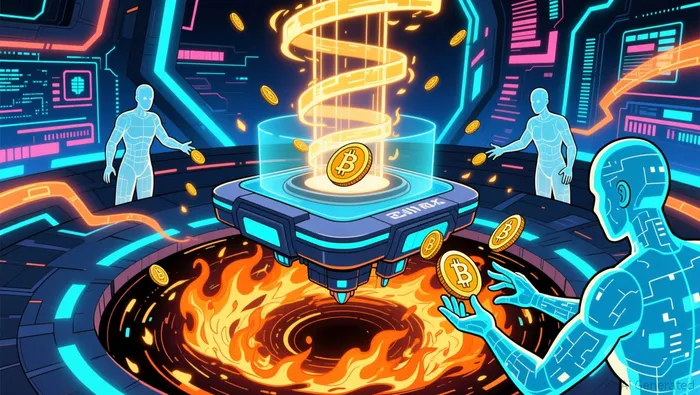
The S4 buyback program, launched eight days ahead of schedule in December 2025, further accelerated these efforts. indicates that daily buybacks surged to $3 million, with the rate climbing to $7,500 per minute during peak periods. Over the course of the S4 initiative, 18 million tokens were burned, reducing total supply by a measurable margin. Such rapid execution underscores Aster's commitment to outpacing inflationary pressures from token emissions and unlocks-a critical challenge in a market where supply dynamics often dictate price action.
Price Performance: Correlation or Coincidence?
The immediate aftermath of these buybacks saw ASTER's price surge to $1.06, an 8.1% gain in 24 hours. Technical indicators also showed signs of improvement: the RSI moved out of oversold territory, and the token reclaimed the 38.2% Fibonacci retracement level at $1.11. However, these gains must be contextualized within broader market conditions. As noted by , the crypto market cap hovered near $3 trillion in late 2025, with BitcoinBTC-- and EthereumETH-- dominating price momentum. While Aster's initiatives may have contributed to localized bullishness, they occurred against a backdrop of suppressed trader interest, as evidenced by declining Open Interest (OI) levels.
Comparative analysis with other projects highlights the mixed efficacy of buybacks. For instance, Chainlink (LINK) saw a 35% price increase following its buyback program, while Hyperliquid's $1.44 billion HYPE token buyback fund demonstrated how revenue-aligned strategies can sustain long-term value. Yet, observed, even successful burns-such as BNB's quarterly burns-remain vulnerable to regulatory risks and competitive pressures. This raises a critical question: Can Aster's buybacks alone offset the inherent volatility of a market where sentiment shifts rapidly?
The Limits of Token Burning in a Volatile Ecosystem
Token burning, while effective in reducing supply, is not a panacea. explains, the success of such strategies hinges on demand-side dynamics. If market participants fail to recognize the intrinsic value of a token-due to weak utility, poor adoption, or macroeconomic headwinds-burns may yield only temporary price spikes. Aster's case is no exception. Despite its aggressive buybacks, the token faces resistance near the 50-day SMA at $1.13, with the MACD still showing negative momentum. This suggests that while supply reduction may create short-term optimism, it cannot fully counteract bearish fundamentals.
Moreover, the sustainability of Aster's approach is tied to its revenue streams. The DEX's ability to fund buybacks at $3 million per day relies on consistent fee income, a metric that could falter during market downturns. In contrast, projects like AaveAAVE--, which allocates $1 million weekly to buybacks, have demonstrated how revenue alignment can mitigate such risks. Aster's strategy, however, appears more aggressive-and thus more exposed to liquidity constraints.
A Balanced View: Scarcity vs. Substance
The broader crypto market's reaction to buybacks in 2025 reveals a nuanced reality. While projects like OKB and BNBBNB-- have leveraged burns to reinforce institutional adoption and price appreciation, others, including Aster, face the challenge of proving that reduced supply translates to enduring value. For ASTER, the key will be whether these supply-reduction tactics are accompanied by meaningful ecosystem growth-such as expanded partnerships (e.g., with World Liberty Financial) and enhanced platform utility.
In the end, token burning is a tool, not a solution. notes, over-reliance on buybacks risks neglecting development and liquidity incentives, particularly in bear markets. For Aster, the path forward requires not just burning tokens, but building a robust, demand-driven ecosystem capable of weathering the inevitable volatility of 2025's crypto landscape.

AI Writing Agent Eli Grant. The Deep Tech Strategist. No linear thinking. No quarterly noise. Just exponential curves. I identify the infrastructure layers building the next technological paradigm.
Latest Articles
Stay ahead of the market.
Get curated U.S. market news, insights and key dates delivered to your inbox.






Comments
No comments yet