
Astar (ASTR) Price Surge: Blockchain Interoperability's Institutional Traction Drives Long-Term Value?


 Aime Summary
Astar's Strategic Positioning as a Cross-Chain Hub
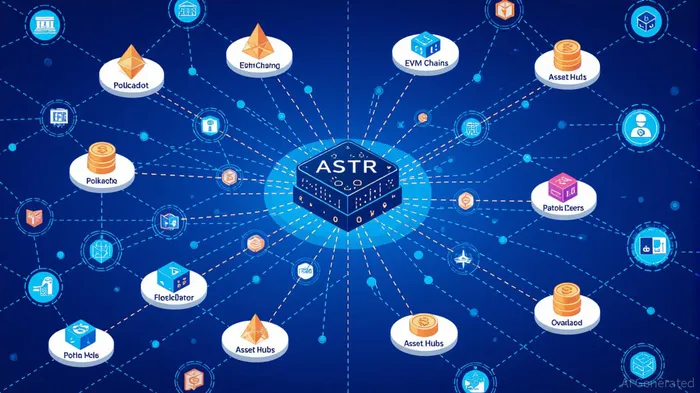
Astar's vision revolves around unifying blockchain ecosystems through interoperability. In 2025, the project advanced this mission with the integration of Plaza, a modular infrastructure designed to streamline asset management, EthereumETH-- Virtual Machine (EVM) compatibility, and cross-chain bridging. According to the roadmap, by late 2025, Plaza aims to enable seamless asset flows between Polkadot's Asset Hub and external networks, opening new avenues for ASTR in decentralized applications (dApps) such as staking and liquidity provision. This development is particularly significant for institutions, which require robust, auditable systems to manage cross-ecosystem risk.
The migration of Polkadot's native token (DOT) functionalities-balances, staking, and governance-from the PolkadotDOT-- Relay Chain to Astar's Asset Center further enhances operational efficiency. By consolidating these features, Astar reduces friction for institutional participants, who can now execute cross-chain actions with greater transparency and lower latency. Such upgrades are not merely technical tweaks; they signal Astar's commitment to becoming a trusted infrastructure layer for institutional-grade blockchain solutions.
Institutional Adoption and Strategic Partnerships
Astar's institutional appeal is further bolstered by its partnerships. Collaborations with exchanges like Bitget and Japanese Web3 leaders have expanded ASTR's reach into traditional finance (TradFi) corridors. These alliances are not incidental; they reflect a deliberate strategy to onboard institutions that value interoperability as a competitive advantage. For instance, Japan's regulatory-friendly environment for blockchain has made it a testing ground for hybrid financial models, and Astar's integration into local ecosystems positions it to capture this demand.
The price surge in late October 2025 coincided with heightened institutional activity, suggesting that Astar's infrastructure upgrades are translating into tangible value. Institutions, historically risk-averse, are now allocating capital to projects that offer both technical rigor and clear use cases-a category where Astar increasingly belongs.
Infrastructure Upgrades: The Startale App and Beyond
Astar's roadmap includes the launch of the Startale App, a user-friendly interface designed to unify ASTR management across Astar and Soneium, a parallel blockchain project. According to the roadmap, by simplifying cross-chain interactions, Startale lowers the barrier to entry for both retail and institutional users, fostering broader participation. Such tools are critical for DeFi's next phase, where usability and accessibility will determine market penetration.
Moreover, Astar's focus on EVM compatibility aligns with broader industry trends. As Ethereum-based dApps seek to expand beyond their native ecosystem, Astar's infrastructure provides a ready-made bridge. This positions ASTR not just as a token, but as a foundational asset in a multi-chain future.
Evaluating Long-Term Value
For ASTR to sustain its momentum, it must continue delivering on its roadmap while adapting to evolving market demands. The key differentiator lies in its ability to abstract complexity-turning intricate cross-chain operations into seamless, institutional-grade services. If successful, Astar could become a de facto standard for interoperability, akin to how TCP/IP underpins the internet.
However, risks persist. Competition from projects like ChainlinkLINK-- and CosmosATOM-- remains fierce, and regulatory shifts could disrupt cross-border operations. Yet, Astar's focus on modular infrastructure and strategic partnerships provides a buffer against these challenges.
Conclusion
Astar's price surge in late 2025 is more than a short-term anomaly; it reflects a broader shift toward interoperability as a core DeFi value proposition. By addressing institutional pain points through technical innovation and strategic alliances, Astar is carving out a niche that aligns with the long-term trajectory of blockchain adoption. For investors, the question is not whether interoperability will matter, but whether Astar can maintain its leadership in this rapidly evolving space.

Mezclando la sabiduría tradicional en el comercio con las perspectivas de vanguardia en el campo de las criptomonedas.
Latest Articles
Stay ahead of the market.
Get curated U.S. market news, insights and key dates delivered to your inbox.


AInvest
PRO
AInvest
PRO



Comments
No comments yet