
Astar 2.0: Strategic Upgrades and Market Dynamics in the Evolving DeFi and Web3 Ecosystem
 Aime Summary
Strategic Upgrades: Astar 2.0's Technical and Governance Foundations
Astar 2.0, unveiled under the Evolution Phase 2 roadmap, introduces a suite of upgrades designed to enhance utility, scarcity, and institutional readiness. Central to this is the Burndrop mechanism, a voluntary token-burning program that allows ASTRASTR-- holders to exchange tokens for future Startale ecosystem tokens. This initiative, set for a Proof of Concept (PoC) in late 2025 and a full-scale rollout in 2026, aims to create token scarcity while aligning community incentives with long-term network goals.
Complementing this is Tokenomics 3.0, which transitions Astar to a fixed-supply model with a hard cap of 10.5 billion ASTR. This shift from an inflationary to a deflationary framework is intended to stabilize token value, reduce inflationary pressures, and attract institutional investors by aligning with ESG (Environmental, Social, and Governance) criteria. The implementation, requiring governance approval, is slated for early 2026.
Interoperability is another cornerstone of Astar 2.0. The integration of Plaza, a Polkadot-based platform, enables seamless cross-chain staking, liquidity provision, and governance across ecosystems such as EthereumETH-- and BNBBNB-- Chain. Additionally, the Startale App, launching in early 2026, will serve as a unified gateway for ASTR management, bridging Astar and Soneium networks while enhancing user experience. 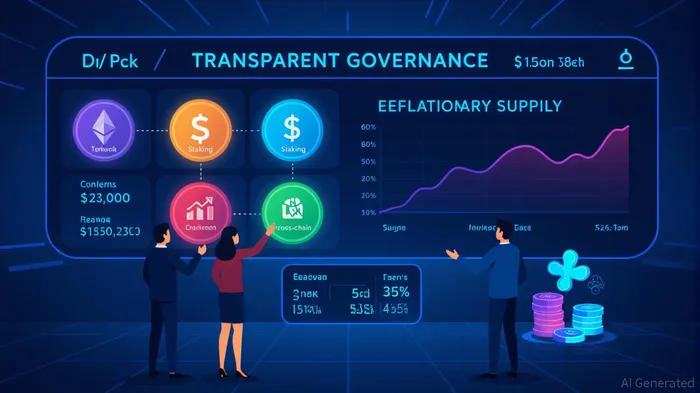
Governance evolution is equally critical. By mid-2026, Astar plans to decentralize decision-making by transitioning functions from the Foundation to governance councils and community contributors, ensuring transparency and decentralization. According to reports, this shift will empower stakeholders through the Astar Community Program, including an Ambassador Fellowship and Governance Program.
Market Response: Institutional Adoption and Competitive Positioning
Astar's strategic upgrades have resonated with both retail and institutional investors. In Q3 2025, the network's Total Value Locked (TVL) reached $2.38 million, outperforming a broader DeFi sector in contraction. This growth is attributed to Astar's technical advancements, including a throughput of 150,000 TPS (with the JAM protocol aiming for 300,000 TPS) and a dynamic 4.32% inflation rate counterbalanced by transaction fee burns.
Institutional confidence has surged, evidenced by a $3.16 million funding round in October 2025 and partnerships with Sony, Toyota, and Binance. Galaxy Digital's $3.31 million OTC trade in November 2025 further underscored institutional validation. However, short-term volatility persists, with ASTR dipping 0.57% in 24 hours due to uncertainties around tokenomics adjustments and macroeconomic headwinds.
Astar's competitive edge lies in its cross-chain interoperability and enterprise partnerships. The platform's 6-second block times and integration with ChainlinkLINK-- CCIP enable seamless asset transfers across Ethereum, BNB Chain, and ArbitrumARB--, surpassing Ethereum's Layer-2 solutions and Solana's 50,000 TPS. Strategic collaborations with Sony and Toyota are expanding real-world use cases, including AI-driven logistics and tokenized loyalty programs. Analysts project ASTR could reach $0.80–$1.20 by 2030, contingent on achieving key development milestones.
Long-Term Investment Potential: Balancing Risks and Rewards
Astar 2.0's long-term appeal hinges on its ability to execute its roadmap while navigating macroeconomic and technological risks. The fixed-supply model under Tokenomics 3.0 enhances predictability for stakeholders, a critical factor for institutional adoption. Meanwhile, the Burndrop mechanism and Plaza integration address scalability and utility gaps, positioning Astar as a bridge between DeFi and enterprise ecosystems.
However, challenges remain. Short-term price volatility, driven by broader crypto market weakness and tokenomics uncertainties, could deter risk-averse investors. Additionally, the success of governance decentralization will depend on community engagement and the effectiveness of decentralized decision-making.
Despite these risks, Astar's strategic focus on interoperability, institutional partnerships, and deflationary tokenomics aligns with long-term Web3 trends. The projected TVL growth and active wallet increase (20% quarter-over-quarter) suggest a resilient ecosystem capable of weathering market cycles. For investors with a multi-year horizon, Astar 2.0 represents a compelling opportunity to capitalize on the convergence of DeFi innovation and enterprise adoption.
Conclusion
Astar 2.0's strategic upgrades-spanning tokenomics, interoperability, and governance-position it as a formidable player in the evolving DeFi and Web3 infrastructure space. While short-term volatility and macroeconomic headwinds pose risks, the platform's technical advancements and institutional traction underscore its long-term potential. Investors who align with Astar's vision of a scalable, interoperable, and institution-ready blockchain may find value in its journey, provided the team executes its roadmap and the broader market stabilizes.

Blending traditional trading wisdom with cutting-edge cryptocurrency insights.
Latest Articles
Stay ahead of the market.
Get curated U.S. market news, insights and key dates delivered to your inbox.




Comments
No comments yet