
Astar 2.0's Launch and Tokenomics Update: A Catalyst for DeFi Disruption and Institutional Adoption


 Aime Summary
Tokenomics 3.0: A Deflationary Framework for Long-Term Stability
Astar 2.0's tokenomics model is designed to address inflationary pressures and align with institutional demand for predictability. The total supply of ASTRASTR-- tokens is now fixed at 10.5 billion, with a 5% annual burn rate embedded into the protocol to create a deflationary mechanism according to Bitget. This approach contrasts sharply with many DeFi projects that rely on inflationary token distributions to incentivize participation. By reducing circulating supply over time, Astar aims to stabilize ASTR's value proposition, a critical factor for institutional investors wary of volatility.
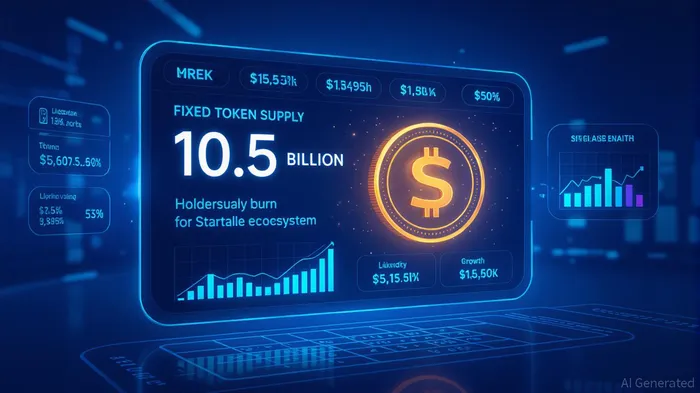 Complementing the burn rate is the Burndrop mechanism, which allows ASTR holders to voluntarily burn tokens in exchange for future Startale ecosystem tokens as reported by Bitget. This not only accelerates deflationary pressure but also fosters conviction among long-term holders, incentivizing them to lock up liquidity and support the ecosystem's growth. According to Bitget, this dual-layered strategy enhances scarcity while aligning token holder interests with the platform's long-term success.
Institutional Adoption: Compliance, ESG, and Risk Mitigation
Institutional investors have historically been hesitant to enter DeFi due to regulatory uncertainties and smart contract risks. Astar 2.0 addresses these concerns through asynchronous backing and comprehensive compliance protocols according to Bitget. Asynchronous backing ensures that assets are secured across chains without relying on real-time validation, reducing exposure to smart contract vulnerabilities. This is particularly critical for institutions managing large portfolios, where even minor exploits can lead to catastrophic losses.
Moreover, Astar's tokenomics align with Environmental, Social, and Governance (ESG) priorities, emphasizing transparency, fixed supply, and sustainability according to Bitget. For instance, the platform's fixed supply and burn mechanisms inherently reduce energy consumption compared to proof-of-work models, appealing to ESG-focused investors. As traditional financial institutions increasingly integrate ESG criteria into their investment frameworks, Astar's alignment with these standards could unlock access to a broader pool of capital.
Cross-Chain Interoperability: Bridging Web2 and Web3
Astar 2.0's Plaza platform is a cornerstone of its cross-chain strategy, enabling seamless asset transfers across EthereumETH--, Binance Smart Chain (BSC), and PolkadotDOT-- ecosystems according to Bitget. This interoperability is vital for DeFi's next phase of growth, as it allows users to leverage liquidity across multiple chains without sacrificing security or efficiency. For institutions, Plaza reduces friction in asset management, enabling them to deploy capital across diverse DeFi protocols while maintaining a unified risk framework.
The platform's hybrid architecture also supports Astar zkEVM, a zero-knowledge Ethereum Virtual Machine that enhances scalability. According to Bitget, by 2025 Astar claims to process up to 150,000 transactions per second (TPS), with plans to scale to 300,000 TPS by 2026. Such throughput is essential for enterprise applications, where high transaction volumes and low latency are non-negotiable. This scalability, combined with cross-chain capabilities, positions Astar as a viable infrastructure layer for institutional-grade DeFi solutions.
Governance Evolution: Decentralization and Community Engagement
Astar 2.0's governance model is transitioning from a foundation-led structure to community-driven councils by mid-2026 according to Bitget. This shift reflects a growing demand for decentralized decision-making in blockchain projects, particularly among institutional stakeholders who prioritize transparency and accountability. By empowering token holders to vote on protocol upgrades and treasury allocations, Astar fosters a more inclusive ecosystem, reducing the risk of centralization and regulatory scrutiny.
Staking Optimizations: Incentivizing Builders and Stakers
The Astar 2.0 update also restructures its staking incentives to better align with the needs of developers and liquidity providers. The tokenomics model dynamically adjusts emissions, increasing allocations to dApp builders while reducing shares for collators and the treasury according to Astar Network. This reallocation encourages sustainable development, ensuring that the ecosystem remains innovation-driven rather than inflation-dependent. Additionally, the Startale App-a unified interface for ASTR management-streamlines user interactions, making it easier for both retail and institutional participants to engage with the platform according to Bitget.
Conclusion: Astar 2.0's Strategic Position in the DeFi Ecosystem
Astar 2.0's combination of deflationary tokenomics, institutional-grade compliance, cross-chain interoperability, and governance innovation creates a compelling value proposition. By addressing key pain points-such as volatility, regulatory risk, and scalability-the platform is well-positioned to attract both DeFi-native users and traditional investors. As the DeFi market matures, projects that prioritize institutional adoption and long-term sustainability will likely dominate. Astar's strategic updates suggest it is not merely competing in the DeFi space but redefining its boundaries.
For investors, the implications are clear: Astar 2.0 represents a rare convergence of technological innovation and market readiness, offering a robust foundation for capturing value in the next phase of DeFi's evolution.

Blending traditional trading wisdom with cutting-edge cryptocurrency insights.
Latest Articles
Stay ahead of the market.
Get curated U.S. market news, insights and key dates delivered to your inbox.






Comments
No comments yet