
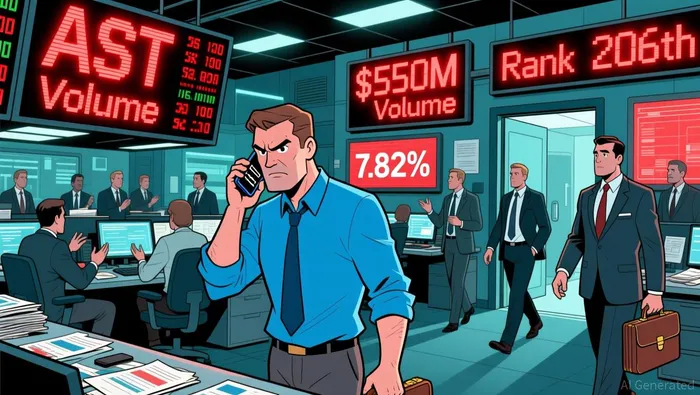
AST SpaceMobile Tumbles 7.82% Amid Mixed Institutional Buying and Insider Selling as $550M Volume Ranks 206th in U.S. Markets
 Aime Summary
Market Snapshot
On November 17, 2025, , marking its worst one-day performance in recent months. . The drop followed mixed institutional activity, with PAX Financial Group and other firms increasing holdings, while key insiders sold significant portions of their equity stakes. , .
Key Drivers
Institutional Accumulation and Insider Selling
Institutional investors have been net buyers of ASTSASTS-- in recent quarters, . Bank of New York Mellon Corp increased its stake by 28.2%, . However, insider transactions painted a contrasting picture. , . These sales, disclosed via SEC filings, signaled potential skepticism among top executives about near-term value realization.
Q3 Earnings Disappointment
ASTS reported Q3 earnings on November 10, . , , . Analysts attributed the shortfall to the company’s pre-commercial status, as it generates revenue primarily through government contracts and early-stage partnerships with Verizon, AT&T, and Vodafone. , but these partnerships have yet to translate into consistent profitability.
Broader Market and Sector Dynamics
ASTS’s decline occurred amid a broader correction in the communication services sector, which had surged 25% year-to-date. While heavyweights like Alphabet and Meta drove gains, ASTS faced pressure from downgrades. , . , as it reacted to macroeconomic concerns and skepticism about the viability of its space-based cellular network. , .
Technological and Regulatory Outlook
ASTS’s long-term prospects hinge on its planned 2026 launch of a satellite-based cellular network, a key differentiator in the direct-to-device (D2D) market. Recent industry reports emphasized D2D’s potential to bridge connectivity gaps, with the U.S. . However, the company’s reliance on 3GPP Release 19 standards (expected in 2027) and spectrum licensing delays posed near-term risks. , with bulls betting on technological disruption and bears focusing on current financial metrics.
Analyst Disagreement and Strategic Uncertainty
. While Roth Capital and William Blair maintained “buy” ratings, UBS and Barclays downgraded ASTS to “neutral” or “underweight.” The lack of consensus reflected uncertainty about the company’s ability to monetize partnerships and scale operations. Additionally, the absence of ASTS in “top analyst” buy lists, as noted by MarketBeat, .
Conclusion
ASTS’s recent performance underscores the challenges of balancing speculative optimism with operational realities. While institutional buying and technological milestones suggest long-term potential, insider selling, earnings misses, and analyst skepticism have triggered near-term volatility. , which remains in its early commercialization phase. For now, investors remain divided between its transformative vision and current financial hurdles.

Stay ahead of the market.
Get curated U.S. market news, insights and key dates delivered to your inbox.
AInvest
PRO
AInvest
PRO



Comments
No comments yet