
AST SpaceMobile's Strategic Breakthrough in Satellite Connectivity: A Game Changer for Space Commerce
 Aime Summary
The satellite broadband market is no longer a niche curiosity but a cornerstone of global infrastructure. As terrestrial networks struggle to bridge the digital divide, space-based connectivity has emerged as a scalable solution, with the market projected to grow from $14.56 billion in 2025 to $33.44 billion by 2030 at a 18.1% compound annual growth rate. At the forefront of this transformation is AST SpaceMobileASTS--, a company whose recent operational and funding milestones signal a pivotal inflection pointIPCX-- for space-based telecom investment.
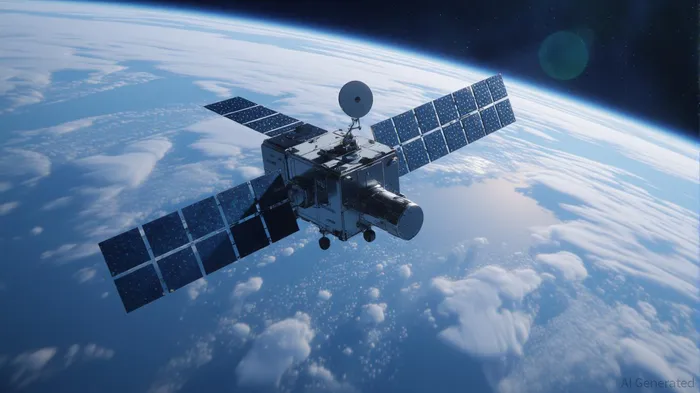
AST SpaceMobile's core innovation lies in its direct-to-cell (DTC) technology, which bypasses traditional terrestrial infrastructure to deliver broadband directly to unmodified smartphones. This approach leverages 3GPP-compliant cellular standards, enabling peak data speeds of up to 120 Mbps via S-Band and L-Band spectrum. By securing 60 MHz of global S-Band and 45 MHz of L-Band in the U.S. and Canada, AST has positioned itself to address the $1.5 trillion global connectivity gapGAP--, particularly in rural and underserved regions.
The company's operational progress is equally compelling. As of June 2025, AST has launched six satellites—five operational and one test unit—and is on track to deploy 45–60 satellites by 2026. This aggressive rollout is supported by a $1.5 billion balance sheet, including a $575 million convertible notes offering and a $550 million delayed draw term loan. These funds are not merely for satellite construction but for a vertically integrated manufacturing process, with 95% of components produced in-house. By 2025, AST plans to expand its manufacturing footprint to 400,000 square feet, further reducing costs and accelerating deployment.
Strategic partnerships amplify AST's scalability. The company has secured agreements with over 50 mobile network operators, representing nearly 3 billion subscribers. Notably, its joint venture with Vodafone—SatCo—has already attracted interest from 21 EU member states, while its collaboration with India's Vi targets one of the world's largest telecom markets. These alliances are not theoretical; they are operationalizing AST's vision by integrating its space-based network into existing telecom ecosystems.
Financially, AST's path to monetization is emerging. While the company reported a $99.4 million net loss in Q2 2025, it anticipates $50–75 million in revenue for the second half of the year from government and commercial contracts. This includes a $43 million contract with the U.S. Space Development Agency and tactical connectivity demonstrations with U.S. military forces. Analysts have set a price target range of $26–$60 for ASTSASTS-- stock, reflecting confidence in its ability to transition from a capital-intensive build phase to a revenue-generating entity.
The broader market dynamics further validate AST's potential. The high-speed (>100 Mbps) segment of satellite broadband is expected to grow fastest, driven by demand for data-intensive applications like video streaming and remote work. AST's DTC model is uniquely suited to this demand, as it avoids the hardware costs associated with traditional satellite internet (e.g., specialized terminals). This not only lowers barriers to adoption but also aligns with global initiatives to expand digital inclusion, such as the U.S. Rural Digital Opportunity Fund and India's National Digital Communications Policy.
Critics may argue that AST operates in a crowded field, with competitors like SpaceX's Starlink dominating headlines. However, Starlink's focus on fixed broadband and mobility services leaves a critical gap in cellular connectivity—a niche AST is filling with its 3GPP-compliant approach. Moreover, AST's partnerships with telecom giants like VodafoneVOD-- and VerizonVZ-- create a hybrid ecosystem that complements existing networks rather than competing with them.
For investors, the key question is whether AST can scale its technology and partnerships into sustainable profitability. The company's recent milestones—funding, satellite deployment, and commercial contracts—suggest a clear path. Its quasi-governmental funding discussions with the U.S. Export-Import Bank and the International Finance Corporation (IFC) also hint at non-dilutive capital, which is critical for a capital-intensive industry.
In conclusion, AST SpaceMobile represents a compelling long-term investment thesis. Its DTC technology, strategic spectrum access, and robust partnerships position it to capture a significant share of the $1.2 trillion satellite communications market by 2030. While risks remain—operating losses, regulatory hurdles, and technological execution challenges—the company's financial discipline, vertical integration, and alignment with global connectivity trends make it a standout in the space commerce sector. For those seeking exposure to the next frontier of infrastructure, AST's recent inflection point warrants serious consideration.

Delivering real-time insights and analysis on emerging financial trends and market movements.
Latest Articles
Stay ahead of the market.
Get curated U.S. market news, insights and key dates delivered to your inbox.
AInvest
PRO
AInvest
PRO



Comments
No comments yet