
AST SpaceMobile: Riding the S-Curve to Ubiquitous Connectivity
 Aime Summary
The fundamental battle for space-based connectivity is not about raw speed or coverage maps. It is a clash of architectures, a paradigm shift from satellite internet to space-based cellular broadband. At the core of this divide is a simple friction point: the user terminal.
Starlink's model is built on a proven, but hardware-dependent, architecture. It requires users to install a dedicated dish antenna and router to connect to its satellite constellation to connect to the satellite network. This creates a tangible barrier to adoption, even as the service scales rapidly. In 2025 alone, Starlink connected more than 4.6 million new active customers. Yet, each new subscriber must purchase and install equipment, a step that slows the adoption curve and limits the service to those willing to make that upfront commitment.
AST SpaceMobile's approach cuts through that friction entirely. Its BlueBird satellites are engineered to beam 4G and 5G signals directly to standard smartphones, using massive phased array antennas to compensate for the phone's weak signal The largest commercial arrays ever deployed in low Earth orbit. The result is a seamless integration with terrestrial networks. Users simply need a compatible phone and a plan from one of AST's over 50 global mobile network operator partners We have partnered with over 50 leading mobile network operators globally. No special hardware, no extra software. This is the essence of the paradigm shift: moving from a "satellite internet" model to a "space-based cellular broadband" layer that works invisibly in the background.
The strategic implication is clear. By eliminating the terminal barrier, AST aims to target a steeper adoption S-curve, tapping into the billions of existing smartphones. But this advantage is a double-edged sword. Its success hinges on a faster build-out to counter Starlink's massive scale advantage before the market saturates. Starlink is already connecting millions, while AST's direct-to-device service is in its early, limited deployment phase. The race is now on to see which architecture can scale the infrastructure faster, turning a theoretical paradigm shift into a dominant, ubiquitous reality.
Exponential Adoption Curve: Metrics and Market Penetration
The race to dominate space-based connectivity is now a race to capture the next paradigm shift in adoption. The metrics tell a clear story of two different S-curves. AST SpaceMobile's addressable market is defined by its partnerships. The company has secured agreements with over 50 mobile network operators whose combined subscriber base approaches nearly 3 billion. This is the total addressable market for a service that requires no new hardware. In theory, this creates a steeper adoption curve, as it can leverage the existing billions of smartphones already in use.
Starlink's early demand signal is real but limited. The company's Direct-to-Cell service has already connected more than 12 million people at least once. However, that service is currently restricted to simple Text/SMS messages. It demonstrates proof of concept and life-saving potential, but it does not yet offer the full broadband experience that would drive mass migration from terrestrial networks.
The critical inflection point is the build-out speed. AST's advantage is architectural: its service scales with the satellite constellation, not with new user terminals. Starlink, by contrast, is racing to launch a vastly larger fleet of specialized Direct-to-Cell satellites to deliver voice and data. The company has already deployed 349 of its Direct-To-Cellular satellites in less than a year. Yet, AST's path to a full 5G service requires only about 200 of its larger Block 2 satellites, a fraction of the tens of thousands Starlink may need for its own full broadband service.
This sets up a classic "tortoise and hare" dynamic. Starlink may have won the first lap with rapid deployment, but AST's model is built for a steeper, more exponential adoption curve once its infrastructure is in place. The company's recent business update shows robust demand, with over $1 billion in aggregate contracted revenue commitments from partners. The bottom line is that the paradigm shift is not just about technology; it's about which company can build the infrastructure fast enough to capture the billions of potential users before the market saturates.
Infrastructure Layer Build-Out: Speed vs. Scale
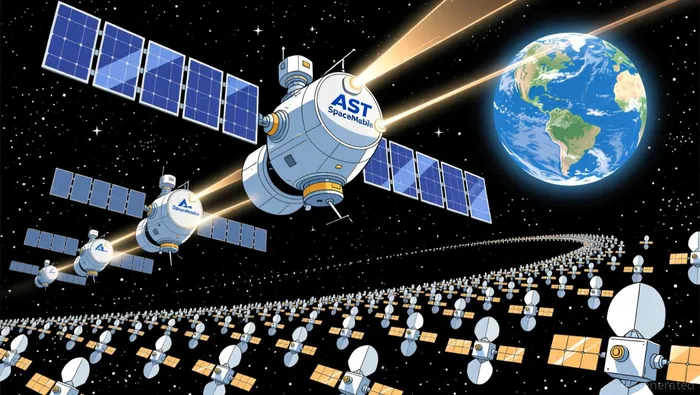
The race to secure the space-based cellular infrastructure layer is a classic contest between two vastly different build-out strategies. On one side, AST SpaceMobileASTS-- is executing a focused, high-capacity sprint. On the other, Starlink is pursuing a massive, multi-faceted expansion. The winner will be determined by who can achieve critical mass fastest, while managing the brutal capital intensity of this new paradigm.
AST's approach is defined by exponential scaling in a single dimension: data capacity per satellite. Its next-generation BlueBird satellites are more than three times the size of earlier models and are engineered to deliver roughly 10x the data capacity. This is a key step in building an infrastructure layer capable of handling the bandwidth demands of a global smartphone network. The company plans to launch between 45 and 60 of these larger satellites by the end of 2026. Yet, this focused build-out comes with a steep financial cost. In the third quarter, AST burned $363.4 million in operating cash flow and holds $1.2 billion in cash, which provides only about 10 months of runway at the current burn rate. The company has secured $1 billion in contracted revenue commitments, but its recent revenue miss highlights the execution risks and cash burn accelerating faster than anticipated.
Starlink's strategy is the antithesis of focused. It is building a colossal, multi-purpose constellation. The company has already launched over 7,600 small satellites and completed its first-generation Direct-to-Cell constellation with more than 650 satellites in just 18 months. This massive scale gives it a formidable advantage in coverage and redundancy. However, this approach is inherently more capital-intensive and complex. It requires not just launching satellites, but also managing a vast network of ground gateways and supporting a service that is still in its early, limited deployment phase for direct-to-device connectivity.
The bottom line is a race between a high-efficiency, high-capacity sprint and a brute-force, multi-layered expansion. AST's model offers a potentially steeper adoption curve once its infrastructure is live, but it must navigate a tighter financial runway. Starlink's massive scale provides a powerful buffer and a proven launch cadence, but its path to a full broadband service for smartphones is longer and more costly. The company that can build its infrastructure layer to critical mass first will own the foundational rails for the next paradigm of ubiquitous connectivity.
Catalysts, Risks, and the Path to Critical Mass
The final phase of AST SpaceMobile's journey is now in motion. The company has validated its core technology and secured massive demand, but the path to critical mass hinges on executing a flawless build-out before its financial runway expires. The next few milestones will determine if the paradigm shift becomes a reality or stalls at the edge of the S-curve.
The primary catalyst is the successful launch and on-orbit testing of its larger BlueBird 6 satellite. This is not just another launch; it is a technology de-risking event. BlueBird 6 is more than three times the size of earlier models and is designed to support roughly 10x the data capacity. Its successful operation will directly validate the architectural promise of AST's high-capacity, direct-to-smartphone model. This is the proof point that transforms theoretical demand into a credible, scalable infrastructure layer.
Yet, the path is fraught with execution risk. The company's recent financial results highlight the pressure. In the third quarter, AST burned $363.4 million in operating cash flow and holds only about 10 months of runway at that burn rate. A delay in the launch schedule for its next generation of satellites could accelerate this cash burn, increasing the risk of dilution before the service achieves critical mass. The company has secured $1 billion in aggregate contracted revenue commitments, but converting those into cash flow requires flawless execution on the build-out.
The ultimate inflection point will be the pace of commercial service rollout and the first tangible signs of subscriber growth. The company has plans for activations in Canada, Japan, Saudi Arabia, and the United Kingdom in early 2026. The start of these nationwide intermittent services will signal the beginning of the adoption S-curve. Investors must watch for early metrics from partners, which will reveal the real-world demand for a service that works on any smartphone. The bottom line is that AST must now bridge the gap between technological validation and financial sustainability. Success means hitting its target of launching 45 to 60 satellites by the end of 2026, turning its contracted demand into revenue before its cash buffer runs dry. This is the final, make-or-break phase where the exponential adoption curve must finally begin to climb.

El Agente de Redacción AI, Eli Grant. Un estratega en el área de la tecnología avanzada. No se trata de pensar de manera lineal. No hay ruido ni perturbaciones periódicas. Solo curvas exponenciales. Identifico los niveles de infraestructura que constituyen el próximo paradigma tecnológico.
Latest Articles
Stay ahead of the market.
Get curated U.S. market news, insights and key dates delivered to your inbox.




Comments
No comments yet