
AST SpaceMobile's Q3 2025: Contradictions Emerge on Launch Schedules, Spectrum Use, and Regulatory Strategy
 Aime Summary
Date of Call: November 10, 2025
Financials Results
- Revenue: GAAP revenue of $14.7M in Q3 2025; reiterating 2025 revenue expectation of $50M–$75M (second half 2025 expected $50M–$75M)
Guidance:
- Revenue for 2025 expected to be $50M–$75M; Q4 revenue to be driven by gateway sales, U.S. government milestones and initial commercial service.
- Q4 2025 adjusted operating expenses (excluding COGS) expected in the mid-$60M range.
- Q4 2025 CapEx expected $275M–$325M; average capital cost per Block 2 BlueBird satellite expected $21M–$23M.
- Manufacturing cadence to reach ~6 satellites/month by end of 2025; 5 launches expected by end of Q1 2026; target 45–60 satellites by end of 2026 and financed for 100+ satellites.
Business Commentary:
- Satellite Launches and Manufacturing Progress:
- AST SpaceMobile plans to conduct
5launches by the end of Q1 2026, with40satellites equivalent of micron BlueBirds completed by early 2026, bringing them to BlueBird 46. The progress is driven by the company's vertically integrated manufacturing, which enables it to accelerate and improve its manufacturing process to achieve a monthly production cadence of
6satellites.Commercial Partnerships and Revenue Commitments:
- AST SpaceMobile secured over
$1 billionin aggregate contracted revenue commitments from commercial partners, marking a significant milestone. This was achieved through strategic agreements with over
50MNO partners covering nearly3 billionsubscribers globally, demonstrating the partners' trust in AST's technology and business model.Spectrum Strategy and Access:
- The company holds rights to access over
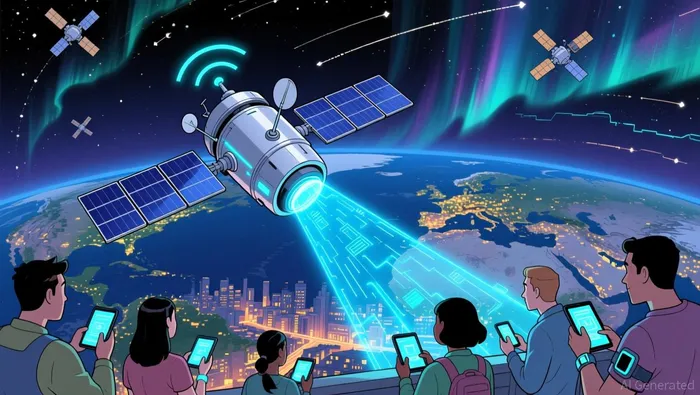
80megahertz of spectrum in the United States alone, including45megahertz of AST SpaceMobile's licensed MSS lower, mid-band spectrum, and60megahertz of S-Band spectrum priority rights. - This comprehensive spectrum strategy provides AST with a competitive advantage by enabling more lanes for direct-to-device cellular broadband services, faster speeds, and greater capacity.
- Financial Fortification and Growth:
- AST SpaceMobile's cash, cash equivalents, and restricted cash reached over
$3.2 billionpro forma, after completing a convertible notes offering and ATM facility transactions. - The financial strengthening allows AST to manufacture and launch a constellation exceeding
100satellites, supporting long-term strategic expansion and service activation in key markets.
Sentiment Analysis:
Overall Tone: Positive
- Management highlighted "standout progress" and "secured over $1 billion in total contracted revenue commitments," reported pro forma cash and liquidity of over $3.2 billion, cited a manufacturing cadence of 6 satellites/month and GAAP revenue ramp (Q3 GAAP revenue $14.7M), and reiterated funded plans for 45–60 satellites (and funding for 100+).
Q&A:
- Question from Michael Funk (BofA Securities): What is your appetite or thoughts on future prepayment deals with customers now that you are fully funded, and any detail on the broad terms of those prepayment contracts?
Response: Strategy unchanged—company will continue to pursue prepayments and long‑term revenue commitments as part of its customer-focused commercialization approach; prepayments are used for near‑term commercial services and are evaluated case by case.
- Question from Michael Crawford (B. Riley Securities): When manufacturing L‑band satellites, do you intend to put L‑band and S‑band on the same satellites, and will you await formal FCC approval before starting to make those? Also, regarding stc, do you anticipate launching commercial services in 4Q'26 and are there additional service revenue commitments beyond the $175M prepayment?
Response: Satellites are designed to support all 3GPP frequencies including L and S bands (interleaved across low and mid bands); plan to begin mid‑band launches by end of next year; stc includes a prepayment plus long‑term revenue commitment and the disclosed >$1B are firm commercial commitments.
- Question from Bryan Kraft (Deutsche Bank): Given summer/fall delays, how confident are you in 5 launches by end of Q1 and 60 satellites by end of next year; are the EU SatCo satellites incremental to the plan; any comment on IRIS2 involvement?
Response: Management expressed strong confidence—manufacturing target of 40 satellites by early 2026 and a 6/month cadence supports the 5 launches by end of Q1; the EU/Vodafone satellites are part of the existing plan (not incremental); no comment on specific IRIS2 awards, but they say AST is well positioned.
- Question from Colin Canfield (Cantor Fitzgerald): How do you think about aperture for additional bands and leveraging economies of scale beyond S, L and C bands?
Response: Platform is software‑defined and designed to tune across ~1,000 MHz of 3GPP low/mid bands; incremental spectrum activation is largely software‑driven with marginal incremental cost as long as bands are 3GPP and supported in devices.
- Question from Christopher Schoell (UBS): Will you remain opportunistic on capital raises into 2026 and is Q4 OpEx/CapEx a good run‑rate for next year or will launch‑payment timing cause volatility?
Response: Company will remain opportunistic but is now commercially focused on prepayments and commitments; OpEx is expected to be relatively stable while CapEx will fluctuate with launch payment timing.
- Question from Louie Dipalma (William Blair): Is ~25 satellites a fair estimate to support beta trials in North America in 2026; are the $1B commitments tied to the definitive agreements and what are typical durations?
Response: Yes—~25 satellites is a reasonable proxy to support beta/intermittent nationwide trials; the $1B figure is primarily from definitive commercial agreements (durations vary across short, medium, and long terms including multi‑year agreements such as 10 years).
- Question from Greg Pendy (Clear Street): Given MNO momentum, how many large MNO opportunities remain and how do you view the total opportunity set?
Response: Management said broad demand exists—most global operators (excluding certain restricted markets like China and Russia) are interested and are candidates for partnerships, leaving a large pipeline of opportunities.
- Question from Christopher Quilty (Quilty Space): Is the $1 billion in commitments all commercial or a mix with government?
Response: All of the disclosed $1 billion in contracted revenue commitments are commercial.
- Question from Christopher Quilty (Quilty Space): Regarding launch vehicles and cadence, which vehicles will you use and how many BlueBirds per launch do you expect?
Response: Immediate launches will use SpaceX, New Glenn and other partners; expect roughly 3–4 BlueBirds per Falcon 9 and up to ~8 on New Glenn.
- Question from Scott Searle (ROTH Capital Partners): Having funding for ~100 satellites, will you continue to build to 90–100+ into 2027 and how should we think about incremental spectrum costs internationally?
Response: Company will expand the constellation opportunistically as commercial/government economics support it; incremental spectrum costs are minimal for 3GPP bands since the platform is software‑defined and designed to combine operator and AST spectrum.
Contradiction Point 1
Launch Cadence and Timing
It involves differing statements about the timeline and criticality of launches, which directly impact the company's progress towards commercialization and revenue generation.
Will AST SpaceMobile structure future launch events for retail shareholders, considering the upcoming launches at Cape Canaveral? - Kevin (Oregon)
2025Q3: We're excited about the launch campaign, which includes multiple launches soon. We plan to invite retail investors to the launches, and we're happy to have them participate in our journey. - Scott Wisniewski(President & Chief Strategy Officer)
Is FM1 launch timing critical to other launches? What would a nationwide intermittent service look like? - Bryan D. Kraft (Deutsche Bank)
2025Q2: FM1 launch is not critical for other launches. Intermittent service will start with non-continuous service in key markets, transitioning to continuous service as more satellites are launched. - Abel Avellan(Founder, Chairman & CEO)
Contradiction Point 2
Spectrum Usage and Capabilities
It involves differing statements about the company's capabilities in spectrum usage and its impact on service provision, which are critical for understanding the technology's value and market potential.
How is the technology combining Verizon and AT&T's spectrum? - Louie DiPalma (William Blair)
2025Q3: Our technology can combine AT&T and Verizon spectrum effectively, enabling nationwide service. - Abel Avellan(Founder, Chairman & CEO)
How does tech teaming impact spectrum acquisition and pricing dynamics? - Colin Michael Canfield (Cantor Fitzgerald)
2025Q2: Our technology enables reuse of satellite and terrestrial spectrum, converting satellite spectrum into more valuable assets. This creates opportunities for spectrum reuse and sharing between applications. - Abel Avellan(Founder, Chairman & CEO)
Contradiction Point 3
Regulatory Approval and Strategy
It involves differing statements about regulatory approval timelines and strategies, which are critical for understanding the company's path to commercialization and market access.
How will AST SpaceMobile plan future launch events for retail shareholders with upcoming launches at Cape Canaveral next month? - Kevin (Oregon)
2025Q3: We're excited about the launch campaign, which includes multiple launches soon. We plan to invite retail investors to the launches, and we're happy to have them participate in our journey. - Scott Wisniewski(President & Chief Strategy Officer)
Is the S-Band spectrum licensed nationally, or on a state-by-state basis? - Caleb Henry (Quilty Space)
2025Q2: The S-Band spectrum is a project that starts now, with a plan to seek country-by-country access in combination with low band spectrum. - Abel Avellan(Founder, Chairman & CEO)
Contradiction Point 4
Launch Costs and Strategy
It involves differing statements about the company's strategy and costs related to satellite launches, which are crucial for the company's growth and operations.
Is there any risk with the compressed timeline? - Bryan Kraft (Deutsche Bank)
2025Q3: Our manufacturing and launch schedule is on track. We're confident in achieving 5 launches by Q1 2026, with launches starting this month. - Abel Avellan(CEO)
Can you explain the higher launch costs, their relation to satellite configurations or pricing factors, and how AST plans to transfer these costs to other launch suppliers through liquidated damages? - Colin Canfield (Cantor Fitzgerald)
2025Q1: The demand signals we're receiving are to get service to market as fast as possible. Pull forward on launch was needed due to harder-to-get launch opportunities. Tariff impacts are a dynamic situation. We are prioritizing speed to launch. Andy: We are optimizing payload and future launch options, but the primary focus is on getting satellites built and launched quickly. - Scott Wisniewski(CSO) and Andrew Johnson(CFO)
Contradiction Point 5
Launch Schedule and Satellite Production
It involves changes in the company's stated launch schedule and satellite production timeline, which are critical for milestone achievements and investor expectations.
Should 4Q OpEx and CapEx be viewed as a sustainable run rate for next year? - Christopher Schoell (UBS Investment Bank)
2025Q3: We are going to start launching Block 2 satellites in the upcoming weeks. We expect to have 5 launches by the end of Q1 2026. - Abel Avellan(CEO)
How should we assess OpEx trends and growth for the year? - Colin Canfield (Cantor)
2024Q4: We expect to launch 4 satellites in the first half of this year and 4 more in the second half, assuming our launch partners hold to their schedule. - Abel Avellan(CEO)

Discover what executives don't want to reveal in conference calls
Latest Articles
Stay ahead of the market.
Get curated U.S. market news, insights and key dates delivered to your inbox.
AInvest
PRO
AInvest
PRO



Comments
No comments yet