
AST SpaceMobile: A High-Stakes Bet on Disrupting Space-Based Mobile Communications
 Aime Summary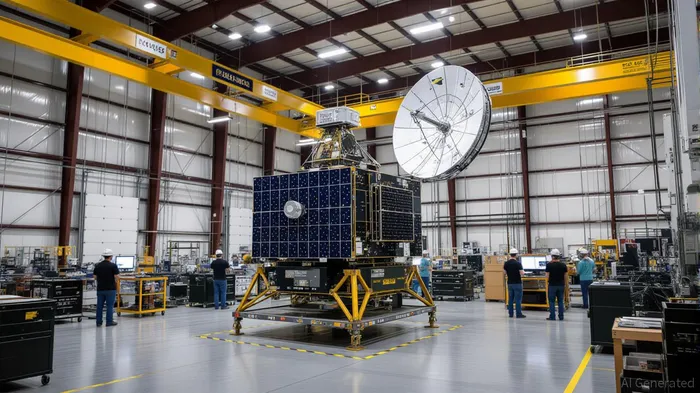
The race to dominate the space-based mobile communications sector is heating up, with AST SpaceMobileASTS-- (NASDAQ: ASTS) and SpaceX's Starlink emerging as two of the most ambitious contenders. While Starlink has leveraged its first-mover advantage and massive satellite constellation to capture headlines, AST SpaceMobile is carving out a niche with its direct-to-device (D2D) cellular broadband technology. But can this smaller, capital-intensive player sustain its momentum amid rising competition and financial demands?
AST SpaceMobile's Satellite Deployment: A Precision Play
AST SpaceMobile's strategy hinges on a lean but highly specialized satellite constellation. As of Q2 2025, the company has six satellites in orbit—five operational and one test satellite—and plans to launch 45–60 satellites by 2026. This is a fraction of Starlink's 8,000+ satellites, but AST's focus on D2D technology allows it to bypass the need for ground-based infrastructure, enabling unmodified smartphones to connect directly to its satellites. This approach targets a critical gap in the market: seamless connectivity for mobile users in remote or underserved regions.
The company's Block 2 BlueBird satellites, designed for higher throughput and lower latency, are central to its scalability. With 95% vertical integration in manufacturing and a production footprint expanding to 400,000 square feet by year-end, AST is prioritizing cost efficiency and rapid deployment. The first Block 2 satellite, FM1, is slated for shipment in August 2025, with launches planned every 1–2 months. This cadence is critical to achieving “continuous service” in the U.S., U.K., Japan, and Canada by mid-2026.
Financials: A Balancing Act Between Growth and Profitability
AST SpaceMobile's Q2 2025 financials reveal a company betting big on the future. Revenue was a modest $1.15 million, far below the $5.56 million forecast, while capital expenditures spiked to $322.8 million—a 160% increase from Q1. Operating expenses also rose to $51.7 million, reflecting the costs of scaling production and securing launch contracts. However, the company's balance sheet remains robust, with $1.5 billion in liquidity after a $575 million convertible notes offering and a $100 million equipment financing deal.
The key question is whether AST can monetize its infrastructure before cash reserves dwindle. The company projects 2025 revenue of $50–75 million, driven by government contracts (e.g., $43 million from the U.S. Space Development Agency) and commercial partnerships with 50+ mobile network operators (MNOs), including VodafoneVOD-- and VerizonVZ--. These partnerships are crucial: AST's SatCo joint venture with Vodafone aims to serve 21 EU member states, while its LTE/5G integration with NokiaNOK-- positions it to piggyback on terrestrial networks for hybrid coverage.
Competing with Starlink: Differentiation or Disruption?
SpaceX's Starlink dominates the satellite broadband market with 5 million+ subscribers and $11.8 billion in projected 2025 revenue. Its military-focused Starshield variant and partnerships with T-MobileTMUS-- and international carriers underscore its versatility. However, Starlink's reliance on proprietary user terminals and its focus on fixed broadband leave gaps in the mobile communications space—gaps AST is actively targeting.
AST's D2D technology, demonstrated by the first smartphone-to-satellite call using AT&T's network in April 2025, is a game-changer. Unlike Starlink, which competes directly with terrestrial providers, AST collaborates with them, offering wholesale connectivity to MNOs. This strategy reduces regulatory friction and accelerates adoption, as MNOs can integrate AST's services into their existing networks without overhauling infrastructure.
Moreover, AST's spectrum strategy—securing 60 MHz of global S-Band rights and 45 MHz of L-Band access—positions it to deliver peak speeds of 120 Mbps per cell, rivaling terrestrial 4G/5G networks. While Starlink's scale is unmatched, AST's agility and focus on mobile-first use cases (e.g., defense, maritime, and rural connectivity) could carve out a sustainable niche.
Risks and Rewards: A High-Volatility Proposition
AST SpaceMobile's beta of 2.32 reflects its stock's volatility, with a 116% gain in the past year but a 1.52% drop following Q2 earnings. The company's path to profitability is fraught with risks:
- Capital Demands: $323 million in Q2 CapEx and $225–300 million in Q3 projections highlight the need for continuous funding. While AST has secured $550 million in quasi-governmental loans and $1.5 billion in cash, rising interest rates or regulatory delays could strain liquidity.
- Competition: Starlink's $15.5 billion revenue target for 2025 and its first-mover advantage in global coverage pose a long-term threat.
- Regulatory Hurdles: FCC approvals for L-Band spectrum and international spectrum rights are critical to AST's expansion.
However, AST's partnerships with tech giants (Google, AT&T) and its $1.5 billion liquidity buffer provide a strong runway. The company's focus on government contracts—eight U.S. military deals and a $43 million Space Development Agency contract—also offers a stable revenue stream.
Investment Thesis: A Long-Term Bet on Disruption
AST SpaceMobile is not a short-term play. Its business model requires patience: the company is investing heavily in infrastructure with the expectation of monetizing it over the next 3–5 years. For investors willing to tolerate high volatility, AST offers a compelling mix of innovation and strategic positioning.
Key Metrics to Watch:
- Satellite Deployment Cadence: Can AST maintain its 1–2 launches per month? Delays could erode momentum.
- Government Revenue Growth: The U.S. military segment contributed $14.9 million in gateway bookings in Q2. Scaling this could offset commercial revenue shortfalls.
- Spectrum Access: Regulatory approvals for L-Band and S-Band will determine AST's ability to deliver high-speed services.
Conclusion: A Niche Player in a Crowded Market
AST SpaceMobile's viability as a long-term disruptor depends on its ability to execute its D2D vision and secure partnerships that differentiate it from Starlink. While the company's financials and capital demands are daunting, its strategic focus on mobile-first connectivity and government contracts positions it to capture a meaningful share of the $22.6 billion satellite broadband market by 2030. For investors with a high-risk tolerance and a belief in the future of space-based mobile networks, AST offers a high-reward opportunity—but one that requires careful monitoring of its deployment timelines and capital efficiency.
Final Verdict: AST SpaceMobile is a speculative but potentially transformative investment. Buy for the long term, but set stop-loss thresholds to mitigate downside risks.

Delivering real-time insights and analysis on emerging financial trends and market movements.
Latest Articles
Stay ahead of the market.
Get curated U.S. market news, insights and key dates delivered to your inbox.




Comments
No comments yet