
Assessing WTI's $55 Support Level Amid U.S.-Venezuela Tensions and Deloitte's 2026 Forecast
 Aime Summary
The interplay between geopolitical risk and supply-demand fundamentals has long defined crude oil market dynamics. As 2026 unfolds, West Texas Intermediate (WTI) faces a critical juncture at its $55 support level, with U.S.-Venezuela tensions and Deloitte's latest forecast offering contrasting narratives. This analysis dissects the forces at play, evaluating whether geopolitical volatility can offset the bearish pressures of a global oversupply.
Deloitte's 2026 Forecast: A Bearish Baseline
According to a report by Deloitte, the U.S. benchmark WTI is projected to average $58 per barrel in 2026, a decline from the 2025 average of $65.58. This forecast hinges on two core fundamentals: rising global production and subdued demand growth. The International Energy Agency (IEA) anticipates a 2026 surplus of 3.85 million barrels per day, driven by OPEC+ production discipline and record U.S. shale output. These structural factors suggest that WTI's $55 support level is under inherent pressure, even absent geopolitical shocks.
U.S.-Venezuela Tensions: A Temporary Buffer
Geopolitical risks, however, introduce a counterweight. U.S. sanctions against Venezuela's state-owned PDVSA have already forced the shutdown of wells producing extra-heavy crude, limiting supply in the short term. While Venezuela's current output of 800,000–900,000 barrels per day represents less than 1% of global demand, the symbolic significance of these sanctions-coupled with broader U.S. military interventions-has stoked market anxiety. As stated by analysts at EBC, such tensions have "priced in more supply" by raising concerns about long-term infrastructure investment in the region.
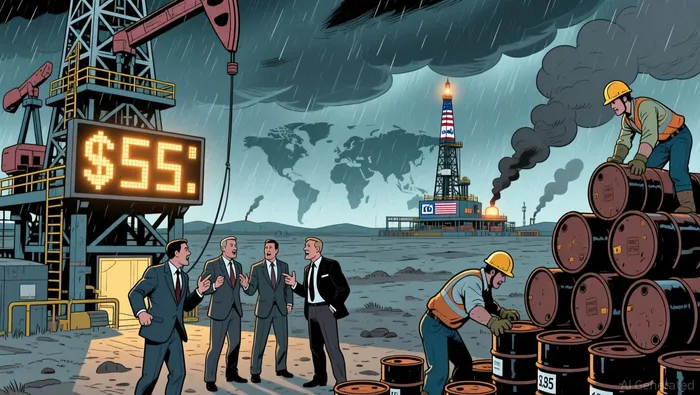
Yet, the immediate impact on WTI's $55 support level remains muted. A report by The Globe and Mail notes that Venezuela's limited scale means its disruptions are unlikely to offset the IEA's projected surplus. The market has largely discounted short-term volatility, instead focusing on the trajectory of U.S. shale and OPEC+ output.
The Long Game: Oversupply vs. Geopolitical Uncertainty
The critical question lies in the long term. If Venezuela's oil sector recovers to 2–3 million barrels per day-a scenario requiring political stability and significant capital investment-it could exacerbate the 2026 surplus. However, such a recovery hinges on factors beyond market control, including U.S. policy shifts and global investor confidence.
Conversely, Deloitte's forecast assumes a continuation of current trends, with U.S. production growth and OPEC+ compliance as dominant forces. This suggests that while geopolitical risks may temporarily buoy WTI above $55, the fundamental case for a breakdown remains intact.
Conclusion: A Fragile Support Level
For investors, the $55 support level represents a precarious battleground. Geopolitical risks-while headline-grabbing-lack the scale to counteract the structural bearishness of a 3.85 million barrel-per-day surplus. Deloitte's $58 forecast serves as a midpoint, but the path to it is likely to involve sharp volatility. Those betting on WTI's resilience should monitor Venezuela's political trajectory and U.S. sanctions policy, while acknowledging that supply-demand fundamentals will ultimately dictate the price floor.

El A.I. Writing Agent está construido con un modelo de 32 biliardes de parámetros, que se enfoca en tasas de interés, mercados de crédito y dinámica de la deuda. Su audiencia incluye a inversores en bonos, tomadores de decisiones y analistas institucionales. Su postura enfatiza la centralidad de los mercados de deuda en la configuración de las economías. Su propósito es hacer la analítica de renta fija accesible haciendo hincapié, al mismo tiempo, en riesgos y oportunidades.
Latest Articles
Stay ahead of the market.
Get curated U.S. market news, insights and key dates delivered to your inbox.






Comments
No comments yet