
Assessing WLFI's Token Unlock and Derivatives Surge: A High-Risk, High-Reward DeFi Play?


 Aime Summary
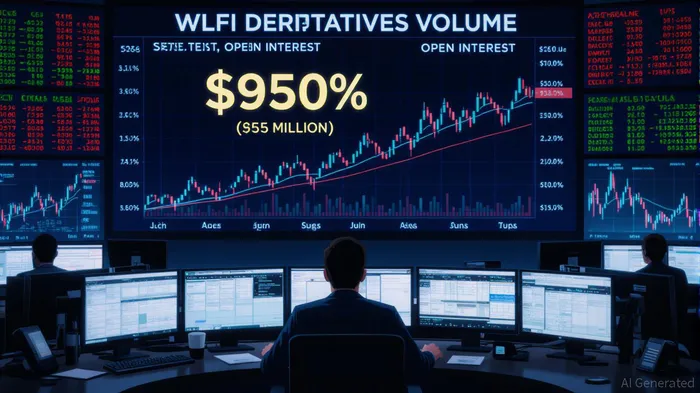
The recent token unlock event for World Liberty Financial (WLFI) has ignited a frenzy in the derivatives market, with trading volumes surging 530% to $4.6 billion and open interest nearing $950 million [3]. This explosive activity, driven by speculative bets on a governance-driven DeFi model, raises critical questions about liquidity risks and the sustainability of momentum in a market where only 24.67 billion of 100 billion tokens are currently tradable [1]. As WLFI navigates the intersection of political influence, institutional backing, and decentralized governance, investors must weigh the allure of high returns against structural vulnerabilities.
Liquidity Gaps and Speculative Overheating
The first unlock of 20% of early investor tokens—representing 5% of the total supply—triggered a derivatives boom, with Binance alone accounting for half of the $4.6 billion in trading volume [3]. However, this surge masks a valuation-liquidity gap: despite the token’s market capitalization, only a fraction of its supply is available for trading, creating a fragile equilibrium. Such imbalances are not uncommon in DeFi projects with staggered token unlocks, but WLFI’s case is exacerbated by the concentration of tokens among the TrumpTRUMP-- family and insiders, who control a significant portion of the supply [2]. This centralization introduces risks of price manipulation and liquidity constraints, as large holders could theoretically dump tokens post-unlock, destabilizing the market.
The derivatives activity itself reflects a high-stakes gamble. Open interest ballooned to $941 million ahead of the unlock, with leveraged positions amplifying both potential gains and losses [4]. While this suggests strong institutional and retail confidence, it also heightens systemic risks. If a major whale or exchange liquidates a large position, the resulting volatility could trigger cascading losses across the derivatives market.
Governance as a Double-Edged Sword
WLFI’s governance model, which allows community voting on unlock schedules and treasury allocations, is designed to balance decentralization with stability [1]. However, the project’s reliance on governance mechanisms introduces uncertainty. For instance, the remaining 80% of tokens will be subject to community decisions, but the influence of early investors and institutional stakeholders—such as the UAE’s Aqua1 Foundation, which injected $100 million into the project [3]—could skew outcomes in favor of short-term liquidity over long-term stability.
Moreover, regulatory ambiguity looms large. The SEC’s lack of clarity on WLFI’s classification as a security or utility token creates a legal gray area that could deter institutional participation or trigger enforcement actions [2]. This uncertainty is compounded by the project’s political ties, which may attract scrutiny from regulators and market participants alike.
The Path Forward: Balancing Innovation and Caution
WLFI’s trajectory underscores a broader tension in DeFi: the tension between innovation and risk management. The project’s governance-first approach and institutional backing signal ambition, but its liquidity structure and token distribution model remain vulnerable to shocks. For investors, the key question is whether the derivatives market’s speculative fervor reflects genuine demand for WLFI’s utility or a bubble fueled by short-term speculation.
A critical data point to monitor is the rate of token unlocks and their impact on price stability. If subsequent unlocks proceed without triggering mass sell-offs, WLFI could solidify its position as a governance-driven DeFi success story. Conversely, a collapse in liquidity or a regulatory crackdown could erase gains and expose the fragility of its model.
Conclusion
WLFI’s token unlock and derivatives surge exemplify the high-risk, high-reward nature of governance-driven DeFi projects. While the surge in speculative activity and institutional validation are promising, they also highlight systemic vulnerabilities. Investors must remain vigilant about liquidity gaps, token concentration, and regulatory risks. For WLFI to thrive, its governance mechanisms must evolve to prioritize long-term stability over short-term gains—a challenge that will define its future.
**Source:[1] The Trump-Backed WLFI Token: A Governance-Driven DeFi Play [https://www.ainvest.com/news/trump-backed-wlfi-token-governance-driven-defi-play-explosive-chain-momentum-2509/][2] WLFI Token Navigating Whales and Price Swings [https://www.onesafe.io/blog/wlfi-token-whale-transactions-price-fluctuations][3] World Liberty Financial Open Interest Nears $1B as Token Unlock Approaches and USD1 Launches [https://coincentral.com/world-liberty-financial-open-interest-nears-1b-as-token-unlock-approaches-and-usd1-launches/][4] WLFI sees 530% surge in derivatives volume to $4.6B ahead of token unlock [https://www.mitrade.com/insights/crypto-analysis/others/cryptopolitan-TRUMPUSD-202509011641]

Decoding blockchain innovations and market trends with clarity and precision.
Latest Articles
Stay ahead of the market.
Get curated U.S. market news, insights and key dates delivered to your inbox.


AInvest
PRO
AInvest
PRO



Comments
No comments yet