
Assessing Winter Weather Risk in Aviation Infrastructure


 Aime Summary
The Financial Toll of Winter Disruptions
The DSM incident exemplifies how localized weather events can ripple across the industry. While DSM's cargo revenue had already declined , the November closure exacerbated operational challenges. Airlines, meanwhile, faced systemic pressures from a confluence of factors: government-mandated flight reductions during the 2025 shutdown, staffing shortages at air traffic control facilities, and winter storms. These combined to cancel over 9,000 domestic flights and generate daily economic losses .
Smaller airports reliant on federal subsidies, , are particularly vulnerable. A lapse in EAS funding during the government shutdown could force flight cancellations, further straining regional economies dependent on air connectivity. For investors, these interdependencies signal a sector where operational resilience is not just a logistical concern but a financial imperative.
Market Response: De-Icing Innovation and Predictive Logistics
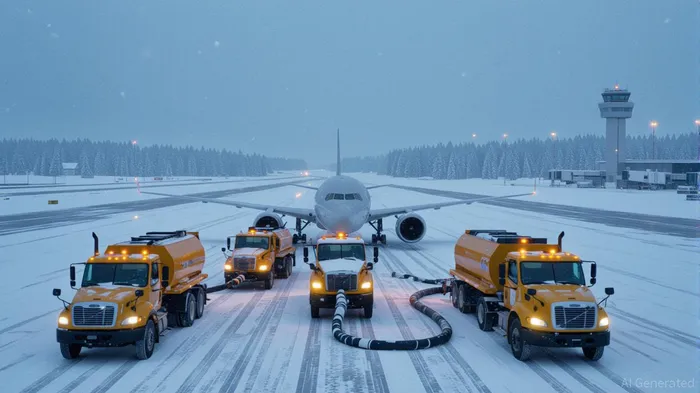
The growing frequency and severity of winter disruptions are accelerating demand for advanced de-icing solutions and predictive logistics systems. The global aircraft de-icing market, , , driven by sustainability mandates, regulatory compliance, and technological innovation. Key players are redefining the industry:
- Oshkosh Aerotech, now part of Oshkosh Corporation following its $800 million acquisition from JBT Corporation in 2023, is expanding its footprint in electrified de-icing trucks and automated systems. The integration of AeroTech into Oshkosh's Vocational segment positions the company to capitalize .
- , a leader in eco-friendly de-icing fluids, , . The company's Q3 2025 financials reflect , underscoring its profitability amid market volatility.
- , a supply chain resilience platform, is addressing predictive logistics gaps in aviation. While specific aviation contracts remain unpublicized, its broader work in mitigating supply chain risks-such as factory fires and extreme weather disruptions-positions it as a critical player in an industry increasingly reliant on real-time risk analytics.
Investment Risks and Opportunities
For investors, the aviation sector's exposure to winter weather risks is twofold: direct operational losses from disruptions and indirect costs from infrastructure modernization. Airports with outdated de-icing infrastructure or limited access to predictive analytics face higher vulnerability. Conversely, companies pioneering sustainable, tech-driven solutions-such as infrared de-icing systems or glycol recycling technologies-are well-positioned to benefit from regulatory tailwinds and rising demand. The financial performance of firms like Clariant and Oshkosh highlights this duality.
The financial performance of firms like Clariant and Oshkosh highlights this duality. Clariant's Q3 2025 results, , demonstrate how sustainability-driven innovation can yield profitability even in challenging markets. Similarly, Oshkosh's strategic acquisition of AeroTech reflects a calculated bet on a sector poised for growth.
Conclusion
As climate-driven disruptions become the new normal, aviation stakeholders must prioritize resilience. For investors, this means scrutinizing companies' preparedness for winter weather risks while identifying those leveraging innovation to turn challenges into opportunities. The DSM incident and broader 2025 disruptions serve as a stark reminder: in an era of climate uncertainty, the airports and airlines that thrive will be those that invest not just in infrastructure, but in foresight.

Delivering real-time insights and analysis on emerging financial trends and market movements.
Latest Articles
Stay ahead of the market.
Get curated U.S. market news, insights and key dates delivered to your inbox.






Comments
No comments yet