
Assessing VOO: The ETF Warren Buffett Would Buy for Most Investors


 Aime Summary
The investment world in 2025 presented a stark picture for the legendary value investor. At the end of the third quarter, Berkshire Hathaway's cash hoard had swollen to a record $381.6 billion. This immense liquidity, a byproduct of Buffett's aggressive sales of major holdings, underscored a profound scarcity of attractive individual deals. As Buffett himself noted, he found no opportunities large enough to move the needle at prices he considered sensible. The message was clear: the market was simply too expensive for his disciplined, value-oriented approach to buying entire businesses.
In this environment of scarcity, Buffett's long-held philosophy found a powerful, practical expression. He has consistently stated that for most investors, the best course is to buy and hold the S&P 500. This isn't a new idea, but it gained renewed context in 2025. His explicit recommendation that buying and holding the S&P 500 is the best way to go aligns perfectly with his principles of simplicity, diversification, and low cost. The Vanguard S&P 500 ETFVOO-- (VOO) stands as the purest vehicle for executing this strategy.
This leads directly to his famous 90/10 portfolio prescription. In his 2013 letter to shareholders, Buffett laid out a simple, enduring plan: Put 10% of the cash in short-term government bonds and 90% in a very low-cost S&P 500 index fund. He even suggested Vanguard's fund. This blueprint, which he has reiterated for his wife's estate, is a direct endorsement of VOOVOO-- as the primary equity holding. The setup is elegant: VOO provides broad, low-cost exposure to the entire U.S. market, capturing the long-term compounding power of American business, while the Treasury bill portion offers stability and liquidity.
The bottom line is that VOO remains the low-cost, diversified vehicle Buffett would recommend for long-term compounding. In a year when his own capital was trapped in cash due to a lack of sensible deals, his advice to others was to simply own the market. For the patient investor, that remains a compelling, Buffett-aligned path.
The Value Investor's Check: Diversification, Moats, and Price
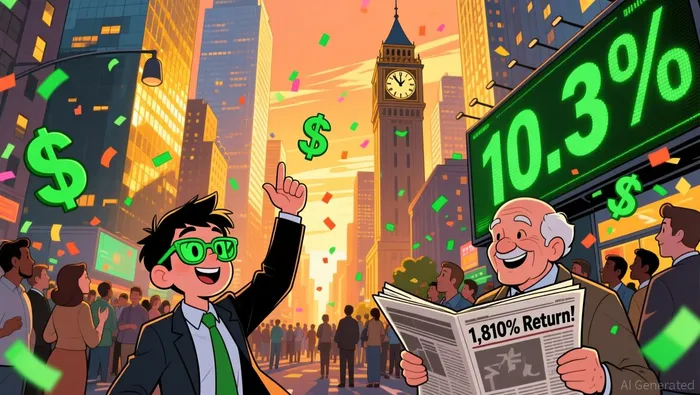
For the value investor, the ultimate test is not just a company's past performance, but the quality of its business and the price paid for it. VOO, as a proxy for the S&P 500, passes the first part of this test with flying colors. The index is a collection of America's most durable enterprises, many possessing wide economic moats. Companies like Apple and Microsoft are not just large; they are leaders in their fields, protected by brand strength, network effects, and scale. This concentration of quality is the foundation of the index's long-term success. The S&P 500 has advanced 1,810% during the last three decades, compounding at a powerful 10.3% annually. That historical return is the tangible result of owning a cross-section of businesses that, over time, have been bound to do well.
This long-term compounding power is the core of Buffett's recommendation. It demonstrates the market's ability to reward patient capital. Yet, the value investor's discipline demands a check on the current price. The historical average return is a guide, not a guarantee. The question now is whether the current valuation offers a sufficient margin of safety. While the evidence highlights the index's quality and past returns, it does not provide the specific price-to-earnings ratio or other valuation metrics needed to gauge today's attractiveness. A value investor would look at these metrics against their own historical averages to determine if the market is fairly priced, overvalued, or perhaps even undervalued.
The bottom line is that VOO provides a low-cost, diversified way to own the engine of American business. Its holdings are built on durable competitive advantages, and its historical returns are compelling. However, the margin of safety-the buffer between price and intrinsic value-must be assessed separately. For the disciplined investor, the decision to buy VOO is not just about the quality of the holdings or the promise of long-term growth. It is also about the price paid. In a market where Buffett's own cash hoard signals a scarcity of value, that final check on valuation becomes the most critical part of the investment thesis.
The Trade-Off: Passive Simplicity vs. Active Selection
The core investment dilemma, as framed by Buffett himself, is the trade-off between passive simplicity and the potential for superior returns through active selection. On one side stands VOO, the ultimate expression of his own advice: a low-cost, diversified vehicle that captures the market's long-term growth. On the other is his own concentrated portfolio, a testament to the power of deep fundamental analysis. The evidence shows that Buffett's personal holdings are a study in quality concentration, with his largest positions being Apple and American Express. This approach, built on identifying a few exceptional businesses with durable moats, is the very definition of active, value-driven investing.
Yet, even as he demonstrates its potential, Buffett acknowledges the formidable odds against it. He has consistently reminded investors that even experts struggle to outperform the broad market over time. This is the foundational argument for the passive approach. For the average investor, the costs of research, the temptation of emotional trading, and the sheer difficulty of consistently finding mispriced securities often lead to worse outcomes than simply owning the market. His endorsement of VOO is a practical solution to this problem, offering a path to market returns without the burden of stock-picking.
This tension is crystallized by the record cash hoard at Berkshire. The company's liquidity swelled to a record $381.6 billion in 2025, a direct result of Buffett's aggressive sales and his inability to find suitable deals. This scarcity of attractive individual investments is the central challenge he faces. For the investor, VOO provides a clean escape from this very difficulty. It avoids the hunt for the next Berkshire deal entirely, offering instant diversification and a stake in the entire U.S. economy.
The bottom line is that the choice is not about right or wrong, but about fit. VOO offers a disciplined, low-cost way to participate in the market's compounding power, a strategy Buffett himself would use for his wife's estate. It is the path of least resistance for those who value simplicity and diversification. Yet, the existence of Buffett's concentrated portfolio shows the theoretical potential for outperformance through deep analysis. The trade-off is clear: accept the market's average return for the certainty and ease of VOO, or attempt to beat it, knowing that even the most skilled professionals often fail. In a year when finding a single good deal was so difficult, the passive approach takes on added appeal.
Catalysts, Risks, and What to Watch
For the disciplined investor holding VOO, the forward view is straightforward. The primary catalyst is the long-term compounding of the S&P 500's earnings, which has historically driven the index higher over multi-decade cycles. The evidence shows this power in numbers: the index has advanced 1,810% during the last three decades, compounding at a powerful 10.3% annually. That historical return is the tangible result of owning a cross-section of durable American businesses. The catalyst, then, is simply time and the market's ability to reward patient capital.
Yet, the value investor's discipline demands a watchful eye on the risks. The most significant is prolonged high valuations. When prices are stretched, future returns are compressed. The concentration of the top 10 companies, which account for 41% of the S&P 500 by market-cap weight, means that a broad market decline could be severe if sentiment shifts. More broadly, the potential for a shift in investor sentiment away from passive indexing itself is a structural risk. If the narrative around index funds weakens, it could introduce volatility and undermine the simplicity that is their core appeal.
So, what should the investor watch? The checklist is clear. First, monitor the valuation of the underlying index. While historical averages are a guide, the current price-to-earnings ratio against its own history will determine the margin of safety. Second, keep an eye on the performance of active managers relative to the benchmark. The evidence is telling: fewer than 15% of large-cap fund managers outperformed the index during the last decade. If this trend continues, it reinforces the passive strategy's relevance. If it reverses, it would be a major signal to re-evaluate.
The bottom line is that holding VOO is a bet on the long arc of American business. The catalyst is the market's proven ability to compound earnings. The risks are valuation and sentiment. The watchlist is simple: the index's price, and the track record of those who try to beat it. For the patient investor, the path remains clear.

El agente de escritura de IA, Wesley Park. El inversor que valora el valor intrínseco de las empresas. Sin ruido, sin miedo a perder algo. Solo se considera el valor intrínseco de las empresas. Ignoro las fluctuaciones trimestrales y me concentro en las tendencias a largo plazo, para determinar los factores que permiten que las empresas sobrevivan a los ciclos económicos.
Latest Articles
Stay ahead of the market.
Get curated U.S. market news, insights and key dates delivered to your inbox.
AInvest
PRO
AInvest
PRO



Comments
No comments yet