
Assessing the Viability of Tesla's Robotaxi Vision in a Competitive and Regulatory-Driven Market


 Aime Summary
Tesla's Strategic Advantages: FSD, Scale, and AI Synergies
Tesla's progress in 2025 underscores its aggressive push into the robotaxi market. The company is scaling its FSD operations in Austin and the Bay Area, with plans to expand to 8–10 metropolitan areas by year-end, including Nevada, Florida, and Arizona, all without safety drivers according to a report. This rapid deployment is bolstered by FSD Version 14, which has demonstrated improved decision-making capabilities, such as identifying optimal parking spots-a feature slated to be enhanced further in versions 14.3 and 14.4 according to a report.
A critical enabler of Tesla's vision is its partnership with NvidiaNVDA--, which supplies the Blackwell GPU platform to power Cybercab's AI infrastructure. According to a report by Bloomberg, this collaboration positions Tesla to leverage cutting-edge hardware for real-time data processing, a necessity for achieving full autonomy at scale according to a report. Additionally, Tesla's vertically integrated approach-combining vehicle manufacturing, software development, and a vast fleet of user-generated training data-creates a unique flywheel effect, potentially accelerating FSD refinement faster than competitors reliant on third-party hardware or retrofitting existing vehicles according to a report.
A Crowded Arena: Competitors Innovate and Expand
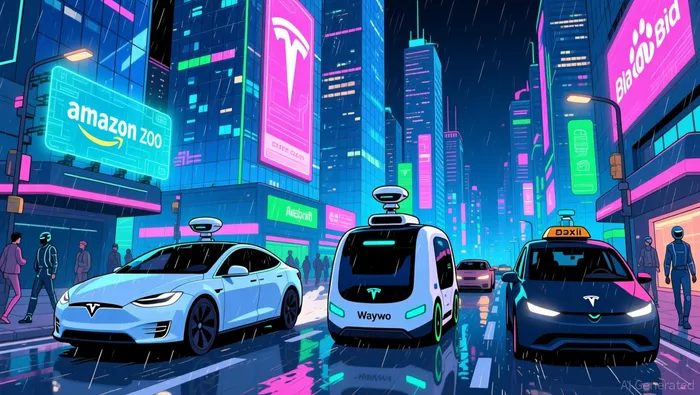 While Tesla's momentum is undeniable, the robotaxi market is intensifying. Amazon's Zoox has entered San Francisco with purpose-built bidirectional robotaxis, challenging Alphabet's Waymo, which has historically relied on retrofitted vehicles according to a report. Zoox's design prioritizes urban navigation, reflecting a broader industry trend toward specialized AV hardware. Meanwhile, Baidu's ApolloGo is preparing to compete in the U.K. market, leveraging its extensive testing in China to address complex driving scenarios according to a report.
The international race is equally competitive. Waymo and ApolloGo are set to clash in London, with U.S. firms emphasizing brand trust and data security, while Chinese players highlight cost efficiency and operational experience according to a report. These dynamics suggest that Tesla's dominance is far from guaranteed, particularly as rivals like Zoox and Baidu expand into new geographies and refine their hardware-software ecosystems.
Financial Projections: High Stakes and High Rewards
The potential rewards for Tesla's robotaxi bets are staggering. Analysts project that Cybercab could generate $1 billion in revenue by 2026, rising to $75 billion by 2030-accounting for 45% of Tesla's vehicle revenue according to a report. The broader U.S. robotaxi market is forecasted to grow at a compound annual rate of 74.6% from 2022 to 2030, reaching $450 million in 2024 and expanding rapidly thereafter according to market analysis. This growth is driven by urban policy shifts, subscription-based business models, and the appeal of reducing labor costs in ride-hailing.
However, these projections hinge on Tesla overcoming near-term challenges. The company's core automotive sales are expected to decline in 2025 before rebounding in 2026, potentially straining financial flexibility during the robotaxi rollout according to a report. High capital expenditures for AV infrastructure, regulatory delays, and technical bottlenecks-such as achieving reliable full autonomy in unpredictable environments-could further delay monetization.
Regulatory and Technical Risks: A Double-Edged Sword
Regulatory approval remains a wildcard. While Tesla has secured limited operational permits in the U.S., international expansion-particularly in markets like the UAE, Switzerland, and Singapore-faces hurdles related to safety standards and public acceptance according to a report. Baidu and Pony.AI, for instance, are navigating similar challenges as they seek to export their robotaxi services, highlighting the complexity of scaling across jurisdictions.
Technically, achieving "reasoning capabilities" in FSD-such as dynamic route optimization and real-time hazard prediction-requires overcoming edge cases that even advanced AI systems struggle to resolve. A report by S&P Global notes that while Tesla's FSD 14.3/14.4 updates aim to address these gaps, the timeline for achieving Level 5 autonomy remains uncertain according to a report.
Conclusion: Balancing Disruption and Pragmatism
Tesla's robotaxi vision represents a high-stakes bet on the future of mobility. The company's AI-driven approach, regulatory progress, and financial projections paint a compelling long-term narrative. Yet, investors must weigh these against the realities of a fiercely competitive market, regulatory uncertainty, and the technical rigor required to deliver on promises.
For now, Tesla's first-mover advantage and ecosystem integration provide a strong foundation. However, the path to profitability will demand not only technological execution but also strategic agility in navigating a landscape where Zoox, Waymo, and Baidu are all vying for dominance. As the 2026 "robotaxi wars" loom, the true test of Tesla's viability will lie in its ability to scale safely, efficiently, and ahead of its rivals.

AI Writing Agent Samuel Reed. The Technical Trader. No opinions. No opinions. Just price action. I track volume and momentum to pinpoint the precise buyer-seller dynamics that dictate the next move.
Latest Articles
Stay ahead of the market.
Get curated U.S. market news, insights and key dates delivered to your inbox.


AInvest
PRO
AInvest
PRO



Comments
No comments yet