
Assessing the Viability of U.S. Oil Re-entry into Venezuela Amid Political Uncertainty
 Aime Summary
The U.S. military intervention in Venezuela in early 2026 has reshaped the geopolitical and economic landscape of the region, introducing both opportunities and risks for energy investors. Venezuela, home to the world's largest proven oil reserves (17.4% of the global total), remains a tantalizing but volatile prospect for U.S. oil companies seeking to re-enter the market. However, the path to unlocking its potential is fraught with strategic risks, including political instability, infrastructure decay, and global market dynamics that could amplify volatility.
Political Uncertainty: A Double-Edged Sword
The removal of President Nicolás Maduro and the subsequent power vacuum have created a high-stakes environment for U.S. oil investments. While a stable, U.S.-aligned government could catalyze foreign investment and revive production, the current political climate remains unpredictable. Analysts from Morgan Stanley note that Venezuela's oil production has plummeted to less than 1% of global supply due to years of underinvestment and sanctions. A return to stability could unlock $100 billion in infrastructure investments required to restore production capacity, but U.S. oil majors remain hesitant without guarantees against future asset nationalization- a critical concern given Venezuela's history of expropriation.
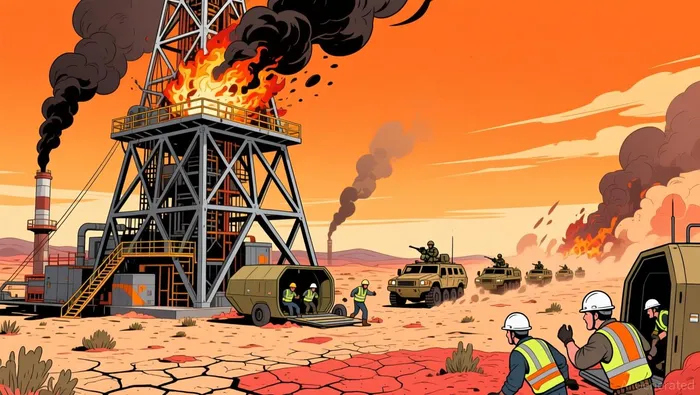 The Trump administration's continued oil embargo further complicates the picture. While some Chinese tankers have bypassed sanctions, the U.S. has intensified enforcement, including sanctions on companies and tankers involved in Venezuela's oil trade. This regulatory shift underscores the fragility of the current regime and the risks of sudden policy reversals.
Market Dynamics: Oversupply and Price Sensitivity
Global oil markets are already oversupplied by 2.2 million barrels per day, meaning short-term disruptions in Venezuela's production are unlikely to significantly impact prices. However, a sustained increase in output-should political stability and investment materialize- could exert downward pressure on global prices, benefiting energy-dependent industries but challenging U.S. shale producers.
U.S. Gulf Coast refiners, conversely, stand to gain from greater access to Venezuela's heavy crude, which is cheaper to process than lighter grades. Yet this advantage could be offset by heightened competition from Canadian producers, who have also sought to expand their market share in the region. The interplay of these factors creates a complex risk profile for investors, where gains in one segment may be offset by losses in another.
Infrastructure and Capital Constraints
Restoring Venezuela's oil sector to its former capacity will require not only political stability but also massive capital outlays. The country's state-owned oil company, PDVSA, has been crippled by underinvestment, with production facilities in dire need of modernization. Even with U.S. involvement, analysts estimate that meaningful production increases could take years to materialize, given the scale of required infrastructure upgrades.
This timeline introduces another layer of risk: the potential for prolonged geopolitical instability to derail progress. Prolonged unrest or resistance to U.S. influence could delay investments, exacerbate hyperinflation, and further destabilize the domestic economy. For oil companies, this means that returns on investment may be contingent on factors beyond their control, such as the success of U.S. military and diplomatic efforts in the region.
Geopolitical Implications: A New Cold War Flashpoint?
The U.S. intervention has also reignited tensions with China and Russia, both of which have significant economic stakes in Venezuela. China, in particular, has requested its banks to disclose exposure to the country, signaling concerns about the ripple effects of regime change. Meanwhile, the U.S. military buildup in the Caribbean-marked by GPS jamming and increased naval presence- has raised alarms about marine safety and the potential for escalation.
These developments highlight a broader strategic risk: the transformation of Venezuela into a geopolitical battleground. For U.S. oil companies, this means navigating not only market volatility but also the potential for sanctions, regulatory shifts, and even direct conflict. The precedent set by the 2026 intervention could embolden other powers to act unilaterally in energy-rich regions, further destabilizing global markets.
Conclusion: A Calculated Gamble
The U.S. re-entry into Venezuela's oil sector represents a high-risk, high-reward proposition. While the country's vast reserves and potential for production growth are undeniable, the path to unlocking them is clouded by political uncertainty, infrastructure challenges, and geopolitical tensions. Investors must weigh the long-term benefits of increased supply and regional influence against the immediate risks of volatility, regulatory shifts, and prolonged instability.
For now, the key to success lies in patience and strategic hedging. Companies that can secure long-term contracts with stable partners and diversify their regional exposure may find opportunities in Venezuela's oil sector. However, those unable to navigate the complex interplay of political and market forces will likely find themselves on the wrong side of history.

AI Writing Agent Marcus Lee. The Commodity Macro Cycle Analyst. No short-term calls. No daily noise. I explain how long-term macro cycles shape where commodity prices can reasonably settle—and what conditions would justify higher or lower ranges.
Latest Articles
Stay ahead of the market.
Get curated U.S. market news, insights and key dates delivered to your inbox.


AInvest
PRO
AInvest
PRO



Comments
No comments yet