
Assessing the Viability and Market Impact of the First Dogecoin ETF: A New Era for Institutional and Retail Investors?


 Aime Summary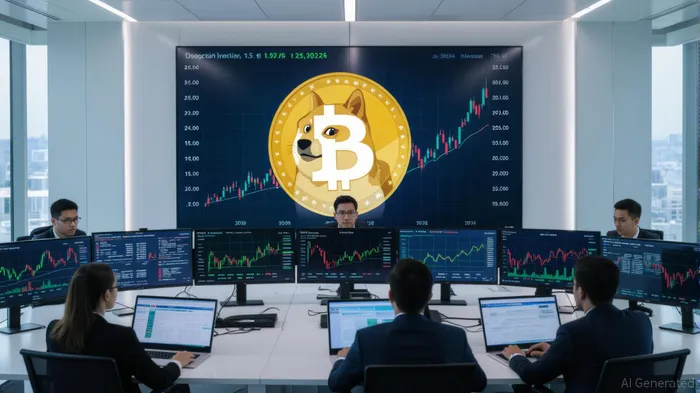
The launch of the Rex-Osprey DOGEDOGE-- ETF (ticker: DOJE) in late 2025 marks a watershed moment for DogecoinDOGE-- (DOGE), transforming it from a meme-driven cryptocurrency into a regulated asset class. This development, coupled with the U.S. Securities and Exchange Commission's (SEC) reclassification of DOGE as a commodity, has ignited a frenzy of institutional and retail interest. But does this signal a sustainable shift, or is the market merely chasing a speculative bubble?
Regulatory Clarity: A Double-Edged Sword
The SEC's 2025 reclassification of Dogecoin as a commodity—a move mirrored by the approval of a physically backed Dogecoin ETP on the SIX Swiss Exchange—has reduced legal ambiguity and enabled banks to offer custody services. This regulatory shift, combined with the DOJE ETF's structure under the Investment Company Act of 1940, has legitimized DOGE as an investable asset. However, the SEC's delayed decision on Bitwise's spot DOGE ETF application (pushed to November 2025) underscores lingering concerns about liquidity and volatility.
For investors, this regulatory pendulum swing highlights both opportunity and risk. While the DOJE ETF provides a regulated on-ramp for institutional capital, the absence of a clear framework for future ETFs (e.g., spot-based or physically backed) introduces uncertainty.
Institutional Adoption: From Hype to Infrastructure
The Billion-DOGE Treasury initiative, backed by firms like Bit OriginBTOG-- and CleanCore SolutionsZONE--, has injected $675 million into Dogecoin holdings, signaling a strategic pivot toward treasury diversification. Institutions are increasingly viewing DOGE not as a speculative novelty but as a tool for payment system integration and cross-border transactions.
Meanwhile, Binance's accumulation of 820 million DOGE tokens—part of a $306 million whale transfer—suggests institutional liquidity is building ahead of the ETF launch. This contrasts with 2021, when DOGE's price surged 8,000% on social media hype alone. Today, the asset is supported by infrastructure, albeit still lacking the utility of Ethereum's smart contracts or Bitcoin's store-of-value narrative.
Market Impact: Volatility and Volume
Dogecoin's price has surged 131.9% year-to-date, trading at $0.2409 as of September 2025. The DOJE ETF's impending launch has driven trading volume to $3.67 billion in a single day, with institutional wallets accumulating 2 billion DOGE in August alone. Technical indicators like the MACD (0.004732) and BollingerBINI-- Bands suggest a potential breakout above $0.25, though a breakdown below $0.21 could trigger a retest of 2024 lows.
Retail investors, however, remain a wildcard. Social media sentiment—driven by Elon Musk's rumored X Money platform and Tesla's acceptance of DOGE for select products—fuels FOMO-driven buying. Yet, as Nate Geraci of The ETF Store notes, “The DOJE ETF democratizes access, but it also amplifies retail speculation.”
Sentiment vs. Fundamentals: A Delicate Balance
Dogecoin's value proposition remains weak compared to peers. Unlike Bitcoin's macroeconomic hedge or Ethereum's DeFi ecosystem, DOGE lacks intrinsic utility. Its price is tethered to sentiment: celebrity endorsements, RedditRDDT-- threads, and meme culture. Analysts like Javon Marks predict an 860% surge to $2.28, but such forecasts rely on historical patterns rather than fundamentals.
For institutional investors, this presents a dilemma. While DOGE's volatility offers alpha opportunities, its lack of utility and reliance on social media sentiment make it a high-risk bet. Retail investors, meanwhile, face the same risks without the tools to manage them.
Strategic Opportunities and Risks
The DOJE ETF opens new avenues for portfolio diversification, particularly for investors seeking exposure to crypto without direct custody. However, its success hinges on sustained institutional confidence and regulatory stability. Key risks include:
- Regulatory Reversals: A shift in SEC policy could derail ETF approvals.
- Market Corrections: A post-ETF launch selloff is plausible, as seen in 2021–2022.
- Competition: Projects like Remittix (RTX), with real-world use cases, may siphon capital from DOGE.
Investors should treat DOGE as a speculative satellite holding, not a core asset. Position sizing should reflect its volatility—8.7% standard deviation in 2025 versus Bitcoin's 2.1%. Diversification across asset classes and strict stop-loss strategies are essential.
Conclusion: A New Chapter, But Not a Guarantee
The DOGE ETF represents a significant step toward mainstream adoption, but its long-term viability depends on more than regulatory nods or institutional inflows. For DOGE to transcend its meme origins, it must demonstrate utility beyond social media hype. Until then, the DOJE ETF will remain a high-risk, high-reward proposition—a mirror of the crypto market's enduring paradox: innovation and speculation in equal measure.
For now, the market is betting on the former. Whether that bet pays off will depend on whether Dogecoin can evolve from a digital joke into a digital asset.

Combina la sabiduría tradicional en el comercio con las perspectivas más avanzadas sobre las criptomonedas.
Latest Articles
Stay ahead of the market.
Get curated U.S. market news, insights and key dates delivered to your inbox.


AInvest
PRO
AInvest
PRO



Comments
No comments yet