
Assessing the Untapped Potential of XRP ETFs: Why Demand May Surpass Expectations in 2025


 Aime Summary
The cryptocurrency market in 2025 is no longer a speculative playground for retail traders. It has evolved into a sophisticated ecosystem where institutional adoption and regulatory clarity are reshaping demand dynamics. At the center of this transformation lies XRPXRPI--, a digital asset poised to capitalize on a confluence of institutional partnerships, regulatory momentum, and infrastructure advancements. As the U.S. Securities and Exchange Commission (SEC) inches closer to approving XRP ETFs, the question is no longer if demand will surge—but how much it will exceed expectations.
Regulatory Momentum: A Tipping Point for XRP ETFs
The SEC's delayed decision on XRP ETF applications—now set for October 24, 2025—has created a vacuum of uncertainty. Yet, this delay is not a rejection. Instead, it reflects the agency's cautious but deliberate engagement with a market that has already demonstrated its legitimacy. Seven major ETF providers, including Grayscale, Bitwise, and WisdomTreeWT--, have submitted revised applications, incorporating cash redemption mechanisms and structural adjustments to align with SEC feedback. These amendments signal that the regulatory process is not deadlocked but actively progressing.
The August 2025 court ruling dismissing the Ripple-SEC lawsuit as a “non-security” in secondary markets has further cleared the path. This legal clarity has removed a critical barrier, allowing institutions to treat XRP as a utility-driven asset rather than a speculative liability. With BitcoinBTC-- and EthereumETH-- ETFs having set a precedent for regulatory approval in 2024, the SEC now faces pressure to maintain consistency. Analysts estimate a 95% probability of XRP ETF approval by late 2025, a figure that reflects not just optimism but institutional demand.
Institutional Adoption: From Speculation to Strategic Infrastructure
XRP's value proposition has shifted from a speculative token to a foundational tool for global financial infrastructure. Ripple's On-Demand Liquidity (ODL) service processed $1.3 trillion in cross-border transactions in Q2 2025 alone, leveraging XRP to reduce settlement times from days to seconds. Partnerships with SBI Remit, Onafriq, and SantanderSAN-- have cemented XRP's role in corridors where traditional systems are slow and costly. For institutions, this utility is a game-changer.
J.P. Morgan's reported accumulation of XRP tokens underscores this shift. The firm's internal analysis projects $4.3–8.4 billion in inflows for XRP-based ETPs if ETFs are approved—a figure that mirrors the $37 billion surge seen in Bitcoin ETFs in 2024. This demand is not speculative; it's driven by real-world use cases. Ripple's 2025 XRPL hub upgrade, which achieved sub-33ms latency, has further enhanced XRP's scalability, making it a viable solution for DeFi and institutional-grade applications.
Market Dynamics: The Perfect Storm for ETF Demand
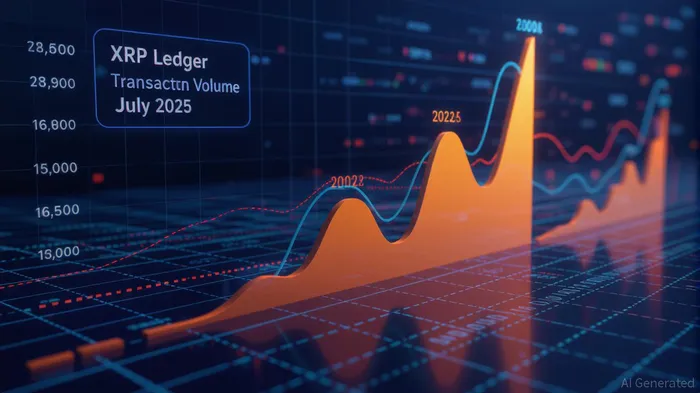
The approval of XRP ETFs could trigger a cascade of capital inflows. With XRP trading at $2.96 as of August 2025, the asset's price stability—despite regulatory uncertainty—reflects underlying confidence. If ETFs are approved, analysts project inflows of $5–8 billion in the first year, potentially pushing XRP's price to $10–$15. This trajectory mirrors Bitcoin's post-ETF surge in 2024, where institutional demand translated into both price appreciation and market legitimacy.
Moreover, the XRP ecosystem is uniquely positioned to absorb this influx. Unlike many altcoins, XRP is not a “store of value” but a “medium of exchange.” Its utility in cross-border payments and DeFi ensures that demand is tied to real-world adoption, not just speculative hype. This distinction is critical for investors seeking exposure to crypto without the volatility of pure speculation.
Investment Implications: A Strategic Bet on Institutionalization
For investors, the key takeaway is clear: XRP ETFs represent a bridge between crypto's speculative past and its institutional future. The asset's regulatory tailwinds, combined with its utility-driven demand, make it a compelling addition to a diversified portfolio. However, caution is warranted. While the 95% approval probability is high, risks remain—particularly around market concentration (Ripple controls 42% of XRP) and potential volatility post-approval.
A prudent strategy would involve allocating a portion of crypto exposure to XRP ETFs, especially for investors who believe in the long-term institutionalization of digital assets. The October 2025 decision window is a pivotal moment; those who position early could benefit from the same compounding effects seen in Bitcoin ETFs.
Conclusion: The XRP ETF Tipping Point
The untapped potential of XRP ETFs lies not in their speculative allure but in their alignment with institutional needs and regulatory progress. As the SEC's October deadline approaches, the market is poised for a seismic shift—one that could redefine XRP's role in global finance. For investors, the question is no longer whether to bet on XRP ETFs, but how to position for a future where digital assets are no longer on the fringes of finance but at its core.

Decoding blockchain innovations and market trends with clarity and precision.
Latest Articles
Stay ahead of the market.
Get curated U.S. market news, insights and key dates delivered to your inbox.




Comments
No comments yet