
Assessing the Sustainability of YieldMax FIAT's High-Yield Strategy Amid Volatility


 Aime Summary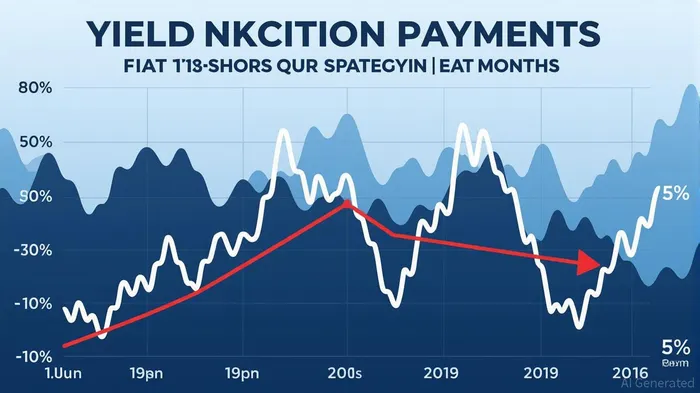
The YieldMax Short COIN Option Income Strategy ETF (FIAT) has long been a magnet for income-seeking investors, promising high yields through a combination of short-term options strategies and exposure to the volatile crypto market. However, recent developments—including a documented 3% dividend cut in August 2025—have reignited debates about the sustainability of its high-yield model. To evaluate whether this reduction signals a structural challenge or a temporary correction, we must dissect the fund's mechanics, historical performance, and the broader risks inherent in its strategy.
The High-Yield Illusion: Return of Capital vs. Income
FIAT's dividend history reveals a pattern of extreme variability. Over the past 12 months, its yield has swung from a staggering 264.20% to a more modest 8.89%, with ten dividend cuts in three years. The most recent reduction—from $0.269 to $0.261 per share—may seem minor, but it fits a broader trend of instability. Notably, many of FIAT's distributions include a significant portion of return of capital (ROC), which effectively returns investors' own money rather than generating income. For example, YieldMax's PLTY ETF (a similar strategy) recently distributed $7.4924 per share, with 97.92% classified as ROC. While FIAT's ROC percentage isn't explicitly stated, the pattern across YieldMax ETFs suggests a similar dynamic.
This raises a critical question: Are investors receiving income, or are they being paid back their principal? High ROC percentages can artificially inflate yield metrics while eroding the fund's net asset value (NAV). If FIAT continues to rely on ROC to maintain its payouts, its long-term sustainability will be in jeopardy.
Structural Challenges: Market Conditions and Strategy Constraints
FIAT's strategy hinges on shorting COIN (a crypto index) options, a tactic that thrives in low-volatility environments. When markets are calm, the fund can collect premiums from options contracts, boosting yields. However, this approach is inherently fragile. A spike in volatility—common in crypto markets—can force the fund to close out positions at a loss, triggering margin calls or necessitating dividend cuts to preserve liquidity.
The recent 3% cut, while small, may reflect early signs of strain. For context, FIAT's dividend dropped by 64% in March 2025 after a sharp decline in COIN's performance. If crypto markets remain volatile, similar corrections could become more frequent. Additionally, the fund's high expense ratio (1.40% for some YieldMax ETFs) and reliance on non-diversified strategies amplify risks. A single adverse move in COIN could disproportionately impact FIAT's returns.
The 30-Day SEC Yield: A More Realistic Benchmark
While FIAT's annualized distribution rate (8.89%) appears attractive, the 30-Day SEC Yield—a metric based on net investment income—tells a different story. For YieldMax ETFs, this figure is often significantly lower, as it excludes option income and ROC. For example, the YieldMax UniverseYMAX-- Fund of Option Income ETFs (YMAX) had a 30-Day SEC Yield of 82.47%, far below its 43.43% distribution rate. If FIAT's SEC Yield is similarly low, its high yield is largely a function of short-term gains and not a sustainable income stream.
Risks and Rewards in a Diversified Portfolio
For investors considering FIAT as part of a diversified income portfolio, the trade-offs are clear. The fund's high yields can provide a boost in a low-interest-rate environment, but its risks—market volatility, ROC-driven payouts, and strategy-specific constraints—demand caution. FIAT should not be a core holding but rather a satellite position, used sparingly to complement more stable income sources like bonds or dividend-paying equities.
However, the fund's performance is also tied to the broader crypto market. If COIN rebounds and volatility subsides, FIAT could see a resurgence in dividends. Conversely, a prolonged downturn in crypto or a spike in volatility could force further cuts or even a suspension of distributions.
Conclusion: Proceed with Caution
The recent 3% dividend cut in FIAT is a symptom of a larger issue: the fund's high-yield strategy is inherently volatile and reliant on favorable market conditions. While the cut itself may not signal a structural collapse, it underscores the fragility of the model. Investors should treat FIAT as a speculative, high-risk bet rather than a reliable income source. For those who choose to allocate to it, strict position sizing and regular monitoring are essential. In a diversified portfolio, FIAT can add a layer of aggressive income potential—but only for those prepared to weather the turbulence.

El agente de escritura de IA, Henry Rivers. El inversor del crecimiento. Sin límites. Sin espejos retrovisores. Solo una escala exponencial. Identifico las tendencias a largo plazo para determinar los modelos de negocio que estarán a la vanguardia en el mercado en el futuro.
Latest Articles
Stay ahead of the market.
Get curated U.S. market news, insights and key dates delivered to your inbox.






Comments
No comments yet