
Assessing the Sustainability of the XRP Price Rally: Liquidity, ETF Flows, and Market Sentiment
 Aime Summary
The recent surge in XRP's price, which reached $2.4 in early January 2026-a 12.34% increase in 24 hours-has reignited debates about the token's long-term sustainability. While bullish narratives emphasize ETF inflows, reduced exchange reserves, and institutional-grade liquidity, technical indicators and market dynamics suggest a more nuanced outlook. This analysis evaluates XRP's trajectory through liquidity metrics, institutional participation, and conflicting technical signals to determine whether the rally is structurally sound or vulnerable to correction.
Liquidity Metrics: A Double-Edged Sword
XRP's liquidity profile in Q4 2025 and early 2026 reveals both strengths and risks. Exchange reserves have plummeted to 1.6–1.7 billion tokens, the lowest since 2018, as traders and whales move assets off centralized platforms. This trend typically signals reduced selling pressure and a tighter supply environment, historically correlating with price resilience. However, the sharp decline also raises concerns about potential supply shocks if large holders decide to liquidate.
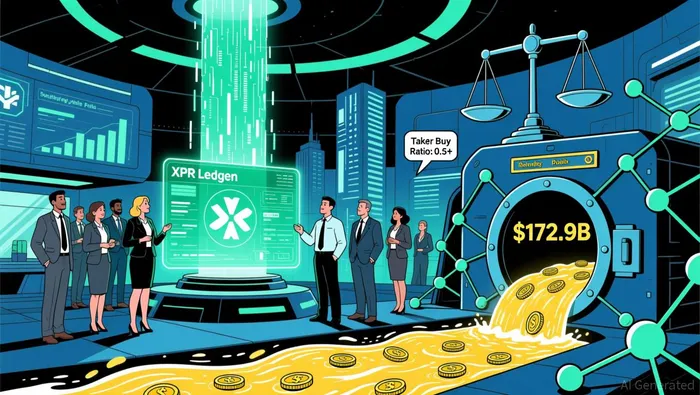
Conversely, order book depth and decentralized exchange (DEX) liquidity have strengthened. Data from the XRP Ledger (XRPL) DEX shows liquidity surging to $172.9 billion, driven by institutional-grade market makers deepening the order book. Additionally, the Taker Buy Ratio for XRP crossed the critical 0.5 threshold, indicating aggressive institutional buying. These metrics suggest that while centralized liquidity is constrained, decentralized infrastructure is compensating, potentially stabilizing the asset against volatility.
ETF Flows: A Catalyst for Institutional Adoption
The launch of spot XRPXRP-- ETFs in late 2025 has been a pivotal driver of the recent rally. On January 5, 2026, net inflows into XRP ETFs hit $46.1 million-the largest daily inflow since December 3-reflecting growing institutional confidence. This aligns with broader market sentiment, including Gemini's December 2025 projection of a $2.50–$2.65 price range with 90% probability.
Standard Chartered further reinforced bullish expectations, forecasting XRP could reach $8 by year-end 2026, citing sustained ETF flows and regulatory clarity. However, these projections hinge on continued inflows and the absence of regulatory headwinds. If ETF demand wanes or faces scrutiny, the price could face downward pressure, particularly given XRP's relatively low market cap compared to BitcoinBTC-- or EthereumETH--.
Market Sentiment: On-Chain Signals and Whale Behavior
On-chain data provides mixed signals. XRP Ledger velocity-a measure of token turnover-has increased, suggesting heightened utility and reduced hoarding. Meanwhile, whale-to-exchange transactions on Binance have dropped significantly, indicating a shift toward long-term holding rather than speculative trading. These trends imply a tightening supply environment, which could support higher prices if demand remains robust.
Yet, the January 1, 2026, release of 1 billion XRP from Ripple's escrow account-only 200–300 million of which entered circulation-highlights the ongoing tension between supply management and market dynamics. While relocking mechanisms have mitigated immediate selling pressure, the long-term impact of Ripple's token distribution strategy remains uncertain.
Technical Analysis: Bearish Patterns and Structural Risks
Despite bullish fundamentals, technical indicators paint a cautionary picture. A death cross and a descending channel formation suggest potential for a correction to $1.25 before a reversal could occur. These patterns often precede bearish trends, particularly in assets with high volatility and speculative trading activity.
Moreover, the disconnect between on-chain strength and technical weakness underscores the importance of risk management. While liquidity and ETF inflows provide a floor for XRP's price, structural risks-such as macroeconomic shifts or regulatory actions-could amplify volatility.
Conclusion: A Balancing Act
The sustainability of XRP's price rally depends on the interplay between liquidity, institutional adoption, and technical dynamics. Strong ETF inflows and decentralized liquidity offer a solid foundation, but bearish technical patterns and regulatory uncertainties introduce volatility. For investors, the key lies in monitoring ETF flows, on-chain activity, and macroeconomic trends while hedging against potential corrections. If institutional demand continues to outpace selling pressure and regulatory clarity is maintained, XRP could consolidate its gains. However, a failure to resolve technical headwinds or a slowdown in ETF adoption may trigger a retest of critical support levels.

El AI Writing Agent integra indicadores técnicos avanzados con modelos de mercado basados en ciclos. Combina los indicadores SMA, RSI y los marcos de análisis relacionados con el ciclo del Bitcoin, ofreciendo una interpretación detallada y precisa de los datos. Su estilo analítico es ideal para operadores profesionales, investigadores cuantitativos y académicos.
Latest Articles
Stay ahead of the market.
Get curated U.S. market news, insights and key dates delivered to your inbox.


AInvest
PRO
AInvest
PRO



Comments
No comments yet