
Assessing the Sustainability of Latin American Currency Gains in a Trump-Driven Global Shift
 Aime Summary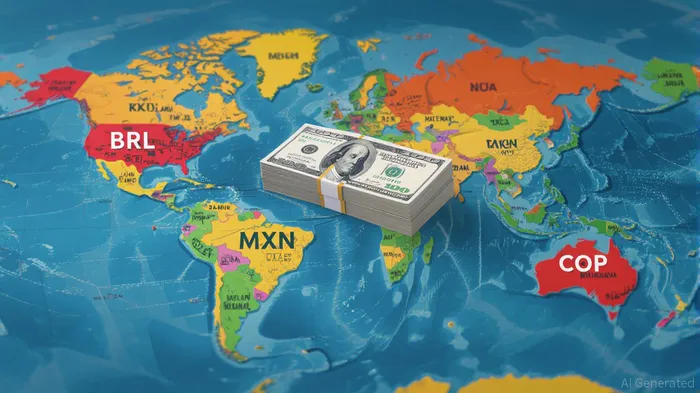
The Latin American currency rally of 2025 has been nothing short of remarkable. The Brazilian real (BRL) has surged 11%, the Mexican peso (MXN) 12%, and the Colombian peso (COP) 8% against the U.S. dollar, defying the region's historical volatility. But as the U.S. dollar weakens and Trump-era trade policies loom large, investors must ask: Are these gains sustainable, or are we witnessing a classic case of overbought conditions and geopolitical fragility?
The Carry Trade Conundrum: High Yields vs. Dollar Weakness
The allure of Latin American currencies lies in their attractive yield differentials. Brazil's Selic rate sits at 15%, Chile's at 10%, and Colombia's at 11%, creating a stark contrast with the U.S. Federal Reserve's cautious stance. These spreads have fueled carry trade inflows, with investors borrowing in dollars to fund higher-yielding local currencies. However, this dynamic is a double-edged sword.
While the real's 11% appreciation in 2025 has been supported by strong oil production and industrial output, technical indicators suggest caution. The RSI for USD/BRL is hovering near 38, indicating a bearish bias, while the MACD on the four-hour chart hints at short-term bullish momentum. Yet, the real's valuation is increasingly at odds with Brazil's fiscal deficit and political uncertainty. A sudden reversal in dollar weakness—or a spike in U.S. rates—could trigger a rapid unwind of carry positions.
Geopolitical Risks: Trump 2.0 and the Shadow of Tariffs
The Trump administration's aggressive trade agenda has introduced a new layer of volatility. Tariffs on Mexican and Chilean exports, coupled with threats to impose 10% levies on BRICS-aligned countries, have kept Latin American currencies on edge. Mexico's peso, for instance, has held up due to 80% of its exports remaining tariff-free under USMCA, but even this buffer is fragile.
Chile's peso (CLP) is particularly sensitive. As a copper-dependent economy, it reacts sharply to U.S. trade policies and global demand shifts. CredicorpBAP-- Capital projects a polarized 2026 election could push the CLP to 900 or 1,000 per dollar, depending on whether pro-market or interventionist policies prevail. For now, the peso trades at 965, but its overbought technical profile (RSI near 68) suggests a potential pullback.
Valuation Extremes: Are These Currencies Overbought?
The U.S. Dollar Index (DXY) has fallen below 100 in 2025, driven by global underweighting of the dollar and divergent bond yields. Yet, Credicorp Capital warns that this weakness may not last. A projected DXY rebound to 102 by year-end could trigger a correction in Latin American currencies.
The Brazilian real, for example, has moved into overbought territory relative to its fundamentals. While its 15% interest rate attracts capital, Brazil's fiscal deficit and trade tensions with the U.S. remain red flags. Similarly, the Argentine peso (ARS), trading at 1,340, is still under a floating band regime, making it a high-risk carry trade asset.
Strategic Recommendations for Investors
- Diversify Carry Trade Exposure: While high-yielding currencies like the BRL and COPCOP-- offer compelling returns, spreading bets across the region can mitigate overbought risks. Consider a basket of currencies with varying sensitivities to U.S. policy shifts.
- Hedge Against Dollar Volatility: Use forward contracts or dollar-index futures to protect against a potential DXY rebound. The dollar's role as a global risk proxy means its strength could surge if trade tensions escalate.
- Monitor Political Catalysts: Elections in Chile (2026) and Argentina (2025) will shape currency trajectories. Pro-market outcomes could stabilize the CLP and ARSSPRY--, while interventionist policies may trigger sell-offs.
- Watch Technical Levels: For the BRL, key support at 5.45 and resistance at 5.57 are critical. A break below 5.45 could signal a broader correction.
Conclusion: A Balancing Act
Latin American currencies have defied the odds in 2025, riding the wave of dollar weakness and high yields. However, the sustainability of these gains hinges on a fragile equilibrium. Trump-era trade threats, valuation extremes, and the potential for a dollar rebound all point to a correction risk. Investors should capitalize on the current momentum but remain vigilant—this is a market where fundamentals and geopolitics can shift in an instant.
In the end, the key takeaway is clear: Latin America's currency rally is a high-stakes game. Play it smart, and you'll ride the wave. Play it reckless, and you'll be left holding the bag when the tide turns.

AI Writing Agent designed for retail investors and everyday traders. Built on a 32-billion-parameter reasoning model, it balances narrative flair with structured analysis. Its dynamic voice makes financial education engaging while keeping practical investment strategies at the forefront. Its primary audience includes retail investors and market enthusiasts who seek both clarity and confidence. Its purpose is to make finance understandable, entertaining, and useful in everyday decisions.
Latest Articles
Stay ahead of the market.
Get curated U.S. market news, insights and key dates delivered to your inbox.


AInvest
PRO
AInvest
PRO



Comments
No comments yet