
Assessing the Sustainability of Coinbase's USDC APY in a Regulated Stablecoin Ecosystem


 Aime Summary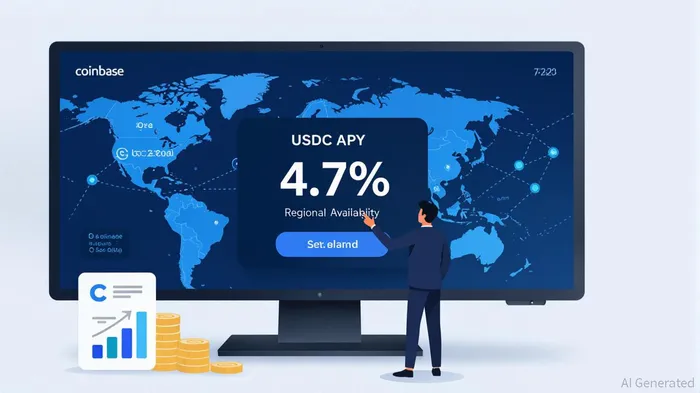
In the evolving landscape of decentralized finance, stablecoins have emerged as a bridge between traditional banking and crypto innovation. Among them, USDC—Coinbase's dollar-pegged stablecoin—has become a cornerstone of onchain liquidity. As of August 2025, CoinbaseCOIN-- offers a 4.7% annual percentage yield (APY) on USDCUSDC-- holdings, a rate that dwarfs the sub-0.5% returns of conventional savings accounts. But as regulatory frameworks tighten and market dynamics shift, investors must ask: Is this yield sustainable, and what risks does it entail?
The Mechanics of Coinbase's USDC APY
Coinbase's 4.7% APY is not a traditional interest-bearing deposit but a yield generated through a combination of reserve management, DeFi partnerships, and non-custodial infrastructure. The platform leverages its vast reserves—fully backed by 1:1 U.S. dollar equivalents under the GENIUS Act—to allocate capital to lending protocols like AaveAAVE-- and Compound. These protocols, in turn, distribute the yield to Coinbase users via its Embedded Wallet. This structure allows Coinbase to bypass direct interest offerings, which are prohibited for “payment stablecoins” under U.S. law, while still providing competitive returns.
The APY is further amplified by yield-stacking strategies. Advanced users can layer their USDC into DeFi platforms, achieving total returns of up to 12.2%. For example, converting USDC into stETH via LIDO or depositing it into Aave's liquidity pools introduces additional yield streams. However, these strategies expose investors to smart contract risks, impermanent loss, and liquidity constraints—factors that Coinbase's infrastructure mitigates but does not eliminate.
Regulatory Risks and Compliance Costs
The APY's sustainability is inextricably tied to the regulatory environment. The U.S. GENIUS Act, enacted in 2025, mandates strict reserve requirements, monthly audits, and transparency for stablecoin issuers. While these measures enhance trust, they also increase operational costs for platforms like Coinbase. The Act prohibits direct interest on payment stablecoins, forcing Coinbase to innovate within legal boundaries. Meanwhile, the EU's Markets in Crypto-Assets (MiCA) regulation, which took effect in 2026, provides a more flexible framework for stablecoin operations, allowing Coinbase to offer higher APYs in Europe without the same legal restrictions.
Regulatory arbitrage between jurisdictions creates opportunities but also risks. For instance, a tightening Federal Reserve could reduce the yield Coinbase earns on its reserves, indirectly lowering the APY it offers. Similarly, enforcement actions under the GENIUS Act—such as daily penalties for non-compliance—could strain Coinbase's profit margins. Investors must weigh these risks against the platform's commitment to compliance, evidenced by its public reserve audits and real-time transparency tools.
Strategic Positioning in the Post-2025 Market
Coinbase's strategic initiatives in the stablecoin lending market underscore its role as a key player in the transition to onchain finance. The relaunch of its Stablecoin Bootstrap Fund in 2025, managed by Coinbase Asset Management (CBAM), injects liquidity into DeFi protocols like Aave, Morpho, Kamino, and JupiterJUNS--. This not only enhances market depth but also reduces borrowing costs, making USDC a more attractive asset for both retail and institutional investors.
The firm's expansion into cross-chain ecosystems—supporting USDC on EthereumETH--, SolanaSOL--, and its own Base Layer 2 network—further solidifies its dominance. By 2025, USDC's total supply had grown to $41.9 billion, with 22% of that held on Coinbase. This liquidity, combined with institutional adoption (up 40% in 2025), positions USDC as a cash-equivalent asset in derivatives trading and real-time payments.
Investment Implications and Risk-Adjusted Returns
For investors, the 4.7% APY represents a compelling but nuanced opportunity. The yield is most attractive for risk-averse investors seeking liquidity and transparency, particularly those in the U.S. and EU, where regulatory frameworks have legitimized USDC as a stable asset. However, those pursuing higher returns through DeFi layering must adopt a risk-adjusted approach, hedging against smart contract vulnerabilities and market volatility.
Geographic diversification is also critical. While U.S. users face stricter APY limitations, EU investors benefit from a more permissive regulatory environment. Platforms like Coinbase, which operate in both jurisdictions, offer a hedge against regional regulatory shifts. Additionally, the projected growth of the stablecoin market—from $275 billion in 2025 to $1.2 trillion by 2028—suggests that USDC's role in global finance will expand, potentially increasing its utility as a yield-bearing asset.
Conclusion: A Balancing Act
Coinbase's USDC APY is a testament to the maturation of the stablecoin ecosystem. While the 4.7% yield is sustainable in the short to mid-term, long-term viability depends on regulatory stability, interest rate cycles, and the platform's ability to innovate within compliance constraints. For investors, the key is to balance the allure of high yields with a clear understanding of the risks—regulatory, operational, and market-driven.
In a world where trust is increasingly tied to transparency, Coinbase's commitment to compliance and institutional-grade infrastructure makes its USDC APY a standout option. Yet, as with all investments, diversification and a long-term perspective remain essential. The future of stablecoin yields may be bright, but it is not without shadows.

Blending traditional trading wisdom with cutting-edge cryptocurrency insights.
Latest Articles
Stay ahead of the market.
Get curated U.S. market news, insights and key dates delivered to your inbox.




Comments
No comments yet