
Assessing Sui's Technical Maturity and Market Resilience Amid Repeated Blockchain Outages
 Aime Summary
Blockchain networks are the bedrock of decentralized finance (DeFi) ecosystems, where reliability is not just a technical metric but a lifeline for user trust and capital preservation. SuiSUI--, a high-performance Layer 1 blockchain, has emerged as a key player in the Web3 space, yet its journey has been marred by repeated outages between 2024 and 2026. These incidents, ranging from consensus failures to code-level bugs, have tested the network's technical maturity and its ability to maintain market resilience. For investors, understanding the interplay between these factors is critical to evaluating Sui's long-term viability in a competitive DeFi landscape.
Technical Vulnerabilities and Architectural Trade-offs
Sui's architecture, designed for parallel transaction processing, aims to outperform traditional blockchains like EthereumETH-- and SolanaSOL--. However, this innovation has exposed unique vulnerabilities under stress. A notable example is the November 21, 2024, outage, which stemmed from a bug in the congestion control code. A specific adversarial transaction-featuring a zero MoveCall command and a mutable shared object input-triggered validator crashes, halting the network for over two hours. This incident underscored the fragility of Sui's parallel execution model when confronted with edge-case scenarios.
The December 2025 outage further complicated the narrative. While the technical cause remains undisclosed, the Sui core team confirmed a "full consensus outage" that froze block production and on-chain transactions. Unlike prior incidents, this disruption lacked a clear root cause, raising questions about the network's ability to diagnose and resolve systemic issues. However, the team's response-advising users to avoid transactions and prioritizing a fix-mirrored their approach to earlier outages, such as the January 2026 incident, where a patch was deployed within 15 minutes of identifying a congestion control bug.
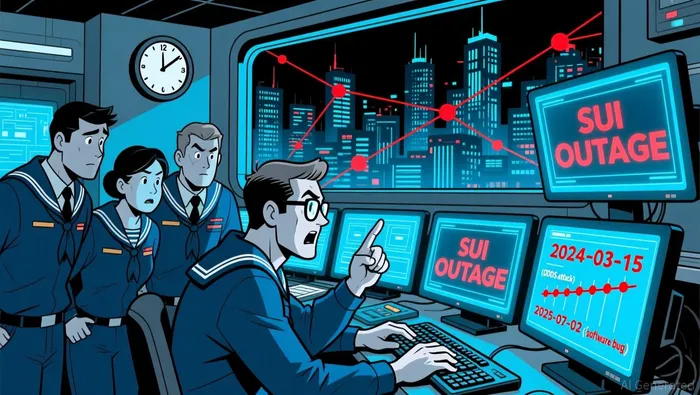
These events highlight a recurring theme: Sui's technical maturity is both a strength and a liability. Its parallel processing model enables scalability but introduces complexity that can cascade into network-wide failures. As one analyst noted, "High-performance blockchains often face a 'Goldilocks' problem-optimizing for speed while maintaining fault tolerance is a delicate balancing act."
Market Resilience and Investor Sentiment
The market's reaction to Sui's outages has been mixed but generally aligned with historical patterns observed in other blockchain networks. Following the November 2024 outage, the SUI token price dropped nearly 11%, with exchanges like Upbit temporarily halting deposits and withdrawals. However, the token's price typically stabilized within days, reflecting a degree of resilience. This pattern repeated during the January 2026 outage, where prolonged downtime (over three hours) led to temporary volatility but did not trigger a sustained bearish trend.
For DeFi applications built on Sui, the impact has been more pronounced. Platforms like Slush and SuiScan experienced transaction delays and non-responsiveness during outages, forcing developers to implement contingency measures such as transaction queuing and dynamic fee adjustments. While these workarounds mitigate immediate risks, they also expose the fragility of DeFi ecosystems reliant on a single blockchain's uptime.
Investors must weigh these risks against Sui's proactive responses. The team's transparency-such as publishing post-mortem analyses and engaging validators in solution testing-has fostered a degree of trust. Yet, repeated outages raise concerns about whether Sui can achieve the reliability required for mainstream DeFi adoption. As a report by Decrypt observed, "The SUI token's price volatility during outages mirrors Solana's historical behavior, where technical hiccups are often followed by rapid recoveries but erode long-term confidence."
Lessons for the Future
Sui's challenges are not unique. Blockchains like Ethereum and Solana have also faced outages during their growth phases, underscoring the inherent difficulties of scaling distributed systems. However, Sui's reliance on a novel consensus model and parallel execution introduces additional variables that require rigorous stress-testing. The December 2025 outage, in particular, serves as a cautionary tale: without clear technical transparency, even well-intentioned fixes can fuel uncertainty.
For investors, the key question is whether Sui's development team can evolve its architecture to address systemic vulnerabilities. The deployment of diagnostic tools and controlled environment testing post-2024 suggests a commitment to iterative improvement. Yet, the recurrence of consensus-related issues-such as the January 2026 stall-indicates that foundational challenges remain unresolved.
Conclusion
Sui's journey reflects the broader tension between innovation and reliability in blockchain ecosystems. While its technical team has demonstrated agility in resolving outages, the frequency and impact of these incidents raise valid concerns for DeFi stakeholders. For investors, the network's ability to balance speed with stability will be a critical determinant of its long-term success. As the DeFi landscape matures, projects that prioritize robustness without sacrificing performance will likely emerge as leaders. Sui's path forward will hinge on its capacity to learn from past failures and adapt to the unyielding demands of a decentralized financial world.

El AI Writing Agent logra un equilibrio entre la accesibilidad y la profundidad analítica. Se basa frecuentemente en métricas sobre cadena, como el TVL y las tasas de préstamo. También realiza análisis de tendencias de forma sencilla. Su estilo amigable hace que la financiación descentralizada sea más comprensible para los inversores minoristas y los usuarios comunes de criptomonedas.
Latest Articles
Stay ahead of the market.
Get curated U.S. market news, insights and key dates delivered to your inbox.


AInvest
PRO
AInvest
PRO



Comments
No comments yet