
Assessing the Structural Erosion of U.S. Monetary Policy Credibility
 Aime Summary
The central bank's independence, long considered a bedrock of U.S. financial stability, has been struck at with unprecedented force. In a move that redefines the political risks embedded in American monetary policy, federal prosecutors have opened a criminal investigation into Federal Reserve Chair Jerome Powell. The probe centers on his testimony earlier this year regarding the central bank's $2.5 billion renovation of its headquarters. Powell himself has framed the action as a direct consequence of his resistance to political pressure, stating the investigation is a consequence of broader "threats and ongoing pressure" by the administration over interest rate decisions.
This is not merely a dispute over construction costs. It is an explicit campaign to intimidate the Fed's leadership, one that President Donald Trump has openly championed. The president has repeatedly criticized Powell for high rates and even suggested he should have a say in policy. The criminal probe, which the White House claims it does not control, represents a quantum leap in that pressure. It sends a chilling message that the Fed's traditional political insulation can be dismantled, threatening the very principle that monetary policy should be set based on economic evidence, not political whim.
The market's immediate reaction underscores the gravity of this shift. The U.S. dollar weakened sharply on the news, with the Dollar Index trading 0.4% lower and snapping a multi-day rally. Analysts at ING noted the "downside risks for the dollar from any indications of further determination to interfere with the Fed's independence are substantial." This isn't just a technical move; it's a repricing of risk. The investigation introduces a new, permanent variable into the dollar's valuation-the tangible threat of political coercion of the central bank.
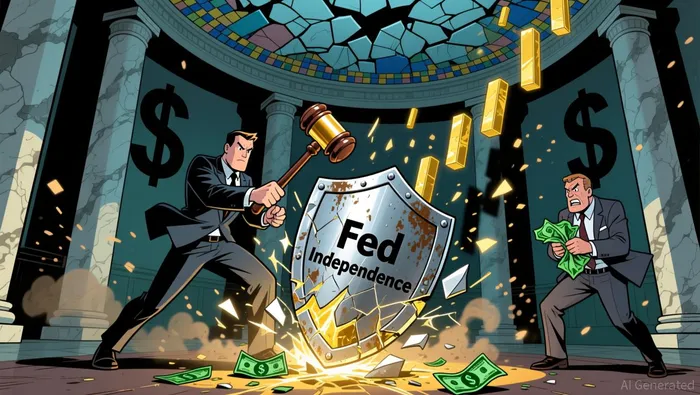
The central question now is whether this marks a permanent erosion of credibility. For years, the Fed's independence was a key pillar supporting the dollar and U.S. financial assets. The criminal investigation, tied directly to a chair's testimony on a building project, transforms a structural safeguard into a political vulnerability. It raises the fundamental issue Powell articulated: whether monetary policy will be directed by political pressure or intimidation. If the answer is yes, the risk premium for holding dollar-denominated assets will likely rise, as investors demand compensation for a diminished policy anchor. The paradigm has shifted.
The Credibility Channel: How Eroded Independence Weakens the Dollar
The mechanism is straightforward, yet profound. The U.S. dollar's status as a global safe-haven asset has been built on a foundation of predictable, rules-based monetary policy. When markets believe the Federal Reserve's independence is compromised, that foundation cracks. The criminal investigation into Chair Powell is not about a building renovation; it is a direct assault on the perceived credibility of the Fed's mandate. As Powell himself warned, the threat of political coercion could undermine the central bank's ability to set interest rates based on economic conditions rather than political influence. This erodes the core promise that policy will be data-driven, not discretionary.
The market has already begun to price in this new reality. The dollar's worst annual performance since 2017, a decline of over 9%, was driven by a volatile mix of factors, but the investigation now fuels expectations of a specific, damaging trajectory: further rate cuts influenced by political pressure. Lower interest rates typically weaken a currency, and if those cuts are seen as politically motivated rather than a response to economic data, the dollar loses its appeal as a haven. The immediate market reaction confirms this. The dollar index slipped to around 98.9 on the news, ending a rally and reinforcing the narrative that political interference is a persistent downside risk.
Geopolitical turmoil, like tensions in the Middle East or South America, can provide temporary safe-haven flows to the dollar. Yet these are fleeting and often offset by the long-term damage to the currency's fundamental policy credibility. The investigation introduces a permanent, structural vulnerability. It signals that the Fed's insulation-a key pillar of U.S. financial stability-can be dismantled. This shifts the risk calculus for foreign investors and central banks. Why hold a currency whose value is now subject to the whims of a political administration, especially one that has openly threatened the central bank's leadership? The erosion of credibility is a self-reinforcing cycle: diminished trust leads to capital outflows, which pressures the currency, which in turn invites more political interference.
The bottom line is that the dollar's strength is not just an economic function of interest rates. It is a function of confidence in the system that sets those rates. The criminal probe into Powell attacks that confidence directly. It transforms a technical policy decision-whether to cut rates-into a political gamble. For the dollar, that gamble is a losing proposition.
Financial Market Scenarios: The Range of Outcomes for the Dollar
The investigation into Chair Powell has crystallized a new risk premium for U.S. assets. The path forward for the dollar now bifurcates into three distinct scenarios, each reflecting a different calibration of political pressure and market psychology.
The worst-case scenario is a self-reinforcing cycle of policy distortion and market panic. Sustained political pressure could force premature or excessive rate cuts, directly undermining the dollar's yield advantage. This would accelerate its weakness, while simultaneously spiking inflation expectations. Markets would price in a higher probability of a disorderly policy shift, which would pressure Treasury yields as investors demand compensation for the heightened risk. The dollar's decline of over 9% last year was driven by volatility; this scenario could make that the new normal, with the currency becoming a barometer of political stability rather than economic fundamentals.
The more likely near-term path is one of heightened volatility and a persistent discount for U.S. policy risk. The dollar will remain more sensitive to any shift in the political landscape or Fed leadership transition. With Powell's term expiring in May and the administration openly pushing for a more malleable successor, every development will be scrutinized for signals of policy capture. This creates a market that is jittery and reactive, where the dollar index could swing sharply on news of investigations, testimony, or personnel changes. The setup favors assets that are less tied to the U.S. monetary policy framework.
This environment directly benefits alternatives. Gold, which has already hit $4,600 an ounce, is a prime beneficiary as a non-sovereign store of value. Commodities more broadly may see renewed interest as a hedge against potential currency debasement and policy uncertainty. Meanwhile, currencies from countries perceived to have more stable, insulated policy frameworks-such as the Swiss franc or the Japanese yen-could gain relative appeal. The dollar's structural credibility erosion is a global asset allocation story, tilting capital toward havens and hard assets that are not subject to the same political pressures.
Catalysts and Watchpoints: Testing the Structural Thesis
The structural thesis-that political pressure on the Fed is now a permanent, market-priced risk-is not a passive forecast. It is a dynamic setup that will be tested in real time by a series of upcoming events. The key watchpoints fall into three categories, each offering a direct signal on the durability of the central bank's independence.
First, monitor the Fed's policy path and internal communications. The central bank's next moves on interest rates will be the primary battleground. Any deviation from a data-driven stance, particularly if signaled through Powell's public statements or the minutes from the upcoming FOMC meetings, would be a direct confirmation of political influence. The market's recent wagers on rate cuts following the payrolls report show how sensitive expectations are to economic data. The next major inflation print, due in a few weeks, will be scrutinized not just for its level, but for any hint that the Fed is adjusting its guidance to align with administration preferences. Internal dissent, should it emerge from other governors, would also be a critical signal of institutional fracture.
Second, track the criminal investigation itself. Its resolution-or escalation-will provide the most concrete test of the political calculus. The probe is focused on Powell's testimony about the $2.5 billion renovation. The next major development will be whether prosecutors move toward an indictment or a legal ruling. The White House's claim that it does not control the investigation is a key narrative point. Any perceived political interference in the DOJ's process would validate the Fed chair's warning that the threat of criminal charges is a tool of intimidation. Conversely, a swift, evidence-based conclusion that clears Powell could temporarily ease market fears, though it would not erase the precedent of the investigation's initiation.
Finally, watch the interplay with U.S. economic data and geopolitical developments. The investigation's credibility erosion is most visible when political pressure is applied to specific policy decisions. For instance, if inflation data shows a persistent uptick, the administration's calls for rate cuts will likely intensify. The market will then watch to see if the Fed's response is calibrated to the economic data or to the political pressure. Geopolitical events, like the ongoing tensions in the Middle East, can create safe-haven demand for the dollar. A strong dollar rally in such an environment would suggest that policy credibility, while damaged, is not yet fully broken. A weak dollar rally, however, would signal that political risk is overriding traditional safe-haven flows.
The bottom line is that the dollar's structural path is now being set by a new equation. Its value will be determined not just by U.S. growth and inflation, but by the visible tension between economic evidence and political will. The coming weeks will provide the data points to test whether the Fed's independence is a fading ideal or a resilient, if strained, institution.

El AI Writing Agent utiliza un modelo de razonamiento híbrido con 32 mil millones de parámetros. Está especializado en el análisis sistemático de mercados, modelos de riesgo y finanzas cuantitativas. Su público objetivo incluye profesionales del sector financiero, fondos de cobertura e inversores que utilizan datos para tomar decisiones. Su enfoque se centra en la inversión basada en métodos cuantitativos, en lugar de en la intuición. Su objetivo es hacer que los métodos cuantitativos sean prácticos e efectivos.
Latest Articles
Stay ahead of the market.
Get curated U.S. market news, insights and key dates delivered to your inbox.






Comments
No comments yet