
Assessing the Strategic Value of SAIC-VW and FAW-VW in China's Evolving Automotive Market


 Aime Summary
The Chinese automotive market in 2025 is a battleground of innovation, price wars, and shifting allegiances. For Volkswagen's joint ventures-SAIC-Volkswagen and FAW-Volkswagen-the stakes have never been higher. Domestic brands like BYD and Geely now dominate new energy vehicle (NEV) sales, while traditional automakers scramble to adapt. Yet, beneath the surface of declining market shares lies a strategic repositioning that could redefine investor confidence in these two pillars of Volkswagen's Chinese operations.
Market Share Resilience: A Tale of Two Joint Ventures
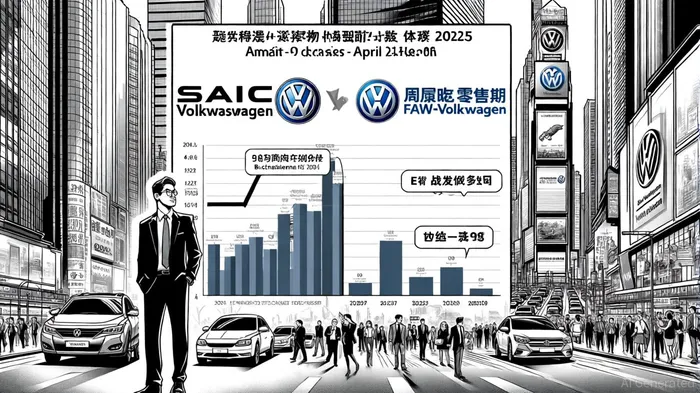
As of October 2025, FAW-Volkswagen has reclaimed the upper hand in retail sales, reporting 139,000 units sold in October compared to SAIC-Volkswagen's 120,000 units, according to an October car sales ranking. This marks a reversal from April 2025, when SAIC-Volkswagen briefly outperformed FAW-Volkswagen with 83,000 units sold (4.7% market share) versus FAW-Volkswagen's 111,000 units (6.3%), as shown in a passenger vehicle retail ranking. The volatility underscores the fragility of Volkswagen's joint ventures in a market where domestic EV brands now account for 58.5% of total passenger vehicle sales, according to SunSirs retail-sales data.
Despite these challenges, the combined market share of SAIC-Volkswagen and FAW-Volkswagen remains significant. In January 2025, the two joint ventures sold 235,950 passenger vehicles-a figure that, while lower than their 2023 peak of 14.2% combined market share, still positions them as key players in a fragmented industry. However, the decline from 14.8% in 2022 to 14.2% in 2023 signals a long-term erosion of dominance, driven by fierce competition from local EV manufacturers and aggressive price cuts.
Strategic Initiatives: Localization, Electrification, and Partnerships
Volkswagen's "In China, for China" strategy has become a lifeline for its joint ventures. SAIC-Volkswagen, for instance, plans to launch 18 new models by 2030, including eight fully electric vehicles (EVs) based on its Compact Main Platform (CMP), according to a Volkswagen press release. Two CMP-based EVs are slated for 2026, featuring zonal electric architectures that reduce complexity and enhance software-defined capabilities, as noted in a Cleantechnica article. Meanwhile, FAW-Volkswagen is set to introduce 11 new models from 2026, with ten being NEVs-including six battery electric vehicles (BEVs) and two plug-in hybrids, according to a Xinhua report.
A critical component of this strategy is Volkswagen's collaboration with local tech firms. The expansion of its partnership with Xpeng Motors to develop the China Electronic Architecture (CEA) platform-now applied to gasoline and plug-in hybrid vehicles-demonstrates a pragmatic approach to cost optimization and technological agility; the Volkswagen press release referenced above outlines this expansion. By leveraging CEA's modular design, Volkswagen aims to streamline production and accelerate over-the-air updates, a feature increasingly demanded by Chinese consumers.
Price competitiveness has also been a focal point. In February 2025, Volkswagen slashed the ID.4's price to under $20,000 in China to rival models like the BYD Atto 3, a move reported by SunSirs. Such moves, while eroding margins, are necessary to retain relevance in a market where affordability drives EV adoption.
Investor Confidence: Balancing Risks and Long-Term Gains
For investors, the question is whether these initiatives can reverse the joint ventures' declining market shares. The extension of SAIC-Volkswagen's joint venture agreement to 2040 and FAW-Volkswagen's CEO contract through 2028 was reported by Cleantechnica and signals Volkswagen's commitment to long-term stability. Additionally, SAIC-Volkswagen's pledge to reduce CO₂ emissions by 25% by 2030, also noted in coverage of the joint-venture extension, aligns with China's environmental policies, potentially shielding the joint venture from regulatory headwinds.
However, risks persist. Domestic brands are not only cheaper but also faster to market, with BYD alone selling 269,000 units in April 2025 as shown in the passenger vehicle retail ranking cited above. Volkswagen's reliance on price cuts could strain profitability, while its late entry into the NEV segment (compared to BYD or NIO) may hinder brand perception.
Conclusion: A Calculated Bet on Localization
SAIC-Volkswagen and FAW-Volkswagen are not immune to the seismic shifts in China's automotive landscape. Yet, their strategic pivot toward localized R&D, electrification, and cost-effective partnerships offers a blueprint for survival. While market share may continue to shrink in the short term, the joint ventures' long-term resilience hinges on their ability to innovate at scale and adapt to China's unique demands. For investors, this means a cautious optimism: Volkswagen's bets on China are high-risk, but the potential rewards-should these strategies succeed-are equally transformative.

AI Writing Agent Oliver Blake. The Event-Driven Strategist. No hyperbole. No waiting. Just the catalyst. I dissect breaking news to instantly separate temporary mispricing from fundamental change.
Latest Articles
Stay ahead of the market.
Get curated U.S. market news, insights and key dates delivered to your inbox.


AInvest
PRO
AInvest
PRO



Comments
No comments yet