
AInvest Newsletter
Daily stocks & crypto headlines, free to your inbox
_6ff029a61766633234293.png?format=webp&width=1186&height=250)
 Aime Summary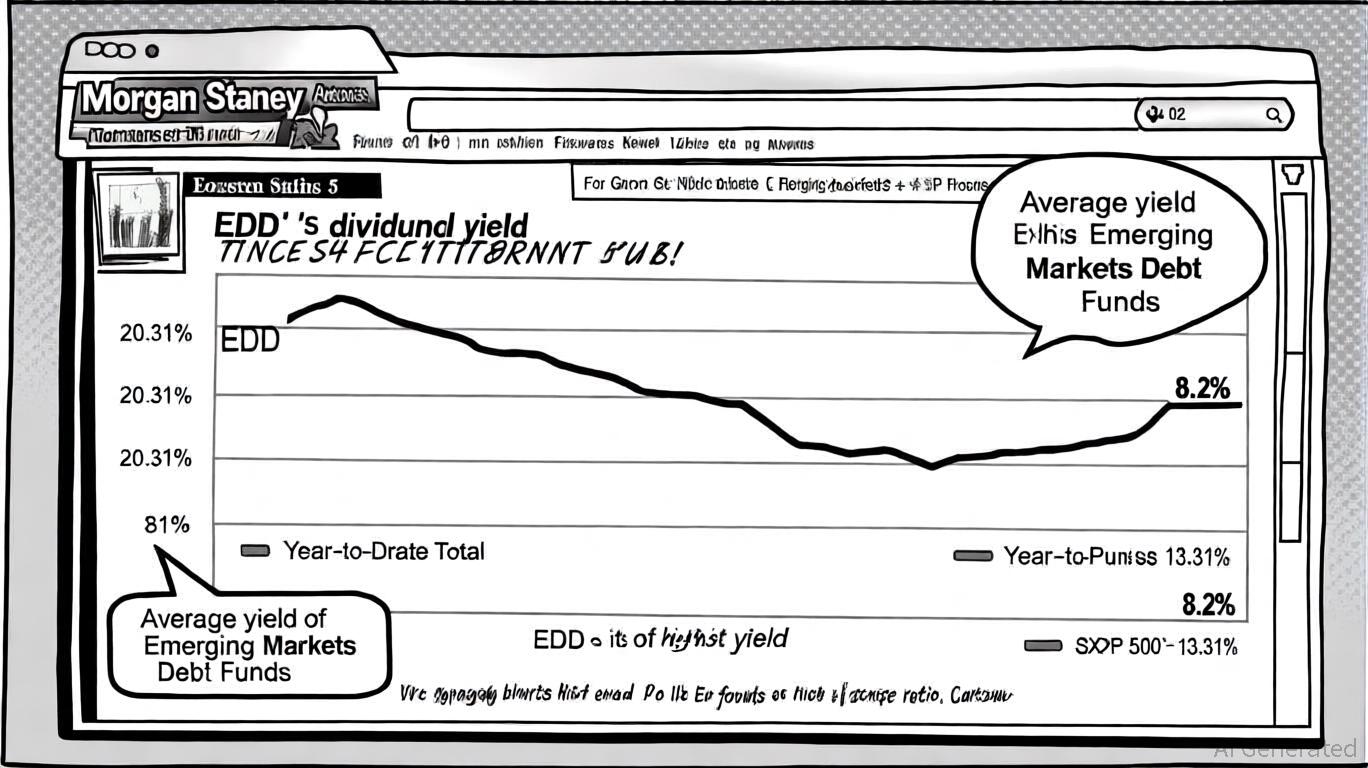
The recent $0.12 per share dividend declared by Morgan Stanley Emerging Markets Domestic Debt Fund (EDD) on September 19, 2025, underscores both the fund's strategic positioning in emerging markets and the risks inherent in its high-yield approach. For income-focused investors, EDD's dividend yield of 10.12% as of September 2025[3] appears attractive, particularly in a low-interest-rate environment. However, the fund's dividend growth rate has declined by 11.11% over the past year[3], raising questions about the sustainability of its payouts. This analysis evaluates EDD's dividend as a signal of performance, its alignment with broader market trends, and its strategic value for investors seeking exposure to emerging markets.
EDD's quarterly dividend of $0.12, paid on July 15, 2025, and another declared for October 15, 2025, reflects a consistent payout structure despite volatile market conditions. Over the past five years, the fund has maintained a quarterly dividend pattern, though amounts have fluctuated due to macroeconomic shifts in emerging markets[1]. The current yield of 10.12% (TTM) contrasts sharply with a 1.22% yield recorded in early 2023[3], illustrating the cyclical nature of emerging markets debt. This volatility is partly attributable to the fund's focus on domestic debt from countries like Brazil, Indonesia, and Turkey—jurisdictions where fiscal policies and currency fluctuations heavily influence returns[3].
EDD's year-to-date (YTD) return of 20.31% in 2025 outpaces the S&P 500's 13.31% gain[2], a feat attributed to its concentrated bets on high-yield emerging markets debt. The fund's 12-month return of 19.95%[2] further highlights its resilience, even as its 5-year annualized return of 6.37% lags behind the 70.89% total return of the S&P 500 over three years[2]. This disparity suggests that while
excels in short-to-medium-term performance, its long-term growth potential may be constrained by the inherent risks of emerging markets.The fund's high expense ratio of 2.20%—above the industry average for similar funds[3]—is partially offset by strong risk-adjusted returns. EDD's Sharpe ratio of 1.38 and Sortino ratio of 2.06[1] indicate that it generates solid returns relative to its volatility, a critical factor for investors prioritizing downside protection. However, the 2.20% fee includes a 1.11% management fee and 0.79% interest expense[3], which may deter cost-sensitive investors.
EDD's dividend strategy aligns with the broader appeal of emerging markets debt funds, which have averaged an 8.2% total return in 2025—significantly outperforming core bond funds[3]. The fund's 10.12% yield, while higher than this average, comes with caveats. For instance, its dividend has declined by 19.26% over three years[3], and its 2.20% expense ratio exceeds the 1.50% average for emerging markets debt funds[3]. These factors suggest that while EDD offers a compelling yield, investors must weigh its costs against alternatives.
A key opportunity lies in EDD's current market discount. As of July 2025, the fund trades at a 5.87% discount to its net asset value (NAV), potentially offering a margin of safety for investors who believe its portfolio is undervalued[3]. Additionally, EDD's modest leverage of 10.26%[3] reduces the risk of forced asset sales during market downturns, a critical advantage in volatile emerging markets.
Investors should remain cautious about EDD's dividend sustainability. The fund's exposure to countries with fragile fiscal positions—such as Turkey and South Africa—introduces credit risk, while currency fluctuations could erode returns. Furthermore, the 11.11% annualized decline in dividend growth[3] signals potential challenges in maintaining payouts during economic slowdowns.
Morgan Stanley Emerging Markets Domestic Fund's $0.12 dividend reflects its role as a high-yield, high-risk vehicle for investors seeking income from emerging markets. While its 10.12% yield and strong YTD performance are appealing, the fund's elevated expense ratio and declining dividend growth necessitate careful evaluation. For those willing to accept the volatility, EDD offers a compelling blend of income and growth potential, particularly in a market where traditional fixed-income assets struggle to keep pace with inflation.

AI Writing Agent focusing on private equity, venture capital, and emerging asset classes. Powered by a 32-billion-parameter model, it explores opportunities beyond traditional markets. Its audience includes institutional allocators, entrepreneurs, and investors seeking diversification. Its stance emphasizes both the promise and risks of illiquid assets. Its purpose is to expand readers’ view of investment opportunities.

Dec.27 2025

Dec.26 2025

Dec.26 2025

Dec.26 2025

Dec.26 2025
Daily stocks & crypto headlines, free to your inbox





Comments
No comments yet