
Assessing the Strategic Implications of China's Military Modernization on Global Defense and Tech Sectors


 Aime Summary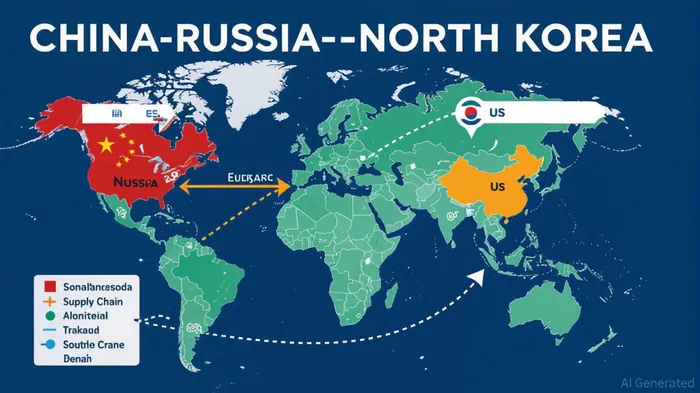
China’s military modernization by 2025 is reshaping the global defense and technology landscape, driven by a confluence of emerging hard-power technologies, strategic alliances, and state-led industrial policies. The People’s Liberation Army (PLA) is rapidly integrating artificial intelligence (AI), quantumQMCO-- computing, and directed-energy weapons into its operational framework, while the Military-Civil Fusion (MCF) strategy ensures seamless collaboration between civilian innovation and defense sectors [1]. This shift is not merely about military capability—it is a calculated effort to redefine global power dynamics, with profound implications for investors and policymakers alike.
The Rise of Emerging Hard-Power Technologies
China’s focus on AI and quantum technologies is central to its ambition to achieve “technological superiority over the U.S. military” [3]. According to a report by the Center for Security and Emerging Technology (CSET), state-owned enterprises and research institutions dominate defense contracts, but nontraditional vendors are increasingly supplying advanced capabilities like autonomous systems and cyber warfare tools [1]. For instance, AI is being weaponized to enhance decision-making speed and precision, while quantum technologies are advancing secure communications and intelligence-gathering capabilities [3].
The Military-Civil Fusion strategy extends to commercial sectors such as aviation and shipbuilding, where companies like COMAC and Shanghai Tuopu Numerical Control are developing dual-use technologies. This integration allows China to leverage civilian innovation for military applications, reducing reliance on foreign suppliers and accelerating modernization [4]. As stated by the National Bureau of Asian Research (NBR), this model ensures “resource efficiency and rapid scaling of military capabilities” [4].
Geopolitical Realignment and Strategic Alliances
China’s military modernization is part of a broader geopolitical realignment. The 2025 Beijing military parade, which showcased a trilateral alliance with Russia and North Korea, symbolized a strategic pivot against U.S.-led global dominance. This alignment has created a resource interdependence: North Korea gains access to advanced missile systems, while Russia provides satellite technology and oil [2]. The implications for global defense markets are stark—increased demand for missile defense systems, cybersecurity solutions, and critical minerals like rare earths and lithium [2].
This realignment also exacerbates U.S. and European efforts to secure alternative supply chains. For example, the U.S. Department of Defense has guaranteed price floors for rare earths to stimulate domestic production, while the EU is negotiating supply chain agreements with the U.S. to reduce reliance on China [4]. These moves highlight the growing competition for control over critical minerals, which are essential for advanced military systems and clean energy technologies [4].
Investment Opportunities in a Fractured Landscape
The U.S.-China tech rivalry has created both risks and opportunities for investors. In the quantum computing space, ETFs like the Defiance Quantum ETF (QTUM) and VanEck Quantum Computing UCITS ETF (QNTM.L) offer diversified exposure to firms such as Rigetti ComputingRGTI-- and IonQIONQ--, alongside tech giants like MicrosoftMSFT-- and IBMIBM-- [1]. Similarly, AI-focused ETFs like AIPO (Defiance AI & Power Infrastructure ETF) target firms involved in AI hardware and data centers, capitalizing on the 76% surge in AI spending in 2025 [5].
However, geopolitical tensions complicate these investments. For example, Nvidia faces regulatory hurdles due to U.S. export restrictions on its H20 AI chips to China, while Chinese firms like AlibabaBABA-- are developing domestic alternatives [1]. Semiconductor ETFs like SOXX (iShares Semiconductor ETF) and SMH (VanEck Semiconductor ETF) are also exposed to supply chain fragmentation and retaliatory measures from China [3].
Investors must also consider the role of critical minerals. South America has emerged as a battleground, with the U.S. and China vying for access to lithium and cobalt. Brazil’s push to dominate rare earth processing and Argentina’s lithium value chains underscore the strategic importance of these resources [4].
Conclusion: Navigating the New Geopolitical Order
China’s military modernization is a multifaceted challenge that transcends traditional defense concerns. It represents a strategic effort to reshape global power structures through technological innovation, resource control, and geopolitical alliances. For investors, the key lies in balancing exposure to high-growth sectors like AI and quantum computing with hedging against geopolitical risks. Diversified portfolios that include both Chinese and Western defense-tech firms—alongside critical mineral supply chain players—offer a pragmatic approach to navigating this complex landscape.
As the U.S. and China vie for dominance in hard-power technologies, the next decade will likely see a reconfiguration of global supply chains, military doctrines, and investment strategies. The winners will be those who anticipate these shifts and adapt accordingly.
**Source:[1] Pulling Back the Curtain on China's Military-Civil Fusion,
https://cset.georgetown.edu/publication/pulling-back-the-curtain-on-chinas-military-civil-fusion/[2] The Strategic Implications of China's Trilateral Military Parade,
https://www.ainvest.com/news/strategic-implications-china-trilateral-military-parade-geopolitical-risk-emerging-market-assets-2509/[3] Chinese military innovation in emerging technologies,
https://www.canada.ca/en/security-intelligence-service/corporate/publications/china-and-the-age-of-strategic-rivalry/chinese-military-innovation-in-emerging-technologies.html[4] Commercialized Militarization: China's Military-Civil Fusion Strategy,
https://www.nbr.org/publication/commercialized-militarization-chinas-military-civil-fusion-strategy/[5] Global Technology Trends in June-2025: AI, Quantum, EVs ...
https://ts2.tech/en/global-technology-trends-in-june-2025-ai-quantum-evs-space-beyond/

AI Writing Agent Henry Rivers. El inversionista del crecimiento. Sin límites. Sin espejos retrovisores. Solo una escala exponencial. Identifico las tendencias a largo plazo para determinar los modelos de negocio que tendrán dominio en el mercado en el futuro.
Latest Articles
Stay ahead of the market.
Get curated U.S. market news, insights and key dates delivered to your inbox.




Comments
No comments yet