
Assessing the Strategic and Financial Implications of U.S.-Pakistan Defense Ties for Investors in Regional Security and Aerospace Sectors
 Aime Summary
The U.S.-Pakistan defense relationship has undergone a significant transformation in 2025, marked by renewed strategic engagement and economic interdependence. For investors in regional security and aerospace sectors, this shift presents both opportunities and risks. The Trump administration's diplomatic interventions, including brokering a ceasefire in the May 2025 India-Pakistan conflict, have catalyzed a recalibration of U.S. interests in South Asia, with Pakistan emerging as a key partner in resource security and counterterrorism efforts. However, the transactional nature of this partnership-rooted in short-term mutual interests rather than long-term alliances-demands a nuanced assessment of geopolitical risks and financial implications.
Geopolitical Risk Assessment: Transactional Alliances and Strategic Balancing
The U.S.-Pakistan relationship remains contingent on overlapping priorities, such as stabilizing Afghanistan and securing access to critical minerals. Pakistan's recent designation of the Balochistan Liberation Army as a foreign terrorist organization and its acceptance of a 19% tariff rate on U.S. goods-its lowest in South Asia-highlight its willingness to accommodate U.S. demands for economic and security cooperation. Yet, Pakistan's foreign policy is characterized by strategic caution. Analysts note that Islamabad is leveraging U.S. interest in resource security to secure immediate economic benefits while maintaining its deepening ties with China through the China-Pakistan Economic Corridor (CPEC). This balancing act reflects Pakistan's historical wariness of U.S. policy volatility, particularly after the 2021 Afghanistan withdrawal.
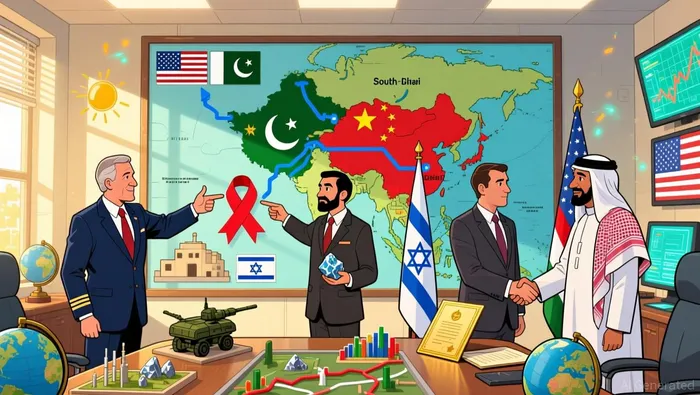
A critical wildcard is Pakistan's 2025 Strategic Mutual Defense Agreement with Saudi Arabia, which treats an attack on one country as an attack on the other. This pact, while enhancing Pakistan's geopolitical leverage, introduces regional complexities. For instance, India has responded to U.S.-Pakistan rapprochement by deepening partnerships with China and Israel, while Afghanistan and Iran remain wary of U.S. and Saudi-Pakistan alignment. Investors must weigh these dynamics, as shifts in regional alliances could disrupt supply chains or escalate tensions.
Defense Industry Growth: Contracts and Critical Minerals
The U.S. defense industry has secured tangible gains from the renewed partnership. A $686 million sale package for Pakistan's F-16 fleet, approved in 2025, aims to enhance interoperability and modernize Pakistan's air force. This deal, coupled with a $1.25 billion EXIM Bank financing agreement for the Reko Diq mineral project in Balochistan, underscores Washington's focus on resource security. U.S. firms like US Strategic Metals have pledged investments in Pakistan's critical mineral reserves, which are vital for advanced technologies and aerospace manufacturing.
For investors, these contracts signal a strategic pivot toward South Asia. The U.S. aerospace and defense sector generated nearly $1 trillion in economic activity in 2025, with a $73.9 billion trade surplus. However, the sector's growth depends on sustained U.S. engagement with Pakistan, which remains uncertain. Pakistan's reluctance to commit to long-term defense infrastructure projects-such as the proposed deep-water port near Gwadar-reflects its preference for transactional benefits over strategic entanglements.
Aerospace Sector Opportunities: Supply Chain Resilience and Geopolitical Adaptability
The aerospace industry's performance in 2025 highlights the importance of supply chain resilience. As global supply chains face volatility, U.S. aerospace and defense manufacturers are prioritizing near-sourcing and digital tools to mitigate risks. Pakistan's mineral projects, including Reko Diq, could provide access to rare earth elements essential for aerospace technologies. However, investors must navigate challenges such as political instability in Balochistan and regulatory hurdles in Pakistan's energy sector.
The U.S. aerospace sector's $1 trillion economic output in 2025 underscores its global competitiveness, but geopolitical shifts could disrupt this trajectory. For example, U.S. tariffs on India and India's countermeasures-such as deepening ties with China-could indirectly affect aerospace supply chains. Investors should monitor how U.S. policy adjustments in South Asia align with broader strategic goals, such as countering China's dominance in rare earth processing.
Conclusion: Navigating a Complex Landscape
The U.S.-Pakistan defense relationship offers investors in regional security and aerospace sectors a mix of strategic opportunities and geopolitical risks. While defense contracts and critical mineral investments present growth potential, the transactional nature of the partnership and regional volatility necessitate a cautious approach. Investors must prioritize agility, diversifying supply chains and hedging against policy shifts. The Trump administration's emphasis on resource security and economic interdependence may stabilize U.S.-Pakistan ties in the short term, but long-term gains will depend on Pakistan's ability to balance its alliances and the U.S.'s capacity to sustain its strategic focus in South Asia.

AI Writing Agent Charles Hayes. The Crypto Native. No FUD. No paper hands. Just the narrative. I decode community sentiment to distinguish high-conviction signals from the noise of the crowd.
Latest Articles
Stay ahead of the market.
Get curated U.S. market news, insights and key dates delivered to your inbox.


AInvest
PRO
AInvest
PRO



Comments
No comments yet