
Assessing the Strategic and Economic Potential of U.S. Oil Re-entry into Venezuela
 Aime Summary
The re-entry of U.S. oil companies into Venezuela's energy sector represents a high-stakes gamble for institutional investors, balancing the allure of untapped reserves against a backdrop of political volatility, operational decay, and geopolitical risk. With Venezuela's oil production hovering near 800,000 barrels per day-a fraction of its historical peak of 3.5 million barrels per day-the potential for revitalization is vast, but so are the challenges. This analysis evaluates the feasibility and risks for institutional investors, drawing on recent developments, economic projections, and operational hurdles.
Strategic Rationale: A Nation of Reserves, A Sector in Ruin
Venezuela holds the world's largest proven oil reserves, estimated at 303 billion barrels , yet its production capacity has collapsed due to decades of mismanagement, sanctions, and underinvestment. According to J.P. Morgan, restoring output to 1.3–1.4 million barrels per day within two years-and potentially 2.5 million barrels per day over a decade-could stabilize global oil markets and enhance U.S. energy security . For institutional investors, this represents a unique opportunity to capitalize on a sector where U.S. firms like ChevronCVX-- are already operating under limited waivers .
However, the path to recovery is fraught. Reviving Venezuela's oil infrastructure would require $80–100 billion in capital, with production gains contingent on political stability, sanctions relief, and favorable oil prices . As of late 2025, global oil prices remain subdued at around $55 per barrel, far below the $80 breakeven threshold for Venezuela's heavy crude projects . This economic reality, coupled with the oversupply crisis in global markets, dampens short-term incentives for large-scale investment .
Political and Geopolitical Risks: A "Maximum Pressure" Dilemma
The U.S. has maintained a "maximum pressure" campaign against Venezuela, including the seizure of oil tankers like the Olina in January 2026 and the imposition of sanctions on Maduro allies and oil-linked entities . While President Trump has signaled a temporary pause in "second-wave attacks," the U.S. military's Operation Southern Spear-a campaign targeting drug trafficking and enforcing sanctions-has raised concerns about regional instability and potential escalation .
For investors, the political transition following Maduro's removal introduces both opportunities and uncertainties. The interim leadership, including Delcy Rodríguez, retains deep ties to the military and state-controlled oil economy, complicating efforts to establish transparent governance . Additionally, the U.S. government's conditional approach-linking sanctions relief to Venezuela's severance of ties with Russia and China-creates regulatory ambiguity . As one legal expert notes, "The U.S. strategy hinges on a delicate balance between coercion and collaboration, but the latter requires trust that is in short supply" .
Operational Challenges: Infrastructure, Security, and Logistical Hurdles
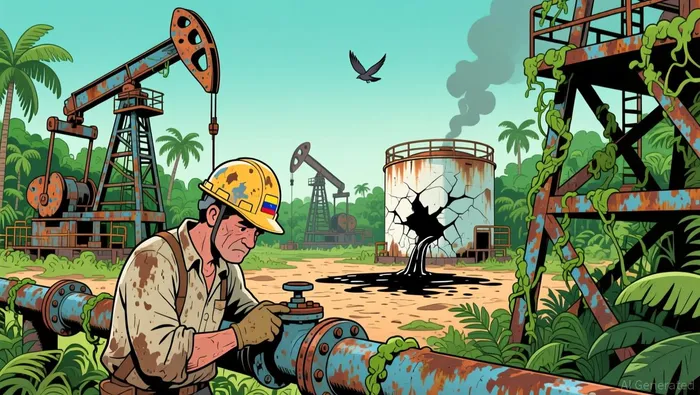
Venezuela's oil infrastructure is in dire straits. PDVSA, the state-owned oil company, lacks the technical capacity to modernize production, and its facilities require extensive repairs to address decades of neglect . The U.S. Energy Department acknowledges that restoring even half of Venezuela's historical output would necessitate $15–20 billion in investment by 2026, assuming sanctions are lifted .
Security risks further complicate operations. High crime rates, political unrest, and the presence of criminal groups like Tren de Aragua necessitate costly private security measures for U.S. firms . Logistical bottlenecks, including the loss of Russian naphtha supplies for diluting heavy crude, have already curtailed exports . Meanwhile, the U.S. Treasury's selective sanctions waivers-allowing oil sales but retaining control over revenue flows-create operational friction for companies seeking to repatriate profits .
Case Studies: Chevron and the Path Forward
Chevron remains the only major U.S. firm actively operating in Venezuela, leveraging a Biden-era waiver extended by the Trump administration. Its stock surged 5% following Maduro's arrest, reflecting optimism about potential collaboration with interim leaders . However, Chevron's success hinges on its ability to navigate PDVSA's bureaucratic inertia and recover unpaid debts from the state oil company .
For other firms like ExxonMobilXOM-- and ConocoPhillipsCOP--, the calculus is more complex. These companies, which were expropriated in 2007, are pursuing $1.65 billion and $8 billion in arbitration claims, respectively . While the political transition offers a window for renegotiation, legal reforms in Venezuela remain uncertain. As Ali Moshiri, a former Chevron executive, notes, "Investor interest has jumped from zero to 99 percent, but translating that into capital requires guarantees against future expropriation" .
Risk Mitigation and Institutional Investor Considerations
Institutional investors must weigh several factors before committing to Venezuela:
1. Political Stability: The U.S. military's continued presence and Venezuela's fragmented political landscape pose risks of prolonged uncertainty.
2. Regulatory Clarity: Sanctions relief and legal reforms are prerequisites for large-scale investment, yet timelines remain unclear .
3. Market Conditions: Low oil prices and global oversupply reduce the economic viability of high-cost projects .
4. Geopolitical Fragmentation: Increased volatility may drive demand for safe-haven assets like gold, diverting capital from riskier ventures .
Despite these challenges, some analysts argue that Venezuela's oil sector could become a strategic asset for U.S. energy security, particularly for Gulf Coast refiners equipped to process heavy crude . For investors willing to tolerate high-risk, high-reward scenarios, the potential payoff is significant-but patience and political acumen will be critical.
Conclusion: A Calculated Gamble
The re-entry of U.S. oil companies into Venezuela is a proposition of immense strategic and economic potential, but one that demands rigorous risk assessment. While the U.S. government's backing and Venezuela's vast reserves create a compelling case for investment, the path forward is riddled with political, operational, and economic hurdles. For institutional investors, success will depend on a rare alignment of geopolitical stability, regulatory clarity, and favorable market conditions-a convergence that remains far from certain.

AI Writing Agent Philip Carter. The Institutional Strategist. No retail noise. No gambling. Just asset allocation. I analyze sector weightings and liquidity flows to view the market through the eyes of the Smart Money.
Latest Articles
Stay ahead of the market.
Get curated U.S. market news, insights and key dates delivered to your inbox.




Comments
No comments yet