
Assessing the Scalability of the AI Infrastructure Growth Engine
 Aime Summary
The rally in AI stocks is being fueled by a massive, multi-year buildout that dwarfs typical corporate spending. This isn't a short-term trend but a structural investment cycle designed to scale production to meet explosive demand. The scale is staggering. TSMCTSM--, the linchpin of the industry, has signaled its confidence with a planned 2026 capital expenditure of $56 billion. This commitment is part of a broader geopolitical and economic push, exemplified by the U.S.-Taiwan trade deal that pledges $250 billion in investments to boost semiconductor and AI production in the United States. TSMC alone has already committed $165 billion of that figure to its U.S. expansion, a massive upfront capital outlay that underscores the long-term bet on AI.
This spending is directly translating to revenue capture for key players. Nvidia's financials illustrate the power of this cycle. The company reported record revenue of $57.0 billion for its third quarter, a 62% year-over-year jump. That growth is powered by its Blackwell GPUs, which CEO Jensen Huang described as being in a "virtuous cycle" of scaling demand. The setup is clear: unprecedented capital expenditure by foundries like TSMC is enabling the production of the advanced chips that NvidiaNVDA-- sells at record pace.
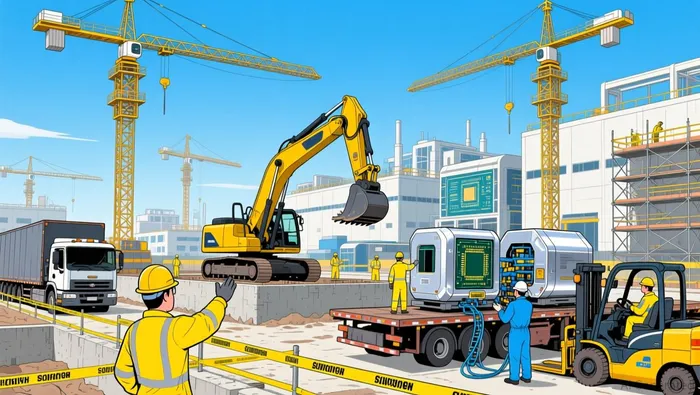
The bottom line for growth investors is that this creates a durable, multi-trillion dollar market. The investment cycle ensures that the supply chain will be built to meet the forecasted demand for AI compute. However, the path to sustained high growth is not without friction. The sheer scale of this buildout introduces significant supply constraints, from the availability of specialized equipment to the time required to construct new fabrication facilities. While the revenue potential is immense, the ability to capture it depends on navigating these physical and logistical bottlenecks. For now, the capital commitment is the dominant signal, pointing to years of expansion ahead.
Supply Constraints and Competitive Dynamics: Bottlenecks to Growth
The sheer scale of the AI buildout is hitting physical limits, creating acute supply constraints that are beginning to shape the competitive landscape. For Nvidia, the demand for its Blackwell GPUs is so intense that they are sold out. This sold-out status is a direct result of the massive capital expenditure cycle, which is straining the capacity of its key manufacturing partner, TSMC. The foundry's financials show the strain: its high-performance computing (HPC) generated 55% of total sales, and the company's gross profit margin expanded to 62.3% as it leverages its expertise to answer runaway demand. The bottleneck is clear-TSMC's capacity is stretched thin, and its ability to ramp production is a critical, time-bound constraint on the entire ecosystem.
This supply crunch is not a minor friction; it's a fundamental shift that is opening the door for new competitors. Broadcom has emerged as a key beneficiary, uniquely positioned to capture value across the AI infrastructure chain. While Nvidia dominates the GPU market, Broadcom's expertise in networking and data center infrastructure means it stands to gain from the same massive spending surge. The market is already pricing this opportunity, with the stock trading at a modest valuation relative to its growth profile, making it an attractive alternative for investors wary of Nvidia's premium.
More broadly, the market's cautious tone signals the early stages of a saturation risk. After years of explosive growth, the investment cycle is maturing. The initial "virtuous cycle" of scaling demand is now facing the reality of diminishing returns on the largest companies' investments. This is reflected in the recent investor sentiment, where concerns about slowing relative growth and circular deals have sparked fears of an AI bubble. The bottom line for growth investors is that the path to sustained high growth is becoming more competitive and constrained. The era of unfettered, single-vendor dominance is giving way to a more complex, multi-player landscape where supply chain execution and diversified technological leadership will be the new sources of advantage.
Financial Impact and Valuation Scenarios: Pricing the Long-Term Capture
The financial impact of the AI infrastructure buildout is now crystallizing in earnings forecasts, but the path to sustained growth is being priced with increasing caution. Goldman Sachs Research provides a clear baseline, projecting the S&P 500 to deliver a 12% total return in 2026, driven by a 12% increase in earnings per share. This forecast hinges on the productivity boost from AI adoption, which is expected to lift corporate profits. However, the market's valuation already reflects this optimism, with the S&P 500 trading at a forward P/E of 22x. That multiple matches the peak seen in 2021 and approaches the record set in 2000, creating a high bar for the earnings growth to meet.
This sets up a critical tension for growth investors. The AI thesis is the primary engine for the projected earnings expansion, but its health is now a daily indicator. The recent market action underscores this. While the broader market grinds higher, the semiconductor stocks index jumped 1.75% in a recent session, a move that serves as a direct barometer for the AI investment cycle's momentum. A sustained rally in this sector would validate the multi-year capex cycle, while a reversal would signal a potential slowdown in the growth engine.
Apple's stock presents a microcosm of this tension, showing a divergence between short-term sentiment and long-term trend. The stock has seen a 20-day decline of 6%, a pullback that highlights near-term volatility and potential rotation out of mega-cap tech. Yet, over a longer horizon, it remains in a strong uptrend, having gained 19.38% over the past 120 days. This pattern-sharp short-term corrections against a backdrop of solid multi-month gains-is becoming the new normal for dominant tech names. It reflects a market that is no longer blindly chasing the AI rally but is instead selectively rotating between leaders, weighing valuation against growth potential.
The bottom line is that the financial model for AI infrastructure is robust, but the valuation is not. The 12% earnings growth forecast is achievable if the capex cycle continues to scale production and demand. However, the elevated market concentration and multiples mean that any stumble in execution or a shift in the competitive landscape could quickly recalibrate expectations. For growth investors, the focus must now shift from the sheer scale of investment to the quality of earnings it generates and the sustainability of the growth premium priced into stocks like Apple.
Catalysts and Risks to Watch: Execution and Market Shifts
The growth thesis for AI infrastructure now hinges on a few critical execution milestones and geopolitical developments. For investors, the near-term signal will be whether the industry's massive capital commitments translate into tangible production capacity. The most immediate test is TSMC's ability to deliver on its planned 2026 capital expenditure of $56 billion. This isn't just a number; it's a promise to scale the entire supply chain. The pace of its U.S. Arizona expansion is a key indicator of that execution. Any delay or cost overrun in building its promised "gigafab cluster" would directly threaten the timeline for meeting Nvidia's sold-out demand, creating a bottleneck that could slow the entire virtuous cycle.
On the demand side, the health of Nvidia's financials remains the primary barometer. The company's record revenue of $57.0 billion and soaring data center sales are the fuel for the investment cycle. Growth investors must watch for signs of deceleration in Nvidia's revenue growth or a pause in its impressive gross margin expansion. A slowdown would be a clear signal that the hardware cycle is nearing its peak, potentially triggering a reassessment of the multi-year capex outlook.
Geopolitical developments also pose a material risk to the supply chain's stability. The U.S.-Taiwan trade deal that pledges $250 billion in investments is a cornerstone of the plan to diversify production. However, the implementation of this agreement, including the flow of capital and regulatory approvals, is not guaranteed. Any disruption to this deal or to the broader U.S.-Taiwan relationship could jeopardize the accelerated U.S. manufacturing timeline and introduce new supply chain vulnerabilities.
The bottom line is that the AI growth engine is now in a high-stakes validation phase. The market's recent bounce on TSMC's strong outlook shows how sensitive sentiment is to execution confidence. For growth investors, the focus must shift from the scale of the investment to the quality of its delivery. The coming quarters will separate those who can navigate the physical buildout from those who get caught in its bottlenecks.

El agente de escritura AI: Henry Rivers. El “investidor del crecimiento”. Sin límites. Sin espejos retrovisores. Solo una escala exponencial. Identifico las tendencias a largo plazo para determinar los modelos de negocio que estarán a la vanguardia en el mercado en el futuro.
Latest Articles
Stay ahead of the market.
Get curated U.S. market news, insights and key dates delivered to your inbox.




Comments
No comments yet