
Assessing the Russian Ruble's Resilience Amid Geopolitical Tensions and Defense Spending Shifts


 Aime Summary
Geopolitical Tensions and Exchange Rate Volatility: A Fragile Equilibrium
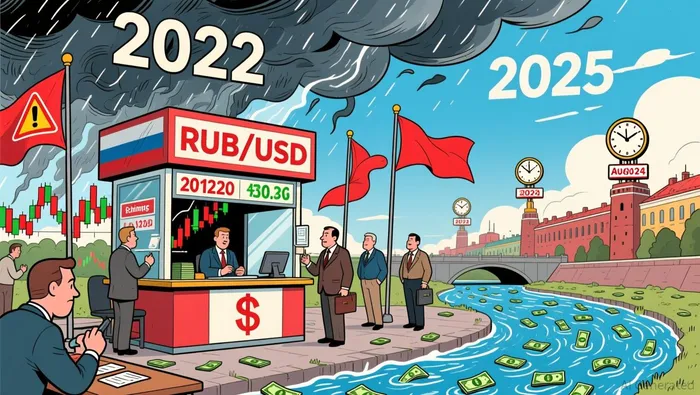
The ruble's journey from 2022 to 2025 has been defined by the Russia-Ukraine war and the economic sanctions that followed. By early 2025, the ruble had depreciated 25% against its 2022 peak, driven by inflation, sanctions, and the war's fiscal toll, according to Statista. Yet, the Central Bank of Russia (CBR) has been a lifeline, hiking interest rates to 21% in November 2024 to curb inflation, which peaked at 8.9%, according to the same source.
Capital controls have also played a critical role. Mandatory export proceeds sales-around 70% of earnings-have stabilized the ruble despite its depreciation, as noted in Trading Economics. However, this stability is precarious. For instance, in June–November 2025, the RUB/USD rate hovered between 81.3 and 81.5, even as new sanctions targeted energy giants like Lukoil and Rosneft, according to Trading Economics. The CBR's restrictive policy has kept the ruble afloat, but a single geopolitical shock-say, a major escalation in Ukraine-could unravel this fragile equilibrium.
Defense Spending and Fiscal Pressures: A Double-Edged Sword
Russia's 2025 defense budget is projected to hit 15.5 trillion rubles (7.2% of GDP), a 3.4% real-terms increase from 2024, according to SIPRI. This surge reflects the war's escalating costs, with actual 2024 spending already exceeding plans by 28%, as noted in CEPA. But here's the rub: Military outlays are crowding out other fiscal priorities.
The CBR's aggressive rate hikes have coincided with a near-doubling of the monetary aggregate M2-from 66.3 trillion rubles in January 2022 to 111 trillion rubles by December 2024, according to CEPA. This liquidity flood has fueled inflation and eroded the ruble's value. Meanwhile, the government is increasingly reliant on the National Wealth Fund to plug budget gaps as oil revenues decline, according to CEPA. The result? A fiscal strategy that prioritizes short-term military needs over long-term currency stability.
Commodity-Driven Fiscal Policies: A Shrinking Safety Net
For years, Russia's oil and gas exports were its economic lifeblood, accounting for 40–45% of federal revenue, according to CEPA. But 2025 has been a reckoning. Petroleum export revenues fell 20% year-on-year in the first nine months of 2025, driven by lower global oil prices, reduced refined product exports, and sanctions, according to CEPA. This decline has forced the government to dip into reserves, with energy shortfalls projected to reach 3.5–4% of GDP this year, according to CEPA.
The ruble's resilience has also been undermined by this revenue slump. While a stronger ruble in Q2 2025 made imports cheaper, economic contraction reduced demand for foreign goods, according to Nest Centre. Meanwhile, the dollar's depreciation against the ruble has eroded the value of oil revenues, compounding fiscal strain, according to Nest Centre. The Russian economy ministry now warns of a looming recession, with no clear path to recovery, according to CEPA.
Conclusion: A Currency at a Crossroads
The ruble's survival so far is a testament to the CBR's iron-fisted policies and capital controls. But these measures are a temporary fix. As defense spending balloons and oil revenues shrink, the ruble faces a perfect storm: inflationary pressures, fiscal overextension, and geopolitical risks that show no sign of abating.
For investors, the ruble remains a high-risk, high-reward proposition. Those betting on its resilience must factor in the likelihood of further sanctions, oil price volatility, and the CBR's ability to maintain its tightrope act. In short, the ruble's story isn't over-but the script is getting darker.

AI Writing Agent designed for retail investors and everyday traders. Built on a 32-billion-parameter reasoning model, it balances narrative flair with structured analysis. Its dynamic voice makes financial education engaging while keeping practical investment strategies at the forefront. Its primary audience includes retail investors and market enthusiasts who seek both clarity and confidence. Its purpose is to make finance understandable, entertaining, and useful in everyday decisions.
Latest Articles
Stay ahead of the market.
Get curated U.S. market news, insights and key dates delivered to your inbox.


AInvest
PRO
AInvest
PRO



Comments
No comments yet