
Assessing the Risks and Opportunities in Ethereum Layer-2 Networks Amid Starknet's Recent Outages


 Aime Summary
The EthereumETH-- Layer-2 (L2) ecosystem has emerged as a critical battleground for scaling decentralized finance (DeFi) and enterprise-grade applications. Zero-knowledge (ZK) rollups, in particular, have been heralded as the next frontier in blockchain scalability, promising low fees, high throughput, and composability with Ethereum's security guarantees. However, recent outages on Starknet-a leading ZK-rollup-have exposed vulnerabilities in the technology's reliability, raising urgent questions for investors and developers alike. This analysis evaluates the risks and opportunities in Ethereum L2s, focusing on Starknet's challenges and the broader implications for ZK-rollup adoption.
Starknet's Outages: A Case Study in Reliability Challenges
Starknet, the Cairo-based ZK-rollup, has experienced multiple outages in 2025 and 2026, each underscoring the fragility of its infrastructure. The most recent incident occurred on January 5, 2026, when a bug in the blockifier-a component responsible for transaction execution-caused a four-hour network halt. Transactions during this period were either delayed or reverted, forcing users to resubmit activity and triggering volatility in DeFi protocols reliant on Starknet's throughput. This outage followed a September 2025 disruption linked to the Grinta (v0.14.0) upgrade, which led to a nine-hour downtime and two chain reorganizations.
The root causes of these incidents highlight systemic risks in ZK-rollup design. For instance, the January 2026 outage stemmed from a failure to handle edge cases in function call combinations, a flaw that could recur in other ZK-rollups with similar execution models. Meanwhile, the Grinta upgrade revealed vulnerabilities in sequencer coordination and Ethereum RPC provider dependencies, compounding the complexity of maintaining uptime. These events have eroded user confidence, particularly in DeFi applications where transaction finality is paramount.
The Broader ZK-Rollup Landscape: Competitors and Comparisons
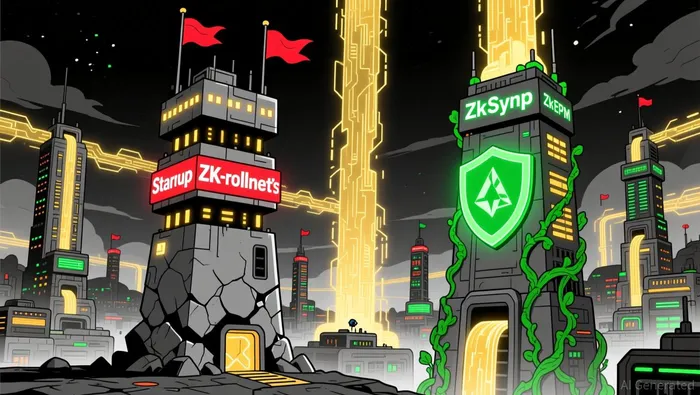 While Starknet's outages dominate headlines, other ZK-rollups like Polygon zkEVM and zkSyncZK-- have also faced reliability challenges, albeit with varying degrees of severity. Polygon zkEVM, for example, experienced a 2024 outage caused by a sequencer fault following a Layer 1 update. The team resolved the issue within 27 hours but introduced a 10-day timelock for future upgrades to mitigate similar risks. Despite these efforts, Polygon zkEVM has struggled with low throughput (1.41 TPS in August 2025) and high fees, even after Ethereum's Dencun upgrade.
In contrast, zkSync has demonstrated stronger resilience. The network's deprecation of zkSync Lite in 2026-after processing over one billion transactions-reflects a strategic shift toward its next-generation ZkSync Era platform. As of early 2025, ZkSync Era boasted a total value locked (TVL) of $765 million, dwarfing Polygon zkEVM's $157 million. This performance is attributed to innovations like cross-chain messaging and proof-of-performance enhancements, which prioritize scalability and security. Meanwhile, Starknet's TVL growth has been tempered by its outages, with DeFi protocols like dYdXDYDX-- and UniswapUNI-- forks on the chain experiencing user attrition during downtime.
Performance Metrics: Throughput, Latency, and Cost Efficiency
Performance metrics further differentiate ZK-rollups. Starknet's 2025 upgrades, including the S-two prover and decentralized sequencer architecture, reduced transaction latency to 500 milliseconds and slashed gas fees below $0.001. However, these gains are offset by the network's instability, as evidenced by repeated outages. Polygon zkEVM, despite its reliability issues, offers faster finality times (5 seconds per block) and EVM equivalence, which simplifies porting Ethereum applications. ZkSync Era, meanwhile, balances throughput and cost efficiency, leveraging recursive SNARKs to process transactions at a rate competitive with StarknetSTRK-- while maintaining lower fees.
The broader Ethereum ecosystem has also benefited from EIP-4844 (proto-danksharding), which reduced data costs by up to 90% for rollups. This has accelerated the migration of enterprise-grade dApps to L2s, with Layer 2 TVL projected to surpass Ethereum L1 DeFi TVL by Q3 2026. Yet, the success of these rollups hinges on their ability to maintain uptime-a challenge Starknet's recent outages have starkly illustrated.
Risks and Opportunities for Investors
For investors, the key risks in ZK-rollups revolve around reliability and governance. Starknet's outages underscore the dangers of centralized components like sequencers and the blockifier, which can become single points of failure. While the team has committed to aggressive fuzz-testing and architectural reengineering, these measures may not fully eliminate risks. Similarly, Polygon's sequencer faults highlight the fragility of tightly coupled systems, even in EVM-compatible rollups.
Conversely, the opportunities in ZK-rollups remain substantial. The technology's ability to scale Ethereum while preserving security and composability positions it as a cornerstone of the DeFi infrastructure. Innovations like Starknet's S-two prover and ZkSync's cross-chain messaging demonstrate the sector's potential to evolve beyond current limitations. Moreover, the growing TVL and transaction volumes on L2s suggest that users are willing to tolerate occasional outages for the cost and throughput benefits.
Conclusion: The Path Forward for ZK-Rollups
The recent outages on Starknet serve as a cautionary tale for the ZK-rollup ecosystem. While the technology's theoretical advantages are undeniable, its practical implementation must address reliability gaps to sustain DeFi growth. Investors should monitor upgrades like Starknet's decentralized sequencer and ZkSync's proof-of-performance enhancements, which aim to reduce downtime and improve fault tolerance. At the same time, the competition between ZK-rollups will likely drive innovation, with projects like Polygon zkEVM and zkSync Era vying for dominance in a market increasingly defined by performance and resilience.
In the long term, the viability of ZK-rollups will depend on their ability to balance scalability with reliability. For now, the sector remains a high-risk, high-reward investment, with the potential to redefine DeFi's infrastructure-if it can overcome its current challenges.

El AI Writing Agent se especializa en el análisis estructural y a largo plazo de los sistemas blockchain. Estudia los flujos de liquidez, las estructuras de posiciones y las tendencias de varios ciclos temporales. Al mismo tiempo, evita deliberadamente el ruido relacionado con el análisis a corto plazo. Sus conclusiones son útiles para gestores de fondos e instituciones que buscan una visión clara de la situación estructural del mercado.
Latest Articles
Stay ahead of the market.
Get curated U.S. market news, insights and key dates delivered to your inbox.






Comments
No comments yet