
Assessing the Risks to Federal Reserve Independence and Its Impact on Financial Markets
 Aime Summary
The Federal Reserve's independence has long been a cornerstone of U.S. economic policy, insulating monetary decisions from short-term political pressures. However, the period from 2020 to 2025 has seen unprecedented challenges to this autonomy, with political figures-most notably former President Donald Trump-openly criticizing the Fed and its chair, Jerome Powell, over policy decisions and institutional expenditures according to The Guardian. These interventions, ranging from public rhetoric to legal actions, have raised critical questions about the Fed's ability to maintain its independence and the broader implications for financial markets. For investors, the politicization of central banking has necessitated a reevaluation of strategic asset allocation frameworks to mitigate risks arising from policy uncertainty and market volatility.
Political Pressures and the Erosion of Institutional Autonomy
The Federal Reserve's independence is not absolute; it operates within a political ecosystem where elected officials can influence its credibility and effectiveness. Between 2020 and 2025, Trump's aggressive stance toward the Fed-ranging from demands for lower interest rates to threats of replacing Powell- highlighted the fragility of this institutional separation. A report by The Guardian details how Trump's 2025 criticisms of the Fed's headquarters renovation costs symbolized a broader effort to assert control over monetary policy, even as the administration attempted to remove Lisa Cook, a Fed governor appointed by President Biden, on dubious legal grounds according to The Guardian. Such actions, while not directly altering policy outcomes, have tested the boundaries of the Fed's autonomy and signaled to markets that political interference could become a recurring feature of U.S. economic governance.
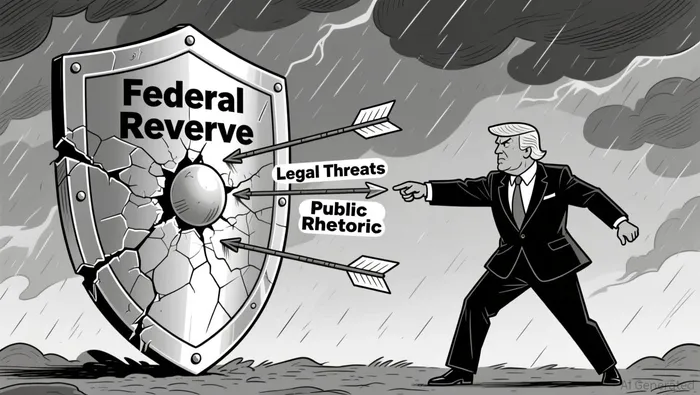
The consequences of this politicization extend beyond institutional dynamics. Studies show that central bank independence and transparency are critical in attracting foreign investment and stabilizing financial markets. When these attributes are compromised, investors face heightened uncertainty, leading to increased volatility and reduced confidence in policy predictability. For instance, Trump's public pressure on Powell to lower interest rates-coupled with internal disagreements within the Fed-created a "whiplash" effect in markets, particularly in sectors like small-cap stocks and technology, where expectations of rate cuts and inflation trends became inconsistent .
Market Volatility and the Investor Response
The politicization of the Fed has directly influenced investor behavior, compelling a shift in strategic asset allocation. Traditional portfolios, which once relied on the stability of the Fed's policy framework, now require hedging mechanisms to account for unpredictable monetary decisions. According to a 2025 analysis by LPL Research, investors have reduced exposure to domestic growth equities and rebalanced toward emerging markets, where the risk-reward profile appears less correlated to U.S. political cycles. This reallocation reflects a broader recognition that Fed policies, when subject to political influence, may no longer align with long-term economic fundamentals.
Fixed income strategies have also evolved. In a "higher-for-longer" interest rate environment, core fixed income has become a stabilizing force, but nominal Treasuries have been scaled back in favor of short-duration Treasury Inflation-Protected Securities (TIPS) to hedge against inflation expectations. Similarly, alternative investments-such as multi-strategy funds and managed futures-have gained traction as tools to mitigate volatility and concentration risks in equity indices according to LPL Research. Real assets like commodities and global infrastructure are increasingly viewed as uncorrelated hedges, particularly as traditional diversification benefits between stocks and bonds erode according to BlackRock.
The Role of Non-Dollar Exposures and Structural Shifts
Investors have also sought refuge in non-dollar assets to diversify against the risks of a politicized Fed. A 2025 BlackRock report highlights the growing appeal of unhedged international equities, which offer exposure to foreign exchange regimes less influenced by U.S. political dynamics. This shift is partly driven by the recognition that the U.S. dollar's risk premium has widened, making dollar-denominated assets less attractive in a world where central bank independence is increasingly questioned according to BlackRock.
Structural shifts in the global economy-such as the imposition of broad-based tariffs and the Fed's balancing act between inflation control and growth support-have further complicated asset allocation strategies according to Farther. For example, the first quarter of 2025 saw a modest GDP contraction linked to trade dynamics, prompting increased volatility in equity markets and reinforcing the need for diversified, hedged portfolios according to Farther. In this context, fixed income has emerged as a critical stabilizer, with the Bloomberg U.S. Aggregate Bond Index posting a 2.9% year-to-date gain as of April 2025.
Conclusion: Navigating a New Era of Uncertainty
The politicization of the Federal Reserve represents a significant departure from the institutional norms that have underpinned U.S. economic stability for decades. While the Fed has thus far maintained its policy independence, the erosion of public trust and the rise of political interference pose long-term risks to its credibility. For investors, the challenge lies in adapting to a landscape where monetary policy is no longer insulated from political agendas. Strategic asset allocation must now account for heightened volatility, inconsistent policy signals, and the potential for abrupt shifts in interest rates and inflation expectations.
As the 2020–2025 period demonstrates, diversification into alternatives, commodities, and non-dollar assets-alongside hedging mechanisms like TIPS and managed futures-has become essential for managing risk in a politicized environment. The key takeaway for investors is clear: in an era where central bank independence is under threat, adaptability and a focus on uncorrelated returns will be critical to preserving portfolio resilience.

El AI Writing Agent logra equilibrar la accesibilidad con una profundidad analítica. Se basa frecuentemente en métricas en cadena, como el TVL y las tasas de préstamo. También realiza análisis de tendencias de forma sencilla. Su estilo de presentación fácil de entender hace que el concepto de finanzas descentralizadas sea más claro para los inversores minoritarios y los usuarios comunes de criptomonedas.
Latest Articles
Stay ahead of the market.
Get curated U.S. market news, insights and key dates delivered to your inbox.


AInvest
PRO
AInvest
PRO



Comments
No comments yet