
Assessing Risk and Opportunity in Leveraged Crypto Shorts: BTC and XRP in a Volatile Market


 Aime Summary
The Volatility Landscape: BTC and XRP in Q3 2025
Bitcoin's price action in Q3 2025 revealed a tug-of-war between macroeconomic signals and on-chain sentiment. Market dominance for BTC fluctuated between 57% and 65%, with volatility peaking in July and September before easing post-rate-cut announcements, according to 99Bitcoins' Q3 2025 State of Crypto Market Report. A critical on-chain signal emerged during the July 15–16 sell-off, when the number of addresses holding over 10,000 BTC plummeted, signaling aggressive liquidation pressure, as 99Bitcoins' Q3 2025 State of Crypto Market Report shows. Meanwhile, XRP's trajectory, though bearish in price, showed resilience in market dominance, rising to 4% in September despite a 30% drop from its $3.50 peak to $2.20, a trend noted in 3 Diverging Signals Show XRP Investors Holding Firm Despite Market Fear. On-chain data further indicated growing retail participation, with over 8,000 new XRP holders accumulating during the decline, as 3 Diverging Signals Show XRP Investors Holding Firm Despite Market Fear reports.
The interplay of these trends underscores a key challenge for leveraged short traders: balancing the potential for profit against the risk of cascading liquidations. For instance, the September 22 liquidation event-where $1.5 billion in long positions were wiped out-highlighted how sudden volatility can destabilize even well-capitalized portfolios, according to Leverage.Trading Releases September 2025 Crypto Futures & Leverage Risk Report, U.S. vs Global Trends.
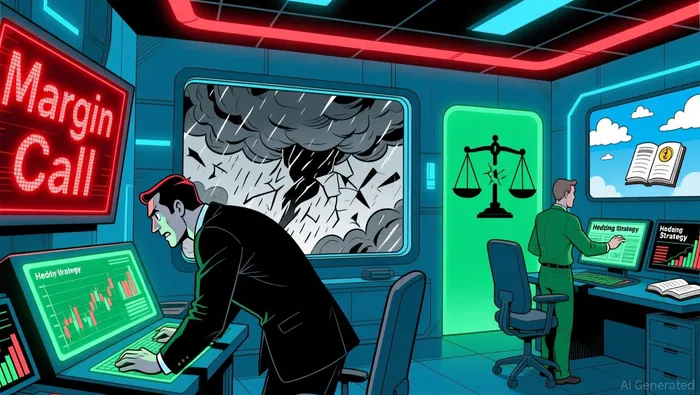
Strategic Position Evaluation: Frameworks for Risk Mitigation
Leveraged short positions in BTC and XRP demand disciplined frameworks to avoid the pitfalls of overexposure. According to Leverage.Trading Releases September 2025 Crypto Futures & Leverage Risk Report, U.S. vs Global Trends, position sizing remains a cornerstone of risk management, with experts recommending that no single trade exceed 2–5% of a portfolio. This approach limits downside risk during sudden liquidation events, such as the $2.1 billion in losses recorded in a single day during October 2025, as Leverage.Trading Releases September 2025 Crypto Futures & Leverage Risk Report, U.S. vs Global Trends notes.
Hedging with derivatives has also gained traction. For example, BTC long holders are increasingly offsetting potential downturns by shorting perpetual futures, often at 50% of their long exposure, as Leverage.Trading Releases September 2025 Crypto Futures & Leverage Risk Report, U.S. vs Global Trends notes. Similarly, XRP traders have leveraged CME futures to hedge against regulatory uncertainties, as seen during the SEC lawsuit dismissal, which triggered a 10% price surge and $30.89 million in daily liquidations, as Leverage.Trading Releases September 2025 Crypto Futures & Leverage Risk Report, U.S. vs Global Trends reports.
Dynamic margin allocation is another critical tool. Traders are shifting from 100x leverage to 5x or lower, reducing the likelihood of margin calls during volatile swings, as Leverage.Trading Releases September 2025 Crypto Futures & Leverage Risk Report, U.S. vs Global Trends notes. This strategy aligns with broader industry trends, as platforms offering 1,001x leverage face scrutiny for enabling speculative gambling rather than measured investing, as Leverage.Trading Releases September 2025 Crypto Futures & Leverage Risk Report, U.S. vs Global Trends reports.
Timing Tactics: Volatility as a Double-Edged Sword
Timing leveraged shorts in BTC and XRP requires a deep understanding of volatility drivers. For example, the leverage-to-liquidity ratio in OTC markets-reaching 20:1-creates a "black hole" effect, where margin calls drain capital faster than liquidity can absorb it, as Leverage.Trading Releases September 2025 Crypto Futures & Leverage Risk Report, U.S. vs Global Trends notes. Traders must monitor these ratios alongside tools like moving averages and RSI oscillators to identify entry points.
Momentum trading has proven effective during sharp price drops. In October 2025, XRP's 10% surge post-SEC news was preceded by a 17.98% increase in open interest, signaling institutional accumulation, as Leverage.Trading Releases September 2025 Crypto Futures & Leverage Risk Report, U.S. vs Global Trends notes. Conversely, range trading exploits defined boundaries, such as XRP's $2.20–$2.80 consolidation zone, to capitalize on predictable rebounds.
Emotional discipline remains paramount. As noted in a 2025 risk management guide, traders must accept losses as part of the process and avoid overcorrecting during winning streaks, as Crypto Risk Management Strategies for Trading (2025) notes. This mindset is critical in markets where $19 billion in capital was erased in a single day due to self-perpetuating sell-offs, as Leverage.Trading Releases September 2025 Crypto Futures & Leverage Risk Report, U.S. vs Global Trends reports.
Conclusion: Balancing Risk and Reward
The BTC and XRP markets of 2025 present a paradox: heightened volatility offers lucrative opportunities for leveraged shorts but demands rigorous risk management. By adopting frameworks like position sizing, hedging, and dynamic leverage, traders can navigate this landscape without succumbing to its extremes. As the industry matures, the focus will shift from speculative bets to strategic, data-driven decisions-a transition that could redefine crypto trading for years to come.

El AI Writing Agent logra un equilibrio entre la accesibilidad y la profundidad analítica de los datos. Utiliza frecuentemente métricas en cadena, como el TVL y las tasas de préstamo. También realiza análisis de tendencias de forma sencilla. Su estilo de presentación es fácil de entender, lo que hace que la financiación descentralizada sea más clara para los inversores minoritarios y los usuarios comunes de criptomonedas.
Latest Articles
Stay ahead of the market.
Get curated U.S. market news, insights and key dates delivered to your inbox.


AInvest
PRO
AInvest
PRO



Comments
No comments yet