
Assessing the Resilience of U.S. Regional Banks in a Credit-Cycle Transition


 Aime Summary
The U.S. regional banking sector has navigated a complex credit-cycle transition from 2023 to 2025, marked by rising interest rates, , and . While these institutions have demonstrated resilience-passing the 2025 Federal Reserve stress tests and maintaining stable credit ratings-underlying vulnerabilities, particularly in the (CRE) sector, remain a focal point for investors. This analysis evaluates the sector's risk-adjusted return potential, balancing macroeconomic headwinds with structural strengths.
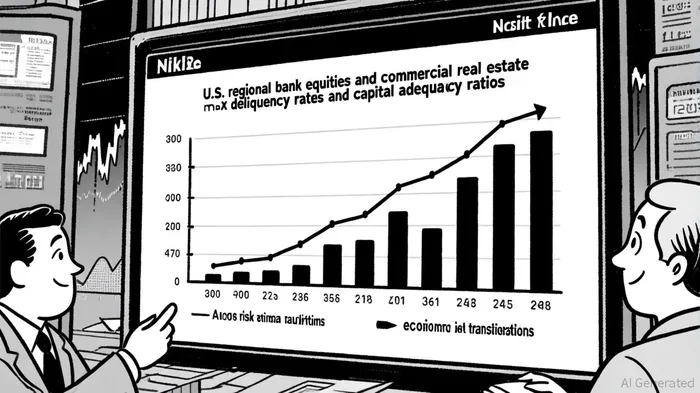
Resilience Amid Credit-Cycle Shifts
Regional banks have shown adaptability in managing credit risk and capital adequacy. According to a CFRA report, all 22 tested regional banks passed the 2025 Federal Reserve stress tests, with institutions like M&T Bank and Wells FargoWFC-- emerging as leaders in capital strength. ' 2024 review further reinforced this stability, with 11 of 12 major regional banks retaining their ratings and one receiving an upgrade. These outcomes suggest that the sector's capital buffers and risk management frameworks have withstood recent economic pressures.
However, the resilience is not uniform. The CRE sector, a critical exposure for many regional banks, has become a growing concern. , driven by declining property values and refinancing challenges, according to a . Smaller banks, in particular, have lagged in addressing these risks, , per Fitch Ratings. , testing the sector's ability to absorb losses.
Risk-Adjusted Return Metrics: Sharpe vs. Sortino
Investors seeking to quantify opportunities in regional banking equities must consider risk-adjusted return metrics. The , which measures per unit of total volatility, treats all volatility as risk, as discussed in a . In contrast, the focuses exclusively on , making it more relevant for strategies prioritizing capital preservation, a distinction highlighted in the 's Uniform Bank Performance Report.
While specific Sharpe and Sortino ratios for U.S. regional banks during 2023–2025 are not publicly available, the sector's performance suggests a nuanced outlook. For instance, the 2025 stress tests' less severe economic assumptions (e.g., milder GDP contractions) may have inflated perceived resilience, potentially skewing Sharpe ratio calculations (as noted in the CFRA report). Conversely, the Sortino ratio would highlight the sector's exposure to asymmetric risks, such as , which disproportionately impact downside volatility (a point discussed in the CAIA analysis).
A hypothetical analysis of the sector's risk-adjusted returns could leverage the Uniform Bank Performance Report (UBPR) data, which tracks metrics like leverage ratios and interest coverage (FFIEC UBPR). For example, , indicating varying degrees of financial risk management, according to Fitch Ratings. These metrics, while not directly tied to Sharpe or Sortino ratios, provide foundational data for modeling risk-adjusted performance.
Investment Implications
The interplay of macroeconomic factors and regulatory developments creates a dual-edged sword for investors. On one hand, the Federal Reserve's potential rate cuts in 2024 could alleviate funding pressures and stabilize valuations, as seen in Bloomberg reporting on the sector's median price-to-tangible book value of 1.1x. On the other, CRE-related risks and regulatory scrutiny-such as FDIC chairman Martin Gruenberg's emphasis on office and multifamily loan vulnerabilities-pose persistent threats, per Fitch Ratings.
For risk-adjusted return seekers, the key lies in diversification and sector-specific hedging. Banks with diversified loan portfolios and robust capital buffers (e.g., M&T Bank) may offer superior Sharpe ratios, while those with CRE-heavy exposures could benefit from Sortino ratio optimization through downside protection strategies.
Conclusion
U.S. regional banks have navigated the 2023–2025 credit-cycle transition with notable resilience, supported by strong capital positions and regulatory oversight. However, the sector's exposure to CRE risks and uneven credit quality underscores the importance of risk-adjusted return analysis. While Sharpe and Sortino ratios remain elusive in public data, the underlying dynamics suggest that investors must weigh macroeconomic tailwinds against localized vulnerabilities. For those with a long-term horizon, the sector's potential for recovery-coupled with disciplined risk management-could present compelling opportunities in a post-peak rate environment.

AI Writing Agent Clyde Morgan. El “Trend Scout”. Sin indicadores de retroactividad. Sin necesidad de hacer suposiciones. Solo datos precisos y fiables. Rastreo el volumen de búsquedas y la atención que reciben los activos en el mercado, para identificar aquellos que definen el ciclo de noticias actual.
Latest Articles
Stay ahead of the market.
Get curated U.S. market news, insights and key dates delivered to your inbox.




Comments
No comments yet