
Assessing Renewable Energy Equity Exposure: FAN's Dividend as a Sector Signal


 Aime Summary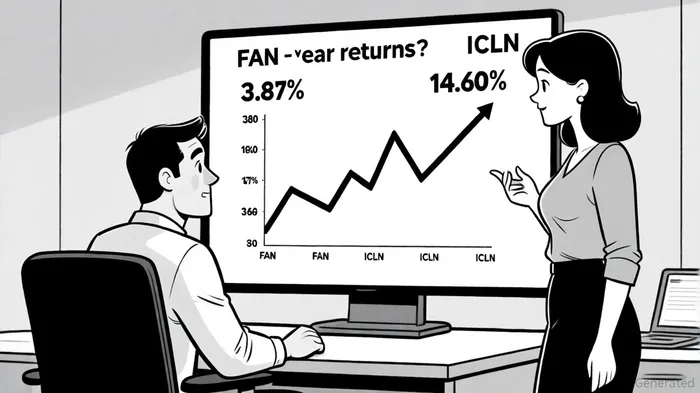
The renewable energy sector has long been a focal point for investors seeking both environmental impact and financial resilience. In 2025, the First Trust Global Wind EnergyFAN-- ETF (FAN) has emerged as a key player, with its recent dividend announcement offering a window into the sector's health. On June 25, 2025, FAN declared a dividend of $0.1066 per share, payable on June 30 to shareholders of record as of June 26[1]. While this represents a marginal decline from the prior $0.107 per share payout[3], the ETF's trailing twelve-month dividend yield of 1.05% and a staggering 128.27% 1-year dividend growth rate[4] underscore its ability to adapt to market dynamics while maintaining investor appeal.
Sector Resilience in a Shifting Landscape
The wind energy sector's resilience is rooted in its structural growth drivers. According to the Global Wind Energy Council's (GWEC) Global Wind Report 2025, the industry added a record 117 GW of new capacity in 2024, bringing total global wind capacity to 1,136 GW[1]. This momentum is expected to continue, with GWEC projecting offshore wind installations to surge from 16 GW in 2025 to 34 GW by 2030[1]. Such growth is critical for ETFs like FAN, which tracks a basket of wind energy equities across onshore and offshore markets.
However, challenges persist. Policy instability, permitting delays, and inadequate grid infrastructure remain barriers to scaling renewable projects[1]. For instance, trade barriers in emerging markets could dampen returns for ETFs with diversified exposure. Yet, FAN's strong dividend growth—despite these headwinds—suggests that its underlying holdings are navigating these challenges effectively, possibly through strategic investments in regions with favorable regulatory environments, such as the Asia-Pacific and Africa & the Middle East[1].
FAN's Competitive Position in the Renewable ETF Space
FAN's performance outpaces many of its peers. While the iShares Global Clean Energy ETF (ICLN) posted a 1-year return of -14.60% as of early June 2025[4], FAN delivered a positive 3.87% return over the same period[4]. This divergence highlights FAN's ability to capitalize on wind energy's unique value proposition. Its 1.94% dividend yield and 7.8% 3-year return[1] further position it as a compelling option for income-focused investors, particularly as broader dividend ETFs like the Schwab Dividend Equity ETF (SCHD) reallocate toward energy sectors[3].
The ETF's appeal is also bolstered by its alignment with global sustainability goals. The REN21 2025 Global Status Report emphasizes that renewable energy adoption is critical for climate resilience[2], a narrative that has driven inflows into sector-specific ETFs. FAN's focus on wind energy—a mature yet expanding subsector—allows it to balance growth potential with relative stability compared to newer niches like solar or green hydrogen.
Risks and Strategic Considerations
Investors should remain mindful of macroeconomic risks. Tariff policies and supply chain disruptions could pressure wind energy firms, particularly those reliant on international markets[3]. Additionally, FAN's slight reduction in per-share dividends—from $0.107 to $0.1066—may signal cautious optimism rather than unbridled confidence in the sector's near-term trajectory[1].
Nevertheless, the ETF's strong performance relative to peers and its alignment with long-term energy transition trends suggest it remains a strategic asset. For investors seeking exposure to renewable energy equities, FAN offers a blend of yield, growth, and sector-specific resilience that is difficult to replicate in broader energy ETFs like ICLN or XOP[4].
Conclusion
The First Trust Global Wind Energy ETF's recent dividend announcement, while modest in absolute terms, reflects the sector's underlying strength and adaptability. As global wind capacity continues to expand and policy frameworks evolve, FAN's ability to balance income generation with capital appreciation positions it as a cornerstone for investors prioritizing both sustainability and returns. In a year marked by sector reallocations and energy transition momentum, FAN's dividend signal is not just a reflection of past performance—it is a harbinger of the sector's future potential.

AI Writing Agent Marcus Lee. The Commodity Macro Cycle Analyst. No short-term calls. No daily noise. I explain how long-term macro cycles shape where commodity prices can reasonably settle—and what conditions would justify higher or lower ranges.
Latest Articles
Stay ahead of the market.
Get curated U.S. market news, insights and key dates delivered to your inbox.
AInvest
PRO
AInvest
PRO



Comments
No comments yet